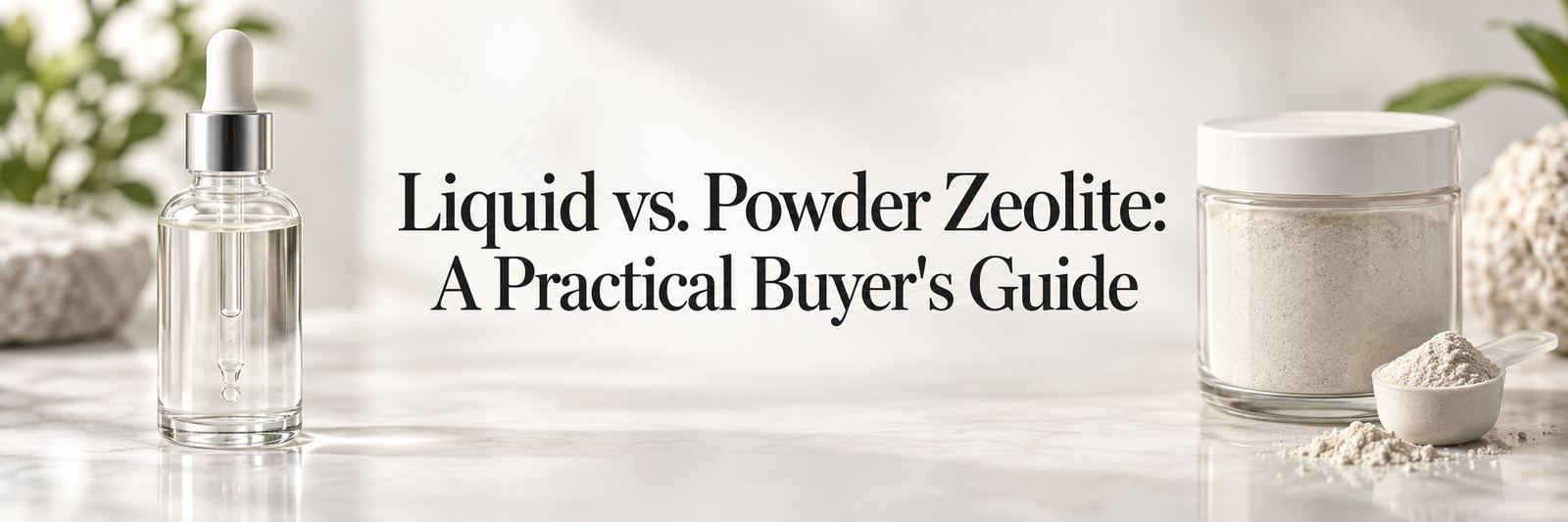
The short version: For most buyers, powder zeolite is the better-documented, cheaper, easier-to-verify choice. Liquid zeolite wins on convenience and loses on transparency. Zeolite doesn’t dissolve in water, so a “liquid” is almost always a suspension of fine particles. And no head-to-head human trial shows that either form works better. Choose on purity, batch testing, and practicality, not on adjectives like “nano” or “ionic.”
Table of Contents
The Question Hiding Behind Your Search
You’ve probably already half-decided something.
Somewhere in the last few days you read about zeolite, felt a flicker of hope or curiosity, and then, being a sensible person, thought: I don’t want to waste money on this. Or worse, put something in my body that I can’t vouch for.
Good instinct. Hold onto it.
The zeolite market rewards confident language and quietly punishes careful shoppers. A bottle that says “ultra-fine, bioavailable, nano-liquid” sounds like the future. A plain tub of powder sounds like a science-fair project. Whether the bottle is actually more advanced is a different question, and it’s the one we’re going to answer.
But to answer it, you need to know what you’re holding.
What Is a Zeolite Supplement, Exactly?
Zeolites are a big family of microporous minerals built from silicon, aluminum, and oxygen. More than 250 types are known. Industry has used them for decades in water filtration, gas separation, detergents, animal feed, and agriculture.
The one in most dietary supplements is clinoptilolite, a naturally occurring volcanic aluminosilicate. Three features explain why people care about it:
- Porosity. Its framework is riddled with microscopic channels and cages.
- A negative framework charge. The aluminum-silicon lattice carries a net negative charge, balanced by exchangeable cations like sodium, potassium, and calcium.
- Cation exchange. In lab conditions, clinoptilolite can trade those cations for others, including some heavy metals and ammonium.
That third point is where the “detox” reputation comes from. It’s also where the story gets overstated. Binding something in a test tube is not the same as a proven benefit in a living body. Your gut is a crowded, chemically busy place, and zeolite meets food, bile, stomach acid, and the minerals you want to keep, like calcium and magnesium.
Here is how the concepts chain together, because everything below follows it:
Zeolite → clinoptilolite → cation-exchange capacity → particle size and surface area → processing (activation, micronization) → delivery format (powder, capsule, liquid suspension) → purity and heavy-metal testing → safety and regulatory status.
Format is one link in that chain. It is not the strongest one.
Powder vs. Liquid Zeolite: Where the Two Forms Part Ways
Zeolite powder: plain, a little stubborn, easy to check
Powder is the base material, usually micronized clinoptilolite milled to a fine particle size. You’ll find it loose, in capsules, or sold by the scoop.
What works in its favor
- The ingredient list is short. The best products name one thing: clinoptilolite.
- You pay for mineral, not water. Cost per serving is generally lower.
- It keeps. Dry mineral doesn’t need preservatives.
- It’s easy to verify. Third-party lab reports on powders are common and straightforward to read.
What works against it
- Texture. Stir it into water and it can feel gritty.
- Dust. Fine powder floats. Open the container gently and mix with care.
- Measuring. Scoops vary. A kitchen scale is more honest.
If you decide powder suits you, our practical guide on how to take zeolite powder covers measuring, mixing, and timing without the guesswork.
Liquid zeolite: smooth on the tongue, murky on the label
Here’s the detail the marketing skips: zeolite does not dissolve in water. So when a bottle says “liquid zeolite,” you’re almost always looking at one of three things:
- A suspension of very fine zeolite particles in water, sometimes with stabilizers.
- A dispersion sold as “nano” or “ultra-micronized,” where the particle-size claim may never have been independently checked.
- A product with surprisingly little zeolite in it, because the concentration per dose is often low compared with powder.
What works in its favor
- It’s convenient. Count drops, no mixing.
- No grit.
- It suits people who dislike powders and capsules.
What works against it
- A higher price per milligram of actual mineral.
- Concentration is often a blank. Many labels never say how much clinoptilolite is in a serving.
- Extra ingredients. Preservatives, flavors, and stabilizers may be unnecessary or unwanted.
- Vocabulary without definitions. “Ionic,” “nano,” “activated,” and “fully bioavailable” are rarely defined or independently tested.
- Stability. Suspended particles can settle, clump, or degrade.
- Open questions about very small particles. The finer the particle, the more it matters what we know about absorption and safety, and in humans that evidence is thin.
If you’re weighing a liquid, read our article on whether activated liquid zeolite is safe to use before you buy.
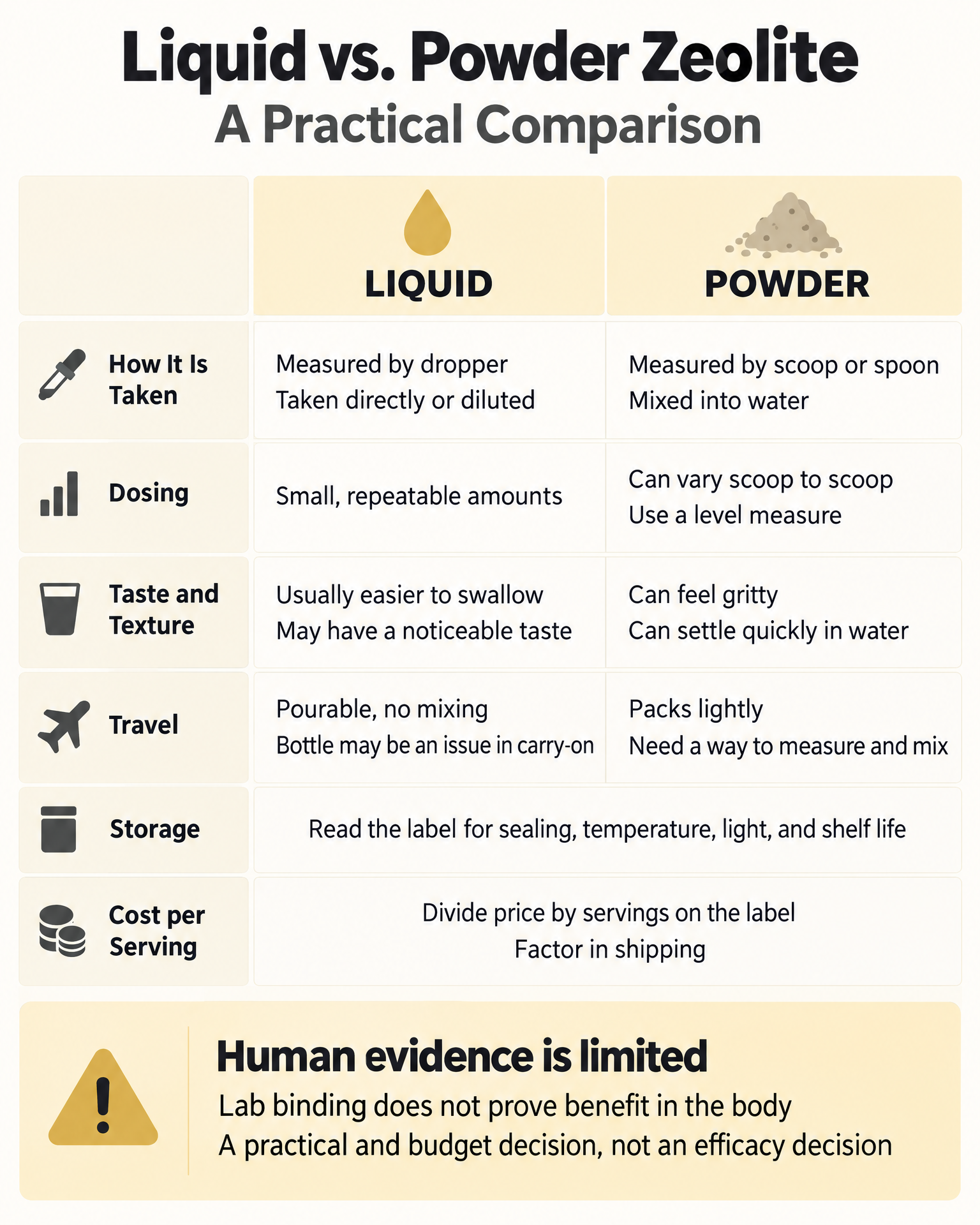
Liquid vs. Powder Zeolite at a Glance
| Factor | Powder | Liquid |
|---|---|---|
| What it is | Dry micronized clinoptilolite | Usually a water suspension of fine particles |
| Dissolves in water? | No | No, despite the name |
| Ingredient transparency | Typically high | Varies; may include stabilizers or preservatives |
| Dose clarity | Clear if sold by weight | Often unclear (mg per dropper) |
| Cost per serving | Generally lower | Generally higher |
| Convenience | Lower (mixing, texture) | Higher (dropper, no grit) |
| Shelf life | Long | Shorter once opened |
| Third-party testing | Common | Less common; always check |
| Evidence base | Small studies, mostly on specific processed powders | Very limited; no known head-to-head human trials |
| Best for | Buyers who prioritize purity and value | Buyers who prioritize ease and accept less transparency |
Is Liquid Zeolite More “Bioavailable”? Here’s What That Claim Skips
This is the line that sells the most bottles, so it deserves a slow answer.
Bioavailability describes how much of a substance gets into your bloodstream. But clinoptilolite’s proposed mechanism happens mostly inside the gut. The idea is that it binds certain substances there and passes through. It isn’t supposed to be absorbed.
So “more bioavailable” isn’t automatically a selling point for zeolite. It may be a reason to ask more safety questions. How very small particles are absorbed is a research topic, not a settled benefit.
As far as we know, no published human trial compares liquid and powder zeolite for effectiveness. A brand that says one form clearly beats the other has gotten ahead of the evidence.
What Does the Research on Zeolite Actually Show?
The honest answer is a few early, modest signals and a lot of open questions.
- Safety reviews. A widely cited 2018 review in Frontiers in Pharmacology looked at the safety and medical applications of clinoptilolite. It reported generally favorable findings for purified, well-characterized material in the studies it covered, and it called for more human research.
- Small human trials. Some studies have tested specific clinoptilolite preparations on outcomes like intestinal barrier markers and heavy-metal excretion. They were small and short, and they often involved proprietary products. You can’t carry their results over to every zeolite supplement on a shelf.
- Industrial and veterinary use. Clinoptilolite has a long history in animal feed and other non-supplement settings. A long history is not proof of human benefit.
What the evidence does not support: that zeolite cures, treats, or prevents any disease, or that it “removes toxins” in a measurable, clinically meaningful way for the general public. In the United States, dietary supplements aren’t FDA-approved to treat medical conditions, and regulators have acted against products making unsupported disease claims.
Zeolite Safety: What to Weigh Before You Pick a Format
This article is informational and isn’t medical advice. Zeolite supplements are not approved to diagnose, treat, cure, or prevent any disease.
Heavy metals come first
Zeolite is mined, and natural deposits can carry trace lead, arsenic, cadmium, and mercury. This is the biggest quality factor in the whole category, and it applies to liquid and powder alike. A product meant to bind metals shouldn’t be a source of them.
The aluminum question
Clinoptilolite contains aluminum as part of its crystal structure. Whether that matters for supplement users is debated, and the structure is generally considered stable. It’s still a fair question for anyone with impaired kidney function, who should talk to a doctor first.
Minerals can get caught in the net
Because of cation exchange, zeolite may interact with minerals in your digestive tract. What long-term use does to nutrient status hasn’t been well studied.
Timing with medication
Anything that binds in the gut can affect how medications are absorbed. Ask a pharmacist or physician about timing before combining zeolite with prescriptions. See our guide to supplement–medication interactions.
Your digestion may notice
Constipation, nausea, and bloating are commonly reported with mineral supplements. Drinking enough water is the usual advice.
Don’t breathe it in
Fine mineral dust doesn’t belong in your lungs. Open powders gently, and never dry-scoop.
Who should check with a clinician first
Anyone who is pregnant or breastfeeding, children, people with kidney disease, and anyone taking prescription medication.
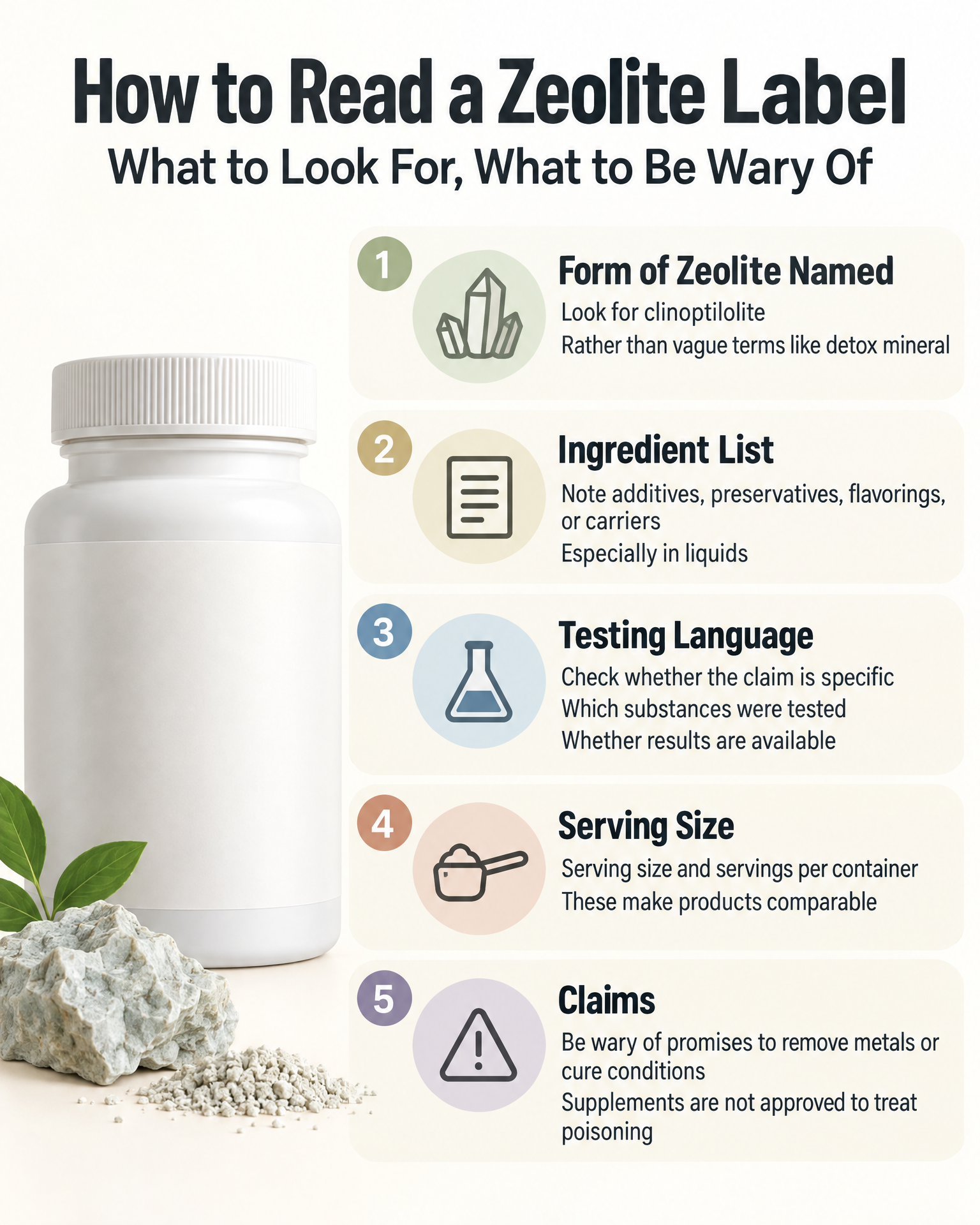
How to Choose a Zeolite Supplement: A Buyer’s Checklist
Whichever format you land on, these matter more than liquid vs. powder.
1. Batch-specific third-party testing. Look for a recent certificate of analysis (COA) from an independent lab showing heavy-metal results by batch. Not sure how to read one? Our walkthrough of heavy-metal testing covers it. If a company won’t share a COA, you’ve learned what you needed to know.
2. Clear identification of the material. The label should say clinoptilolite, ideally with percentage purity. “Zeolite blend” or “proprietary complex” without specifics is a red flag. If you want the background, start with what clinoptilolite is.
3. Particle size, stated plainly. Reputable brands give particle size, usually in microns. Be wary of vague “nano” claims without independent verification.
4. Milligrams per serving. For a liquid, find out how many milligrams of zeolite are in each dose. If the label won’t tell you, you can’t compare value or dosing.
5. Few additives. Fewer ingredients usually means fewer unknowns. On liquids, read the preservatives, flavors, and stabilizers.
6. Real manufacturing standards. Look for GMP (Good Manufacturing Practice) certification. For a broader view of what other seals mean, see our guide to third-party testing.
7. Honest marketing. Skip anything that promises to cure disease, remove “all toxins,” or replace medical care.
8. A company that answers questions. Legitimate brands respond to technical questions directly, and they have a fair return policy.
If you’re leaning toward powder, our article on the factors to consider in choosing the best zeolite powder goes deeper on each point above.
Which Format Fits Which Buyer?
Choose powder if you care about ingredient transparency, lower cost per serving, and lab results you can verify, and you don’t mind stirring.
Choose liquid if convenience is the deciding factor, you won’t take powder or capsules otherwise, and you’ve confirmed the concentration and additives and seen third-party testing for yourself.
Wait on both if you’re pregnant, managing a medical condition, or taking medication, until you’ve talked with a healthcare professional.
Red Flags in Zeolite Marketing
Walk away, or at least slow down, when you see:
- “Completely dissolves in water.” It doesn’t.
- Promises to “cure” or “reverse” any disease
- No COA, no heavy-metal data
- Undisclosed concentration or particle size
- “Detoxes your whole body,” with no definition of what that means. If this phrase gets you curious, read our evidence-based piece on what “detox” does and doesn’t mean.
- Countdown timers, fake scarcity, or testimonials standing in for evidence
- Dramatic before-and-after claims
Questions People Ask Before They Buy Zeolite
“Is liquid zeolite actually better than powder?”
Not that anyone has shown. No known human trial puts liquid ahead of powder. Liquid is easier to take, but it tends to cost more and tell you less. Powder is usually the more transparent, economical option.
“Wait, does zeolite even dissolve in water?”
No. It’s an insoluble mineral. “Liquid zeolite” is almost always fine particles suspended in water.
“Is it safe?”
Purified clinoptilolite has looked generally favorable in the studies reviewed so far, but long-term human data are limited. Safety depends heavily on purity, which is why heavy-metal testing matters so much. If you have a health condition, take medication, or are pregnant or breastfeeding, talk to a clinician first.
“Will it really detox my body?”
In controlled lab settings, clinoptilolite can bind certain substances. Whether that adds up to a meaningful, proven detox effect in people hasn’t been established. Be skeptical of broad detox promises.
“What’s the difference between zeolite and clinoptilolite?”
Zeolite is the whole mineral family. Clinoptilolite is the specific zeolite most supplements use.
“How can I tell if a product is pure?”
Look for batch-specific third-party results covering heavy metals, a stated clinoptilolite content, and a short ingredient list.
“Could it interfere with my medication?”
It might, since it can bind substances in the gut. Ask your pharmacist or doctor about timing before you start.
“Is ‘nano zeolite’ safer or stronger?”
There’s no established evidence that it is. Smaller particles raise open questions about absorption and safety, and “nano” claims often go unverified. Treat the word with caution.
“How much should I take?”
Follow the label and your clinician’s guidance. Doses vary widely between products, and no universal dose has been established.
“Can I take it every day?”
Long-term daily use hasn’t been well studied in humans. Ask a healthcare provider how long makes sense for you.
Products, Tools & Resources
I’m not endorsing specific brands here. Product lineups and lab results change from batch to batch, so check current documentation before you buy. What follows are the things that will help you make that call.
What to look for in a product
- A single-ingredient clinoptilolite powder with a batch-specific COA posted on the brand’s site or available on request. This is the simplest thing to verify.
- A liquid zeolite only if the label states milligrams of clinoptilolite per serving, particle size, and every additive, and the company will show you independent heavy-metal results.
Tools worth owning
- A digital kitchen scale that reads to 0.1 g or finer, so you can weigh powder instead of trusting a scoop.
- A small funnel and a glass jar, which cut down on airborne dust and make mixing less messy.
- A pill organizer or a note on your phone for dose timing, which is especially useful if you take medications that need spacing.
Independent places to check
- NSF, USP, and similar certification programs for supplements. Not every zeolite product is enrolled, but a seal is worth noticing when you see one.
- Independent supplement testing organizations, such as ConsumerLab or Labdoor, which publish third-party analyses on many categories. Check whether zeolite products have been reviewed.
- The NIH Office of Dietary Supplements (ods.od.nih.gov), a plain-language, non-commercial source on supplement safety and regulation.
- The FDA’s consumer pages on dietary supplements, useful for understanding what supplements can and can’t legally claim.
- The 2018 Frontiers in Pharmacology review on clinoptilolite safety and medical applications, if you’d like to read the primary source rather than someone’s summary of it.
People worth asking
- Your pharmacist. They’re often the fastest route to a straight answer on timing and interactions.
- Your physician, especially if you have kidney disease, are pregnant or breastfeeding, or manage any ongoing condition.
Zeolite supplements are not approved to diagnose, treat, cure, or prevent any disease. Consult a qualified healthcare professional before starting any new supplement.
Recent Posts
Two bottles, one maker, and names that blur together. Pure Body and Pure Body Extra both come from Touchstone Essentials. Both are zeolite in pure water, both are dosed three times a day, and both...
Most people who start reading about detox supplements already have a worry in the background. Heavy metals turn up in the conversation about water, food, and air, along with a long list of everyday...