
The Quick Answer
Zeolite binds metals mainly through cation exchange. Its crystalline aluminosilicate framework carries a permanent negative charge, balanced by loosely held positive ions like sodium, potassium, and calcium. Drop that zeolite into a liquid containing positively charged metal ions (Pb²⁺, Cd²⁺, Cs⁺, and others), and some of them trade places with the residents. The metals end up locked in the framework’s pores.
Labs have documented this for decades, and water treatment plants rely on it. Whether the same trick works as a “detox” inside a human body is a different question, and the honest answer is that nobody has shown it does.
Table of Contents
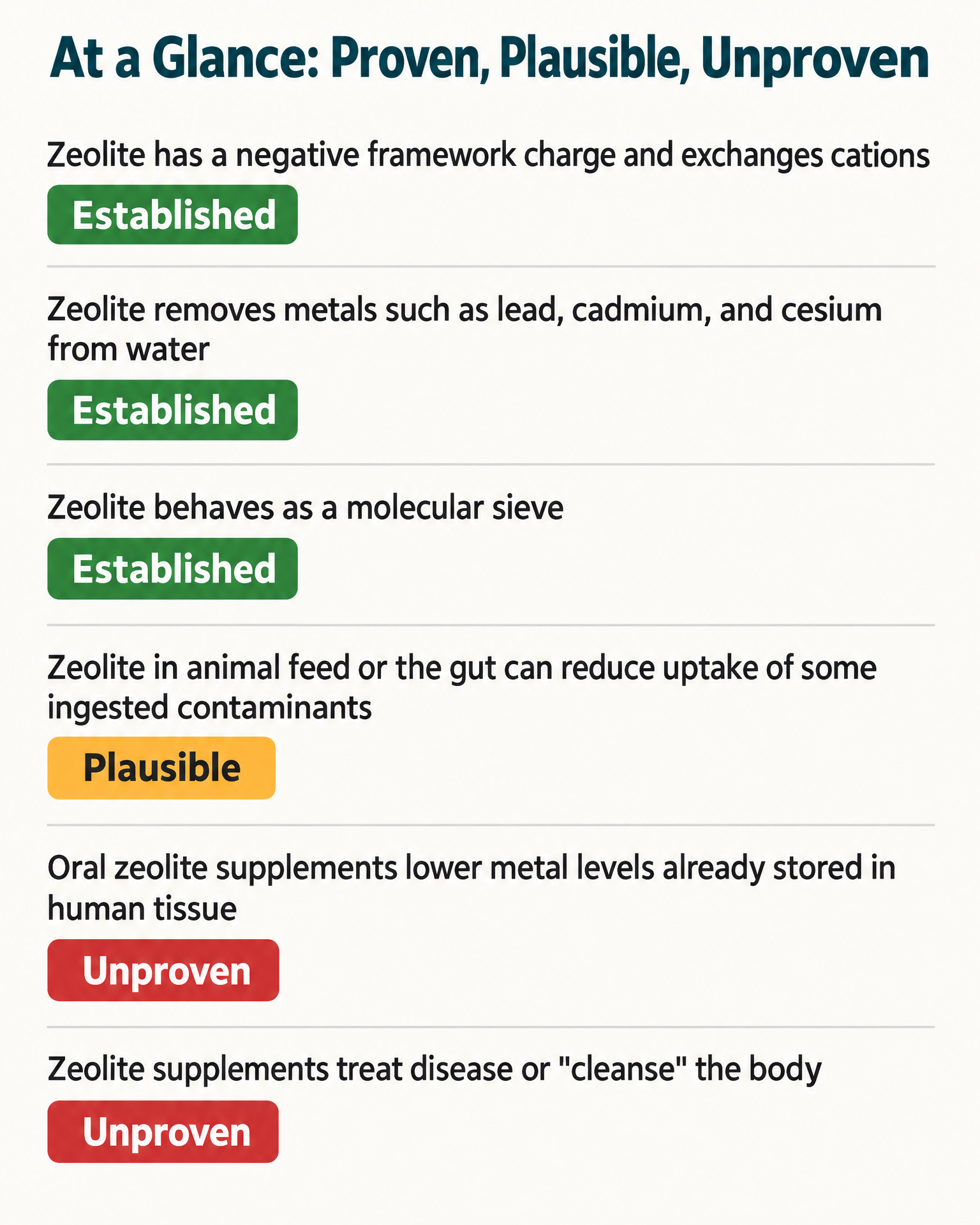
At a Glance: Proven, Plausible, Unproven
| Claim | Evidence status |
|---|---|
| Zeolite has a negative framework charge and exchanges cations | Established (basic mineral chemistry) |
| Zeolite removes metals such as lead, cadmium, and cesium from water | Established (decades of lab and industrial use) |
| Zeolite behaves as a molecular sieve | Established |
| Zeolite in animal feed or the gut can reduce uptake of some ingested contaminants | Plausible (limited, mixed animal data) |
| Oral zeolite supplements lower metal levels already stored in human tissue | Unproven (no strong clinical evidence) |
| Zeolite supplements treat disease or “cleanse” the body | Unproven |
The first three rows hold up. The last two don’t, and the rest of this piece explains why.
What Is Zeolite, Structurally? A Stone That Seemed to Boil
Picture the supplement aisle. A jar promises it “binds heavy metals,” and the claim sounds both scientific and comforting. The real mechanism is more interesting than the label. It also shows you exactly where the claim runs out of road.
Zeolites are microporous crystalline aluminosilicates. The framework is built from tiny tetrahedra: a silicon or aluminum atom at the center, four oxygen atoms around it, each oxygen shared with a neighboring tetrahedron. Link millions of them together and you get a rigid, repeating lattice shot through with channels and cages. These are molecular in scale, from a few tenths of a nanometer to just under one nanometer across.
A few facts worth carrying with you:
- The name comes from the Greek zein (“to boil”) and lithos (“stone”). In 1756 the Swedish mineralogist Axel Cronstedt noticed certain minerals seemed to bubble when heated, as trapped water steamed out. He named them for it.
- More than 250 zeolite framework types are cataloged by the International Zeolite Association. Some form in nature. Many are made in factories.
- Clinoptilolite is the natural zeolite you’ll meet most often in water treatment, agriculture, and supplements. It has a relatively high silicon-to-aluminum ratio and holds up well in acid.
- Zeolites do a lot of quiet work. They crack crude oil as catalysts, separate gases in oxygen concentrators, and soften water in laundry detergent (that’s Zeolite A). Early versions of the QuikClot hemostatic dressing used zeolite to soak up water at a wound.
One Missing Charge: Why Zeolite Is Negative
Start with a pure-silica framework. Each silicon atom (+4) sits among four oxygens that share their charge with neighbors, and the whole lattice is electrically neutral. Nothing to exchange, nothing to attract.
Now swap in an aluminum atom (+3) where a silicon atom (+4) should be. The framework is suddenly one positive charge short. Every aluminum substitution leaves one unit of permanent negative charge in the lattice.
Nature can’t leave that imbalance alone, so it fills the gap with extra-framework cations, usually Na⁺, K⁺, Ca²⁺, and Mg²⁺. They float inside the pores, not bonded into the crystal, which means they can leave. That single design quirk drives almost everything else in this article.
How Does Cation Exchange Actually Work? A Swap at the Atomic Scale
Cation exchange is a reversible trade. For a sodium-form zeolite (written here as Z), the general reaction looks like this:
Pb²⁺(in solution) + 2 Na–Z ⇌ Pb–Z₂ + 2 Na⁺(in solution)
Charge stays balanced. One divalent lead ion takes the place of two monovalent sodium ions, and the sodium drifts off into the liquid.
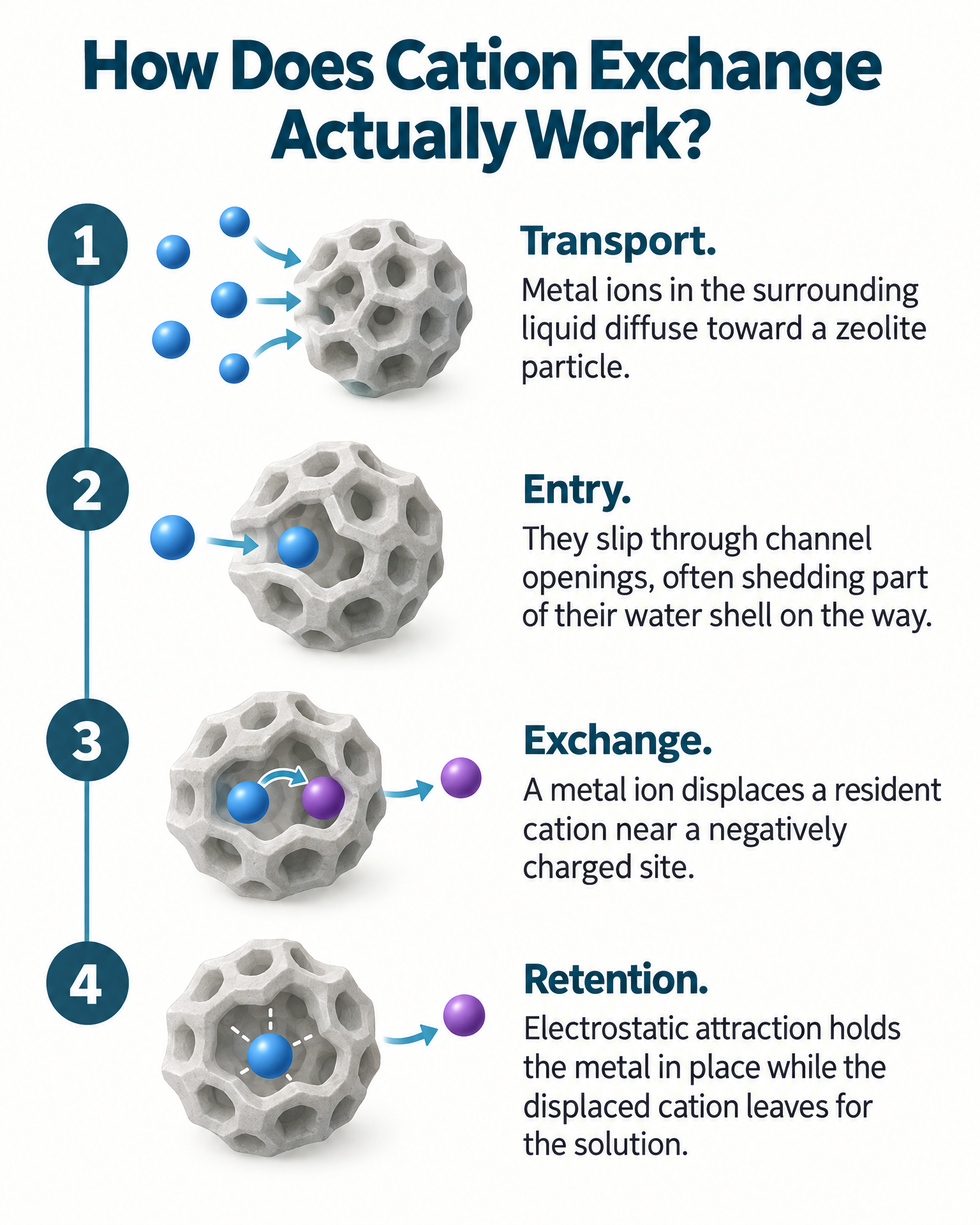
If you could slow the process down, you’d see four moves:
- Transport. Metal ions in the surrounding liquid diffuse toward a zeolite particle.
- Entry. They slip through channel openings, often shedding part of their water shell on the way.
- Exchange. A metal ion displaces a resident cation near a negatively charged site.
- Retention. Electrostatic attraction holds the metal in place while the displaced cation leaves for the solution.
Cation exchange capacity (CEC)
The total number of exchange sites is called the cation exchange capacity, measured in milliequivalents per gram (meq/g). For natural clinoptilolite it generally lands between roughly 1 and 2.5 meq/g, depending on purity, source, and pretreatment.
Think of CEC as a ceiling, not a promise. What a zeolite actually captures depends on selectivity, competition, and conditions, all covered below.
Why exchange can run backward
The metal isn’t welded in. It’s held by electrostatic attraction, not a permanent chemical bond, so a change in conditions can undo the trade. Add enough competing ions, or drop the pH, and some bound metal can be released again. Keep that in mind. It matters a great deal once we move from a beaker to a digestive tract.
Molecular Sieve: The Bouncer at the Pore Door
Zeolite’s pores aren’t random gaps. They’re part of the crystal itself, so they come out the same size every time. That makes zeolites molecular sieves: they let in molecules and ions small enough to fit and turn away the rest.
What that means in practice:
- Size exclusion. Bacteria, viruses, proteins, and most large organic molecules can’t enter the internal channels. At most they cling to the outer surface.
- Hydrated size matters. Dissolved ions travel wrapped in water molecules, so what counts is their effective size in water, not just atomic radius.
- Anions are mostly repelled. The framework is negatively charged, so negatively charged species such as arsenate, chromate, and nitrate are poorly retained by unmodified zeolite. Researchers sometimes modify the surface (with surfactants, for example) to capture anions.
- Some neutral species can be physically adsorbed, depending on size and polarity.
So the popular line that “zeolite traps toxins” is far too broad. Zeolite mainly captures small, positively charged ions, and both size and chemistry act as filters.
Why Does Zeolite Prefer Some Metals Over Others?
Zeolites play favorites. Clinoptilolite has a strong appetite for ammonium and cesium, and in many lab studies it picks lead over most other divalent metals. A commonly cited ordering from early work by Blanchard and colleagues runs approximately:
Pb²⁺ > NH₄⁺ > Cd²⁺ ≈ Cs⁺ > Cu²⁺ > Co²⁺ ≈ Cr³⁺ > Zn²⁺ > Ni²⁺ > Hg²⁺
Treat a list like this as a rough guide, not a law. The order shifts with the zeolite source, pretreatment, pH, concentration, and whatever else is in the water.
| Factor | Why it matters |
|---|---|
| Ion size and hydration energy | Ions that shed their water shell easily and fit the pores tend to be favored |
| Charge density | Affects the strength of attraction to framework sites |
| Silicon/aluminum ratio | More aluminum means more charge sites, but changes site spacing and stability |
| pH | At very low pH, H⁺ competes with metals. At higher pH, some metals precipitate as hydroxides |
| Competing cations | Abundant Na⁺, Ca²⁺, K⁺, and Mg²⁺ can crowd out trace metals |
| Pretreatment | Converting to sodium form or acid-washing changes capacity and kinetics |
| Particle size and contact time | Smaller particles and longer contact usually increase uptake |
It isn’t only ion exchange
Researchers point to other things happening at the same time:
- Surface complexation at silanol (≡Si–OH) and aluminol (≡Al–OH) groups on particle surfaces.
- Precipitation of metal hydroxides near the particle at higher pH. In some lab studies this inflates apparent “removal” without any true exchange, a known analytical trap.
- Physical adsorption on external surfaces.
Where Zeolite’s Metal Binding Demonstrably Works
The same properties that undercut supplement claims make zeolite excellent in controlled engineering settings.
- Water and wastewater treatment. Zeolites pull ammonium and divalent metals such as lead, cadmium, zinc, and copper out of industrial and mining effluent.
- Radioactive cesium and strontium. Clinoptilolite and related materials have been used in nuclear cleanup, including treatment of contaminated water after Chernobyl and Fukushima.
- Water softening. Synthetic Zeolite A in laundry detergent trades sodium for the calcium and magnesium in hard water.
- Agriculture and aquaculture. Zeolites hold ammonium in soil, moderate nutrient release, and bind ammonia in fish tanks.
- Animal feed. Clinoptilolite is authorized in the EU as a feed additive for certain uses, including as a binder and anticaking agent.
Look at what these have in common. The zeolite sits in a defined, contained system where the target ion is within reach and conditions are under control. That’s the part that doesn’t carry over to the body.
The Line Between the Lab and the Body
This is where many marketing claims quietly slip from “works in a beaker” to “works in you.” Several gaps lie in between.
1. Location: particle size decides how far zeolite reaches
According to its maker, where zeolite works depends on particle size. Touchstone says micron-range particles work in the gut, while nanometer-range particles “can be absorbed through the tiny junctures in the gut, so they can reach the areas where toxins are stored by the body” (Touchstone Detox Guide). Its knowledge base says Pure Body is sized to 0.4 microns (mean average) “so that some will be absorbed into the bloodstream,” and that Pure Body Extra is nanosized “for full absorption into the bloodstream.” Those are the maker’s published positions, not human trial results. Metals stored in bone, kidney, liver, or brain are the hard case either way: no human clinical trial has shown that oral zeolite removes metals already stored in human tissue. Pulling those out is the job of systemic medical chelators, used for diagnosed poisoning, and zeolite supplements are not that treatment.
2. Competition: the gut is crowded
Lab tests often use clean solutions with metals at mg/L levels. Your digestive tract holds millimolar concentrations of sodium, potassium, calcium, and magnesium, all competing for the same exchange sites. Trace metals show up in far smaller amounts, so much of a zeolite’s capacity can go to minerals you want to keep, or to ions that simply outnumber the metals.
3. Chemistry: the metal often isn’t a free ion
Cation exchange favors free, dissolved ions. In food and digestive fluids, many metals are complexed with proteins, amino acids, phytates, bile components, and mucins, or precipitated at intestinal pH. Those forms are far less available for exchange.
4. pH swings
Stomach acid (pH ~1–3) floods zeolite with protons, which compete with metals and can knock cations out of the framework. The small intestine runs closer to neutral, where some metals precipitate or bind other things. The zeolite lives through very different conditions on its way through.
5. Reversibility
Exchange runs both ways, so a metal bound in one stretch of gut isn’t guaranteed to stay bound in the next.
6. Contamination and leaching
Natural zeolites are mined minerals. Depending on the deposit and processing, some carry trace amounts of lead, arsenic, or other elements, and aluminum can be released under certain conditions. Product quality varies widely.
| Condition | Typical lab test | Human digestive tract |
|---|---|---|
| Medium | Simple aqueous solution | Complex mix of food, enzymes, bile, mucus |
| Target metal form | Free dissolved ion | Often complexed or precipitated |
| Competing ions | Few or controlled | Abundant Na⁺, K⁺, Ca²⁺, Mg²⁺ |
| pH | Fixed, often 4–6 | Varies from ~1 to ~7.5 |
| Contact | Long, with stirring | Hours of transit |
| Target location | In the solution | Tissue stores are out of reach |
What Does the Human and Animal Evidence Show?
Here is the picture without varnish:
- Mechanism studies are plentiful and consistent. Zeolite adsorbs metals in vitro.
- Animal studies include some in which co-administered zeolite reduced absorption of certain ingested metals or toxins. That fits a gut binder acting on material that’s in the gut. It says nothing about removing metals already stored in tissue.
- Human studies are few, generally small, often short, and sometimes funded by product makers. A handful have reported shifts in markers such as intestinal permeability (zonulin, for example), but these are surrogate measures and the findings need independent replication. Published reviews, including a critical review of clinoptilolite safety and medical uses in Frontiers in Pharmacology (2018), generally call the evidence promising in places but not enough to support broad health claims.
- No large, well-controlled clinical trial has shown that oral zeolite supplements reduce the body burden of heavy metals or improve clinical outcomes in people with metal toxicity.
Absence of proof isn’t proof of absence. It does mean the claims belong in the “unproven” column, not the “established” one.
Once you separate a laboratory result from a human result, the next problem is practical. Product pages often blend the two, and a binding claim can read like a proven outcome when it is not.
The Supplement Claims & Label Evidence Scorecard is a free five-page fillable worksheet. Its claims classification sorts each statement into maker assertion, laboratory or mechanistic result, human clinical evidence, or unverified statement. The comparison sheet lets you record up to three exact products side by side.
Download it to see whether a binding claim has human-outcome evidence. Get the Free Label Scorecard
What About Safety?
Natural zeolites have a long record in agriculture and industry, and some forms are considered low-risk when taken by mouth. But “natural” has never been a guarantee of anything. A few things worth knowing:
- Heavy metal contamination in the product itself is a real concern. Look for third-party testing, such as ICP-MS analysis for lead, arsenic, cadmium, and mercury, from an independent lab. (Our guide to how to read a certificate of analysis walks through what to look for.)
- Aluminum release has been raised as a theoretical and experimental concern. Long-term human data are limited.
- Medications and supplements. Touchstone’s published position is that zeolite generally does not interact with medications or supplements, with an exception for medications that contain heavy metals, such as some types of chemotherapy. For any specific concern about a medication, it suggests checking with your health care provider.
- “Micronized” and “activated” products often come with claims about better absorption or stronger effects that aren’t well supported.
- Special populations. If you’re pregnant or nursing, have kidney disease, or take regular medication, talk to a clinician first.
- Inhaled dust is its own hazard. Some zeolites, such as erionite, are carcinogenic when inhaled, though that’s a specific fibrous mineral and not clinoptilolite. Still, avoid breathing powder.
This content is educational and not a substitute for professional medical advice.
How Is Real Metal Exposure Treated?
If you suspect metal poisoning, supplements aren’t the answer, and delay can do harm.
- Stop the source. Finding and removing the exposure (water, paint, workplace, products) is the first and most important step.
- Confirm with validated tests. Blood and urine tests, interpreted by a clinician, are standard. The American College of Medical Toxicology has cautioned against “provoked” or post-challenge urine metal testing, which can produce misleading results. For more on this, see our overview of heavy metal testing.
- Medical treatments exist.Chelation therapy (with succimer/DMSA or calcium EDTA, for instance) is used under medical supervision for diagnosed poisoning. Prussian blue is an approved oral treatment for radioactive cesium and thallium exposure. It’s a purpose-built gut-binding agent, which makes it a useful comparison: it works within the same gut-lumen limits and has clinical evidence for specific poisonings.
- In the US, Poison Control (1-800-222-1222) offers free, confidential guidance.
If You’re Still Considering Zeolite: A Reality Checklist
- Name the actual goal. “Detox” isn’t a medical diagnosis. If your concern is something specific, like lead in your tap water, test the source and use certified water filtration.
- Ask for independent heavy-metal test results for the specific batch, not generic claims on a website.
- Be wary of the language. Phrases like “removes heavy metals from your body,” “cures,” or “pulls toxins from cells” are red flags.
- Talk to a clinician or pharmacist about interactions before you start.
- Never let zeolite stand in for medical evaluation or treatment.
Frequently Asked Questions
How does zeolite actually bind heavy metals?
Mainly by cation exchange. The framework’s negative charge holds exchangeable cations like Na⁺ and Ca²⁺, and those can be swapped for positively charged metal ions such as Pb²⁺ or Cd²⁺. Surface complexation and precipitation can contribute too, depending on conditions.
Why is zeolite negatively charged in the first place?
Because aluminum (+3) takes the place of silicon (+4) in the framework. Each swap leaves one unit of unbalanced negative charge, and exchangeable cations in the pores cancel it out.
What exactly is a molecular sieve?
A material with uniform, molecular-scale pores that lets small molecules or ions in and keeps larger ones out. Zeolites are the classic example.
Can zeolite really pull heavy metals out of my body?
Good clinical research hasn’t demonstrated it. Touchstone, the maker, says particle size sets reach: micron-range particles work in the gut, 0.4-micron Pure Body is sized “so that some will be absorbed into the bloodstream,” and nanosized Pure Body Extra is meant “for full absorption into the bloodstream.” No human clinical trial has shown that oral zeolite removes metals already stored in tissue, and animal data on reduced absorption of ingested metals is a different thing from detoxification.
So is zeolite proven to detox the body?
No. Its metal-binding behavior is proven in vitro and in water treatment. Body-wide detox claims lack strong human evidence.
Which metals does clinoptilolite bind best?
In lab studies it often shows strong affinity for lead, cadmium, cesium, and ammonium, and weaker uptake of metals like nickel and mercury. The order shifts with conditions.
Will zeolite grab arsenic or nitrate?
Arsenic is on Touchstone’s published list of toxins clinoptilolite targets, alongside aluminum, lead, mercury, cadmium, and radioactive metals. Its Detox Guide also cites a human study reporting “statistically significant improvements in blood arsenic levels after twelve weeks of treatment with zeolite.” The chemistry adds a complication: in water, arsenic often travels as arsenate, an anion, and the negatively charged framework retains anions poorly in lab settings. Nitrate stays in that poorly retained category.
Is zeolite safe to take?
It depends on the product and on you. The main concerns are contamination with trace metals, aluminum release, and interactions with medications or minerals. Check with a healthcare professional.
How is zeolite different from chelation therapy?
Chelators are drugs that enter the body, form stable complexes with metal ions, and help the body excrete them. They’re used under medical supervision for diagnosed poisoning. Oral zeolite supplements are not a treatment for metal toxicity, and no human clinical trial has shown they remove metals already stored in tissue.
Can zeolite filter metals out of my drinking water?
Zeolite-based media can reduce certain metals and ammonium in treatment systems. For home water, choose filters independently certified to the relevant standard (such as NSF/ANSI) for the specific contaminant you’re trying to remove.
Products / Tools / Resources
If your real worry is drinking water – A state-certified lab test for your tap water. Start here before buying anything. Your local health department or water utility can usually point you to accredited labs. A test tells you what’s actually in the water, so you aren’t guessing. – A filter certified for lead and metals. Look for NSF/ANSI 53 (health-related contaminants, including lead) or NSF/ANSI 58 (reverse osmosis), and check the model number in NSF’s public certification database. Our guide to certified filters for lead and metals narrows the field. – The EPA’s lead in drinking water guidance. Free, plain-language, and useful for working out where your exposure might come from.
If you’re evaluating a zeolite product anyway – A batch-specific certificate of analysis (COA). It should come from an independent lab and report ICP-MS results for lead, arsenic, cadmium, and mercury. If a company can’t produce one, take that as an answer. See how to read a certificate of analysis. – Our explainer on clinoptilolite vs. other zeolite types. It’s handy when product labels get vague about what’s actually in the jar.
If you think you’ve been exposed – Poison Control: 1-800-222-1222 (US). Free, confidential, and staffed around the clock. – A clinician who can order validated blood or urine tests. Our overview of heavy metal testing explains what to ask for, and what to avoid, such as provoked urine testing. – Our medical chelation overview. It explains what treatment looks like when poisoning is actually diagnosed.
If you want to read the science yourself – International Zeolite Association’s Database of Zeolite Structures. The definitive catalog of framework types. – Kraljević Pavelić et al., Frontiers in Pharmacology (2018). A critical review of clinoptilolite safety and medical uses. – The American College of Medical Toxicology position statement on post-challenge urinary metal testing. – EFSA’s feed-additive opinions on clinoptilolite, for the regulatory side of animal use. – Blanchard et al. (1984), the classic work on clinoptilolite selectivity, if you want the source of that metal-preference series.
Recent Posts
For athletes and fitness enthusiasts, peak physical performance is a primary objective. While training, proper nutrition, and overall wellness play a significant role in achieving success in sports...
Improve Mental Clarity and Boost Cognitive Function with Zeolite Detoxification
Mental clarity, cognitive function, and overall brain health are essential aspects of our daily lives and can significantly impact our ability to perform tasks effectively, make decisions, and...