
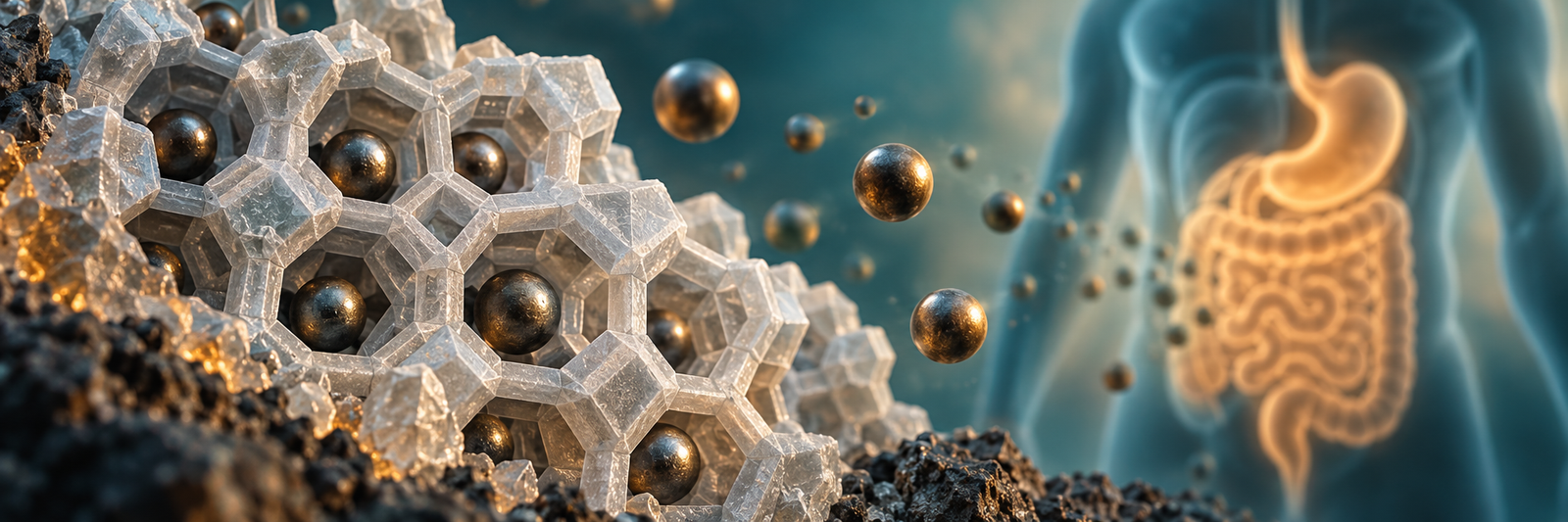
The Short Answer, Before You Spend Another Dollar
No. Not according to the evidence we have today.
Zeolite, usually a mineral called clinoptilolite, does grab certain metals, including lead and cadmium, in laboratory solutions. A handful of animal studies suggest it may reduce how much metal gets absorbed from the gut. But no large, well-controlled human trial has shown that an oral zeolite supplement lowers the total heavy metal burden in your body, or improves outcomes in people with metal toxicity.
If you only have thirty seconds – Test tube: Strong evidence that zeolite binds some metals under controlled conditions. – Animals: Mixed, moderate evidence, mostly about blocking absorption, not removing stored metal. – Humans: Weak, thin, and not enough to support “detox.” – Safety: Purity, particle size, and aluminum exposure are real open questions. – What works: Finding and stopping the exposure, and medically supervised chelation when poisoning is confirmed.
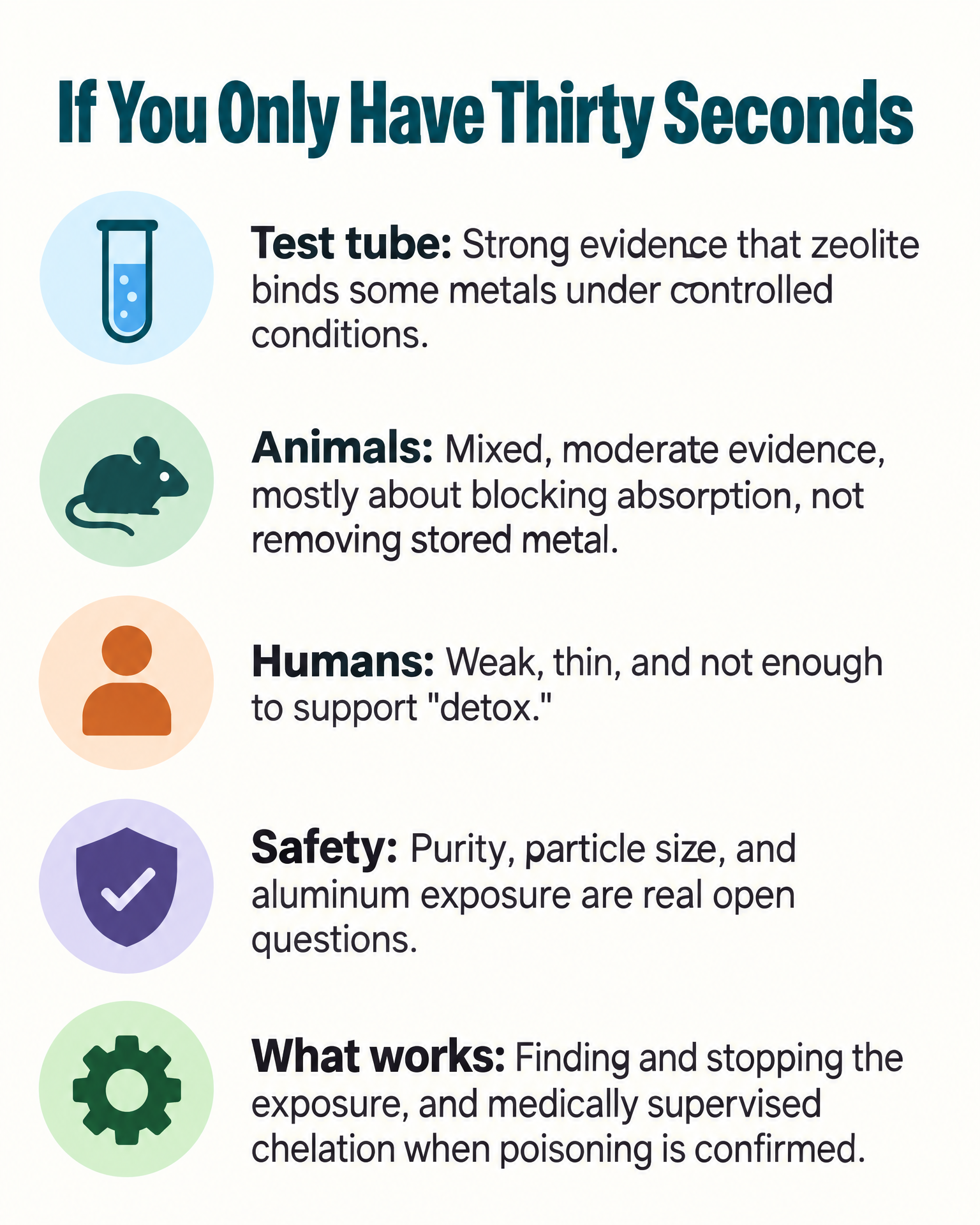
Table of Contents
Why This Claim Gets Under Your Skin
You’ve seen the pitch. A volcanic mineral, built like a honeycomb of microscopic cages, moves through your body like a magnet, collects the toxins you can’t see, and carries them out. It’s tidy and almost beautiful.
It’s also partly true, and that’s what makes it hard to judge. Zeolites do pull metals out of water in treatment plants. Zeolite-based materials have a place in medicine, including hemostatic dressings. The chemistry is real.
The trouble starts at the leap from “binds metals in a beaker” to “pulls lead out of your bones.” That leap is where the science thins, and where the marketing begins.
So we’ll follow the claim through four layers (the lab, animal studies, human trials, and the sales page) and see where it holds and where it gives way.
First, What Are We Even Talking About?
Zeolites are crystalline aluminosilicate minerals with a porous, cage-like framework. Clinoptilolite is the natural zeolite most supplements are built on.
The property behind every metal-binding claim is cation exchange capacity (CEC). Loosely held ions inside the structure, such as sodium, potassium, and calcium, can trade places with other positively charged ions. That’s ion exchange, not magnetism. Outside the supplement aisle, it’s used for water softening, wastewater treatment, radioactive waste cleanup, and animal feed additives.
On the shelf you’ll find raw powders, capsules, “activated” or micronized products, and liquid drops, often labeled “nano.” Around them sits a cluster of related ideas: chelation therapy (DMSA/succimer, EDTA, DMPS), blood lead level, urine metal testing, the gut barrier, and enterohepatic circulation.
Hold onto one fact, because everything else hangs on it: zeolite works where it physically touches something. Where that contact happens is exactly what makers and skeptics describe differently. Makers like Touchstone say properly sized particles, such as the 0.4-micron drops or the nanosized spray, are partly or fully absorbed and work beyond the gut. What’s still open is what human trials have actually shown. That distinction changes how every claim should be read.
One Sentence, Three Different Claims
“Zeolite detoxes heavy metals” sounds like a single idea. It’s actually three, and they don’t carry equal weight.
| Claim | What it really means | How plausible |
|---|---|---|
| A. Gut binding | Zeolite grabs metals in food or gut contents, so less gets absorbed | Plausible, with some animal support |
| B. Interrupting recirculation | Zeolite catches metals released in bile before they’re reabsorbed | Theoretically possible, barely tested in humans |
| C. Body detox | Zeolite pulls stored metal from blood, bone, kidney, or brain | Not supported by solid evidence |
Most marketing quietly implies C. Most of the research, where it exists at all, speaks only to A. Once you learn to see the gap between those two letters, you’ll read every zeolite page differently.
The Evidence Ladder
| Layer | What it shows | Strength for “removes metals from the body” |
|---|---|---|
| In-vitro (lab) | Binds Pb, Cd, and others in solution | High for binding, low for relevance |
| Animal studies | Some reduced absorption or tissue buildup | Moderate, mixed, species-specific |
| Human studies | Few, small, short, often sponsor-linked, mostly surrogate markers | Low |
| Manufacturer claims | Broad, extrapolated from the layers above | Very low as stated |
Each rung gets less certain and more relevant to you. Here’s how each one holds up.
The Beaker Problem: Why the Strongest Data Matters Least
In the lab, clinoptilolite can adsorb and exchange metal ions from a solution, and the results can look impressive. But they swing with conditions:
- Which metal. Clinoptilolite generally favors lead and cadmium and does noticeably worse with mercury, though results vary by sample.
- pH. Binding shifts between acidic and neutral environments.
- Competition. Calcium, magnesium, sodium, and potassium fight for the same sites, and your gut is crowded with them.
- Preparation. Acid-washing, grinding, and “activation” all change performance.
- Time. Digestion is brief and chaotic, nothing like a patient batch test.
A beaker holds one known metal at one known concentration. A digestive tract holds food, bile, mucus, and a crowd of minerals, and the metals already lodged in your tissues aren’t in the gut at all. In-vitro data tells you what zeolite can do under favorable conditions. It can’t tell you what it does inside a person.
Animal Studies: Suggestive, Not Transferable
Researchers have fed clinoptilolite to rodents, poultry, and livestock alongside toxic metal exposure. The pattern is interesting but narrow:
- Some studies report reduced absorption or tissue accumulation when zeolite is given with the contaminated feed or water.
- Results shift with the metal, the dose, the zeolite, and the species.
- The findings tend to describe prevention of uptake (Claim A), not removal of an established burden (Claim C).
- Many animal studies are really about other things, like mycotoxin binding or growth performance.
A broad review of clinoptilolite safety and in-vivo use (Kraljević Pavelić et al., Frontiers in Pharmacology, 2018) pulls much of this together, and it also points out how little human data exists.
Animal doses are often large for body weight. Exposure timing is tightly controlled. Digestion differs from ours. Showing that zeolite fed with lead reduces absorption says nothing about whether a capsule swallowed weeks after exposure will lower the lead already inside you.
The Human Evidence: Where the Story Runs Thin
Here is the honest state of things.
- There is no large randomized controlled trial showing that oral zeolite lowers total-body heavy metal burden or improves clinical outcomes in people with metal toxicity.
- Small pilot studies exist. They’re short, small, sometimes uncontrolled or industry-linked, and they lean on surrogate markers like urine or blood metal levels. Results are mixed.
- Some human trials look at other things entirely. One example is a trial of clinoptilolite and intestinal barrier markers in trained athletes (Lamprecht et al., Journal of the International Society of Sports Nutrition, 2015). It isn’t a heavy metal study, and the markers it used are still debated.
- Aluminum keeps coming up, because zeolites are aluminosilicates. Whether a given supplement meaningfully raises exposure seems to depend on the product, and the data is limited.
“But my urine metals went up”
This is the most persuasive thing anyone says in defense of zeolite, so it deserves a real answer. A rise in urinary metals after starting a detox product feels like proof. It isn’t:
- It may be contamination. Natural minerals can carry trace metals of their own.
- It may be ordinary variation. Seafood, rice, hydration, and the timing of the sample all move urine results.
- Mobilization isn’t removal. Even if metals shifted around, that doesn’t mean your total burden dropped or your health improved.
- Urine is a poor window into body burden for most metals. Blood is the standard for recent lead exposure, and for mercury the right test depends on the form.
Two related practices deserve a warning. Provoked (post-challenge) urine testing, where a chelating drug is given before collection, produces misleading results, and the American College of Medical Toxicology advises against it. Hair mineral analysis is also considered unreliable for diagnosing metal toxicity, partly because hair picks up contamination from the outside.
Reviewing the human evidence leaves a practical problem. Product pages often place laboratory findings next to everyday language, and it is easy to read one as if it were the other.
The Supplement Claims & Label Evidence Scorecard is a free worksheet for keeping them apart. Its claims classification labels each statement as a maker assertion, laboratory or mechanistic result, human clinical evidence, or unverified statement. Its documentation checklist reminds you that a certificate of analysis speaks to identity and purity only, never to human benefit.
Use it to separate human evidence from product positioning. Get the Free Label Scorecard
Reading the Label Like a Skeptic
| What the marketing says | Verdict | Why |
|---|---|---|
| “Traps heavy metals like a magnet” | Oversimplified | Ion exchange is selective and competitive, not magnetic |
| “Removes mercury, lead, arsenic, and cadmium from the body” | Unsupported in humans | Lab binding isn’t body clearance, and selectivity varies by metal |
| “Crosses into your bloodstream to grab toxins” | The maker’s stated mechanism, not a demonstrated human outcome | Touchstone says properly sized particles are absorbed and reach tissues, but no large, well-controlled human trial has shown this lowers body burden or improves outcomes. |
| “Nano or liquid zeolite works better” | Unproven | Smaller particles may change safety and behavior, not just binding |
| “Clinically proven” | Ask what ‘clinically’ means | Often refers to lab, animal, or non-metal outcomes |
| “Natural means safe” | Not a safety argument | Natural minerals can carry contaminants, and some zeolites are hazardous |
| “FDA-approved detox” | False or misleading | No zeolite supplement is FDA-approved to treat heavy metal poisoning |
Metal by Metal: Your Body Already Has a Plan
The biggest thing missing from most zeolite pages is how slowly, or how easily, each metal actually leaves the body.
| Metal | Where it comes from | How the body handles it | Zeolite’s realistic role |
|---|---|---|---|
| Lead | Old paint, dust, water pipes, some imports, ceramics | Blood half-life of about a month; stored in bone for years to decades | May bind lead in the gut; unproven for reducing stored lead |
| Mercury (methylmercury) | Large predatory fish | Absorbed efficiently; half-life of roughly 50 days | Weak binding in lab data; no solid human evidence |
| Cadmium | Smoking, some foods, industrial exposure | Accumulates in the kidney; half-life of decades | May reduce gut absorption in animals; no human clearance data |
| Arsenic | Rice, some well water, certain seafood | Much is excreted within days | Source control matters most |
| Aluminum | Food additives, antacids, cookware, medication | Excreted by healthy kidneys | Zeolites contain aluminum; the effect of supplements is an open question |
Read down that third column. For several of these metals, the body is already clearing them once the exposure stops. For others, the metal sits in bone or kidney tissue that an intestinal binder simply can’t reach. The biology matters more than the capsule.
The Part Most Zeolite Articles Skip: Safety
Purity. Natural zeolite is mined. It can contain trace lead, arsenic, and other elements. Without third-party testing for heavy metals and mineral identity, a “detox” product can become a source of exposure.
Mineral identity. Not all zeolites are alike. Erionite, a fibrous zeolite, is a known carcinogen linked to mesothelioma in parts of Turkey. Clinoptilolite is a different mineral, but this is exactly why identification and testing matter.
Particle size and “nano” claims. Ultrafine particles raise open questions about inhaling powders and about absorption and long-term effects.
Aluminum. Because zeolites are aluminosilicates, aluminum release is a fair question, especially for anyone with impaired kidney function.
Interactions. In theory, an ion exchanger could bind essential minerals like calcium, magnesium, zinc, and iron, or affect how medications are absorbed. That is a theoretical concern, not a demonstrated one. Touchstone’s published position is that, generally speaking, zeolite does not interact with medications or supplements. The exception it names is medications that contain heavy metals, such as some types of chemotherapy. If you take any prescription medication, or have a specific concern, check with a health care provider.
Digestive effects. Constipation and bloating are commonly reported.
Who should be most careful. People who are pregnant or breastfeeding, children, and anyone with kidney disease should avoid unsupervised use.
What Actually Lowers Your Heavy Metal Burden
If you’re worried, the path with real evidence behind it looks very different from “take a binder.”
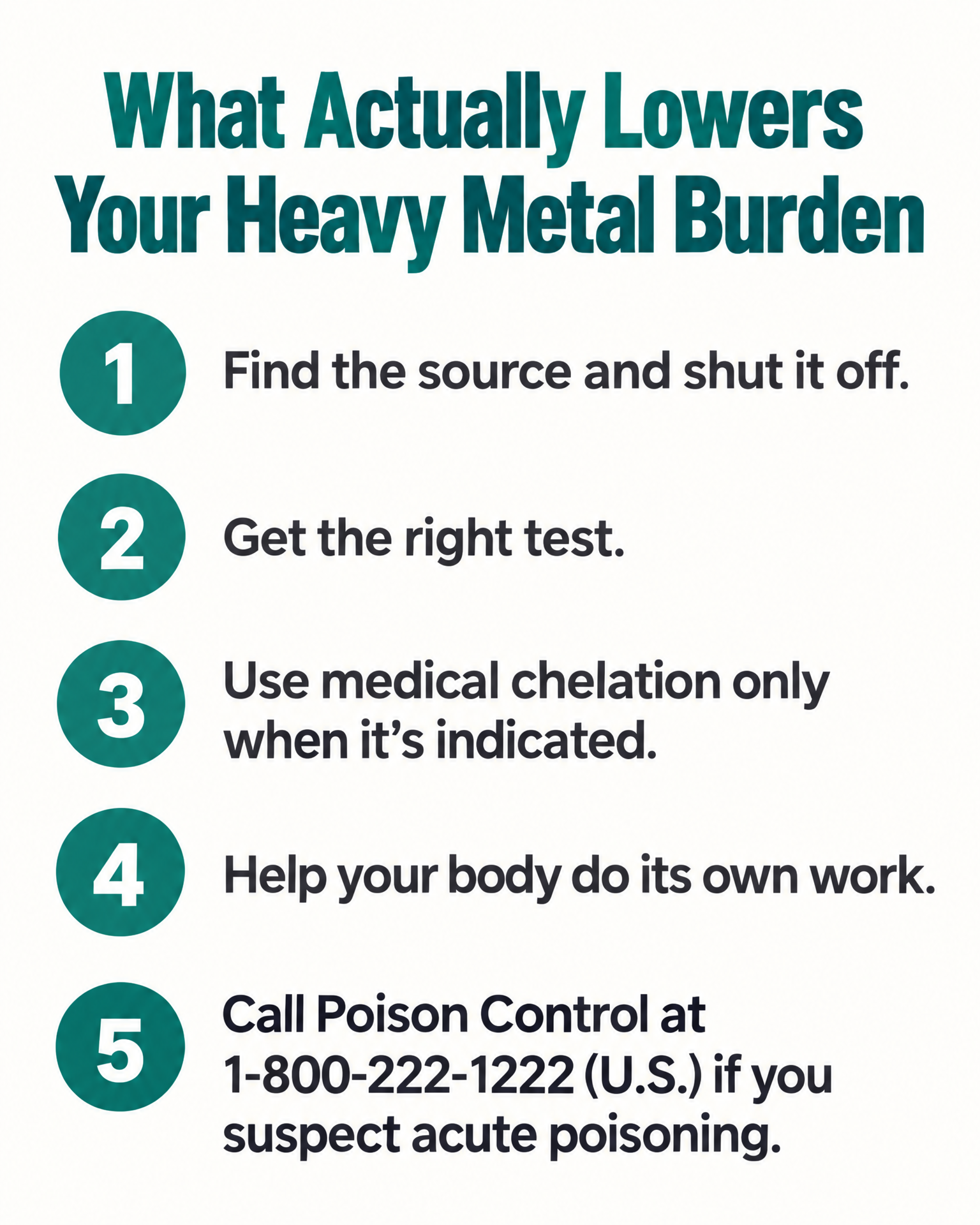
- Find the source and shut it off. For lead, that means testing paint, dust, and water. For mercury, it means looking honestly at how much large fish you eat. For cadmium, it means quitting smoking. Source control is the most effective intervention there is.
- Get the right test. For lead, that’s a blood lead level. The CDC’s reference value for children is 3.5 µg/dL, which signals when to investigate and is not a “safe” threshold. Other metals call for blood, urine, or both, depending on the exposure. A clinician or poison control center can guide you.
- Use medical chelation only when it’s indicated. Prescription chelators such as succimer/DMSA, EDTA, and DMPS are for confirmed poisoning under medical supervision. They carry real risks, including mineral depletion and kidney effects, which is why they aren’t casual wellness tools.
- Help your body do its own work. Enough iron, calcium, and protein reduces lead absorption, and healthy kidneys and liver handle the rest.
- Call Poison Control at 1-800-222-1222 (U.S.) if you suspect acute poisoning. See our emergency resources page.
If You’re Going to Try It Anyway
This isn’t an endorsement, but people make their own choices, and a safer choice beats an uninformed one.
- Talk to a clinician first, especially with kidney disease, pregnancy, or regular medications.
- Choose products with third-party testing for heavy metals and mineral identity.
- Be wary of “nano,” “activated,” or liquid products with big promises and little data.
- Never inhale powders.
- Don’t let it replace testing, source removal, or medical care.
- If new symptoms appear, stop and tell a clinician.
The Questions You’re Actually Asking
Okay, but does zeolite really pull heavy metals out of my body? There’s no solid human evidence that it does. It binds some metals in the lab, and a few animal studies hint at reduced absorption, but removing metals already stored in a human body hasn’t been shown.
What about mercury? That’s the one I’m most worried about. Lab data suggests clinoptilolite binds mercury less well than lead or cadmium, and there’s no human evidence that it lowers mercury burden. If fish is your likely source, start with mercury in fish.
Could it clear lead from my bones? Nothing supports that. Bone lead releases slowly over years, and no study has shown oral zeolite removing lead stored in bone, whether it acts in the gut or, as the maker describes for smaller particles, beyond it.
Is it FDA-approved for detox? No. Zeolite supplements aren’t FDA-approved to treat or prevent heavy metal poisoning.
Is it safe to take? It depends on the product and on you. The concerns are trace-metal contamination, aluminum exposure, mineral and drug interactions, and the unknowns around nano and liquid forms. Ask a clinician first, especially if you have kidney disease, are pregnant, or take medication.
How is this different from chelation therapy? Prescription chelators bind metals in the bloodstream and tissues and are used for diagnosed poisoning under medical care. Touchstone describes its zeolite as working in the gut and, at the sizes it sells, partly beyond it. Either way, zeolite hasn’t been shown to do the chelators’ job, and it is not a treatment for diagnosed poisoning.
Is liquid or nano zeolite stronger? There’s no good evidence it is. Smaller particles raise extra safety questions.
My urine test showed more metals after zeolite. Isn’t that proof? No. Diet, contamination, and normal variation can all explain it, and it doesn’t show your body burden went down.
How would I even know if I have heavy metal toxicity? Symptoms are vague and overlap with many conditions, so testing is the only real answer. Ask a clinician which test fits your suspected exposure, and steer clear of hair analysis and provoked urine tests.
So what lowers my exposure the most? Finding and removing the source, whether that’s lead in the house, mercury-heavy fish, or tobacco smoke, followed by medical evaluation if your levels are elevated.
Products / Tools / Resources
These are things worth having if you’re taking a heavy metal concern seriously. None is a cure. Each helps you find out what’s actually going on.
Testing and measurement – A blood lead test through your clinician or pediatrician. It’s the standard for recent lead exposure and usually inexpensive. For children, ask about it at routine visits. – Your local health department’s lead programs. Many offer low-cost or free paint, dust, and water testing, and some loan out testing equipment. – Accredited lab water testing. If you’re on well water or have older plumbing, a state-certified lab can test for lead, arsenic, and cadmium, and it’s more reliable than a drugstore strip. – EPA-recognized home lead swab kits. They’re a reasonable first screen for paint and surfaces, though a positive result still deserves professional follow-up.
Reducing exposure at home – A water filter certified to NSF/ANSI Standard 53 for lead. Check the certification claim, not just the marketing on the box. – A HEPA vacuum and damp-wiping routine if your home has older paint and dust. – The FDA/EPA fish advice chart, which shows which fish are lowest in mercury, useful if you eat seafood often.
If you’re evaluating any supplement – Third-party seals such as USP or NSF Certified for Sport indicate independent verification of contents and contaminants. Few zeolite products carry them, which is worth knowing. – A certificate of analysis (COA) showing heavy metal testing and mineral identification for the specific batch. If a company can’t provide one, that’s your answer.
Where to read further and who to call – Poison Control: 1-800-222-1222 (U.S.). Free, confidential, and staffed around the clock. – ATSDR toxicological profiles for lead, mercury, cadmium, arsenic, and aluminum, for the detailed science behind each metal. – CDC childhood lead poisoning prevention pages, for current reference values and guidance. – American College of Medical Toxicology (ACMT), for its position on post-challenge urine testing and for finding a medical toxicologist. – PubMed and ClinicalTrials.gov, if you’d like to check for newer clinoptilolite trials yourself. Search “clinoptilolite” with “lead,” “cadmium,” or “mercury,” and filter for human studies.
Recent Posts
Two bottles, one maker, and names that blur together. Pure Body and Pure Body Extra both come from Touchstone Essentials. Both are zeolite in pure water, both are dosed three times a day, and both...
Most people who start reading about detox supplements already have a worry in the background. Heavy metals turn up in the conversation about water, food, and air, along with a long list of everyday...