
You’ve seen the phrase on supplement labels, wellness blogs, and water filter packaging. “Heavy metals” gets tossed around like everyone already knows what it means. Nobody stops to explain it.
So you’re left guessing. Is this a real risk for you, or is it the same fog that gets attached to every detox pitch? One page says your water is loaded with it. Another says it’s nothing to worry about. Neither tells you where exposure actually happens.
That confusion costs you something. You either worry about the wrong things or shrug off the ones that matter. I run ZeoliteForDetox.com, and this is the post I wish I could hand to every new reader first.
Here, I’ll sort real exposure from marketing noise. We’ll go route by route (water, food, air, home) and then look at why small amounts add up and who tends to carry the most. By the end, you’ll know what’s worth your attention.
Table of Contents
What “Heavy Metals” Actually Means
In plain terms, “heavy metals” is a loose label for metallic elements that are relatively dense and can be harmful to living things at certain levels. It’s not a tight scientific category, which is part of why the phrase gets abused so easily.
Some metals are essential. Your body needs small amounts of iron, zinc, and copper to function. The “heavy metals” people worry about are the ones your body has no use for and that cause trouble when they build up.
Four come up again and again in everyday exposure:
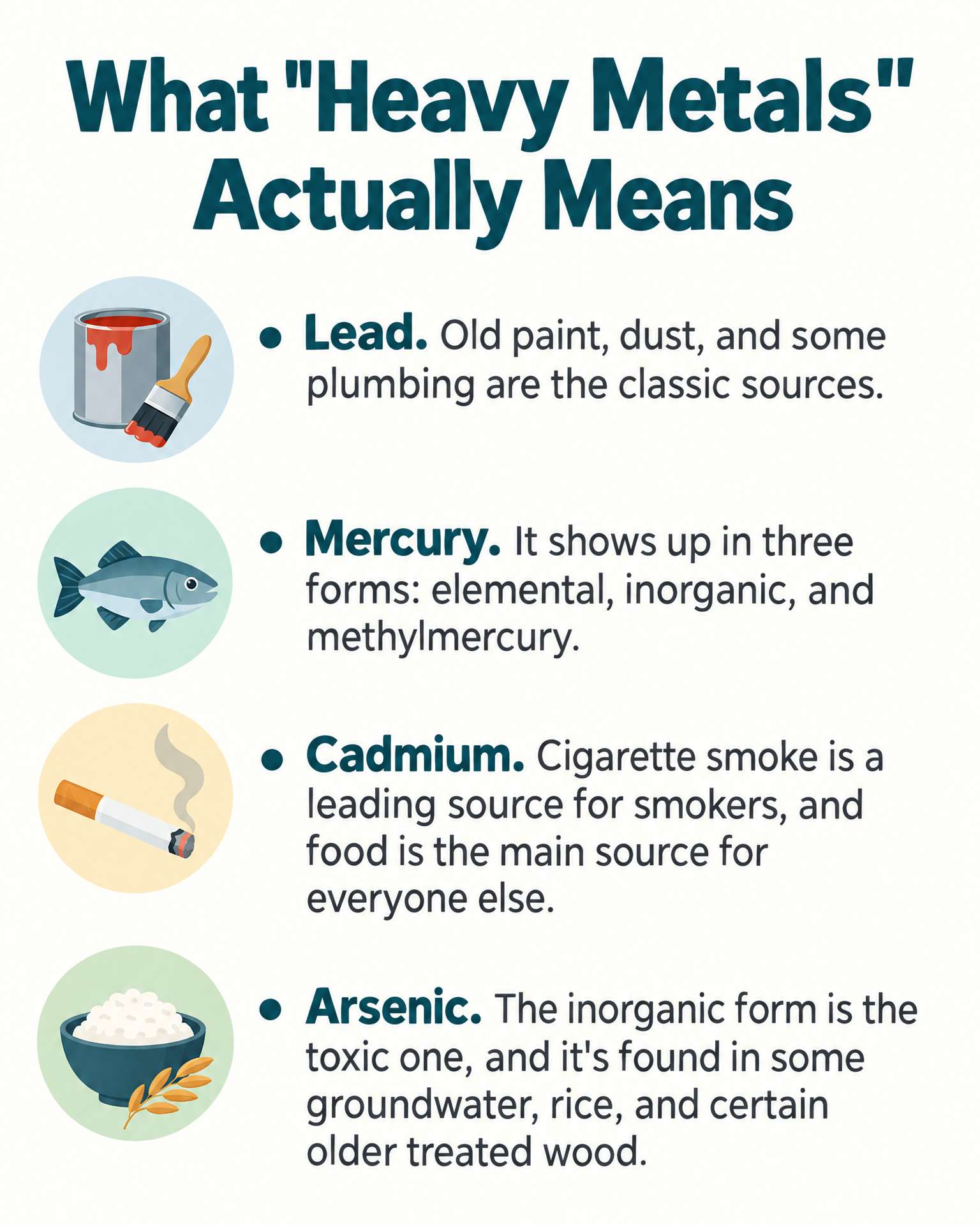
- Lead. Old paint, dust, and some plumbing are the classic sources.
- Mercury. It shows up in three forms: elemental, inorganic, and methylmercury. The last one is the form that builds up in fish.
- Cadmium. Cigarette smoke is a leading source for smokers, and food is the main source for everyone else.
- Arsenic. The inorganic form is the toxic one, and it’s found in some groundwater, rice, and certain older treated wood.
There are others, but these four are the ones that realistically touch ordinary lives. If you understand how people run into these, you understand most of the topic.
What You Drink
Water is the quiet route. You can’t see, taste, or smell most metals in it, which is why it deserves attention.
Metals get into drinking water two main ways. Some come from the ground itself, where naturally occurring minerals seep into groundwater. Others come from the pipes and fixtures that carry water to your tap, where older plumbing can release metals as water sits and moves through.
That’s why arsenic is tied to groundwater and private wells. It’s also why lead is tied to plumbing rather than the water source. Public systems test and treat their water under federal rules. Private wells usually aren’t covered the same way, so the owner is responsible for checking.
The EPA drinking-water standard for arsenic is 10 ppb. For lead, the EPA’s maximum contaminant level goal is zero, with an action level of 15 ppb. That zero matters. It tells you the agency doesn’t treat any amount of lead as a comfortable target. The 15 ppb action level is the point where water systems have to act, not a line below which lead is fine.
I go deeper on this route in the companion piece on heavy metals in drinking water, so I’ll keep this section short. The takeaway: your tap can be a source, and the only way to know is to look.
What You Eat
Food is where most people get their steady, low-level exposure, because we eat every day. Plants pull metals up from soil and water, and animals concentrate them further.
Fish and mercury. Methylmercury builds up in fish, and larger, longer-lived predator fish carry more. That’s why the FDA and EPA advise pregnant women and young children to avoid shark, swordfish, king mackerel, and tilefish. Fish isn’t the enemy here. It’s a matter of choosing species wisely, especially for the people most vulnerable to mercury.
Rice and arsenic. Rice is grown in flooded fields and tends to take up arsenic from the water and soil. Rice and rice-based foods are a recognized dietary source of inorganic arsenic. If rice makes up a big share of what you or your kids eat, it’s worth knowing.
Grains, leafy vegetables, and cadmium. For non-smokers, cadmium comes mainly through food, including grains, leafy vegetables, and shellfish. Plants absorb it from soil, so it’s baked into ordinary staples rather than coming from some exotic source.
None of this means you should fear dinner. It means variety matters. Eating the same one or two foods all the time is how a small amount in each serving turns into a bigger total.
What You Breathe
Air is the route people forget, and it’s a major one in two situations: smoking and certain workplaces.
Cigarette smoke is a leading source of cadmium for smokers. The tobacco plant takes cadmium up from the soil, and smoking delivers it straight to your lungs, where it’s absorbed efficiently. If you smoke, this is likely your biggest cadmium route by a wide margin.
Workplace exposure is the other big one. Jobs that involve welding, smelting, battery work, metal recycling, soldering, or demolition can put metal-laden dust and fumes in the air. In these settings the exposure can be much heavier than anything from food or water, which is why workplaces have protective practices in the first place.
For most people with desk jobs and no tobacco habit, air is a minor route. But if either of those two situations fits you, it moves to the top of the list.
What You Touch and Live Around
Your home can be a source, and the story here is mostly about age.
The federal government banned lead paint in housing in 1978. Homes built before that year may contain lead paint. Intact paint isn’t the main concern. The trouble starts when it chips, peels, or gets disturbed during sanding and renovation, which turns it into dust. That dust settles on floors, windowsills, and hands, and then it ends up in mouths.
Some older pressure-treated wood contains arsenic, which matters for old decks, playsets, and garden beds. Soil near older buildings or busy roads can also carry metals from past paint and other sources.
Then there’s what comes home with you. People who work around metals, batteries, or construction dust can carry residue on clothes, boots, and hair, and expose the rest of the household without meaning to. Changing clothes before you walk into the house is a plain, free habit that makes a difference.
If you’re renovating an older house, treat dust as the thing to manage. That’s where the real risk lives.
Why Small Amounts Add Up
This is the part that makes heavy metals different from most things you worry about. Your body doesn’t clear them the way it clears a cup of coffee.
Some metals get stored. Lead can be stored in bones, where it can stay for a long time and be released back into the body later. Cadmium accumulates in the kidneys over decades, so exposure from your twenties can still be sitting there in your fifties.
That’s why the slow, ordinary routes matter. A little in the water, a little in the rice, a little in the dust adds up when the body keeps some of each round. No single source has to be dramatic. Years of small contributions can create a meaningful load.
It’s also why the long game matters more than any single meal or glass of water. Reducing your regular, repeated exposures does more than obsessing over a one-off.
Who Tends to Carry the Highest Exposure
Not everyone’s situation is equal. A few groups consistently end up with more.
Children. They absorb far more ingested lead than adults do, and hand-to-mouth behavior raises their exposure further. The CDC has not identified any safe blood lead level in children. That’s one of the clearest statements in the whole field, and it’s why kids in older homes get so much attention.
People in certain jobs. Anyone working with batteries, metals, welding, smelting, construction, or demolition faces more contact than the general public.
People in older homes. Pre-1978 housing means a possibility of lead paint, and older plumbing can add to the picture.
Smokers. Because cigarette smoke is a leading cadmium source, smokers typically carry more cadmium than non-smokers.
Private well users. With no public system testing the water, arsenic and other metals can go unnoticed for years.
If you recognize yourself in one of these, that’s useful information, not a reason to panic. It tells you where to focus.
Straight Talk: Exposure Is Not the Same as Poisoning
Here’s the one thing I want you to hold onto. Being exposed to a heavy metal does not mean you’re poisoned. Everyone has some exposure, because these elements are in soil, water, food, and air.
What matters is dose and duration: how much, how often, and for how long. A trace amount from a rice dish isn’t the same as years of breathing welding fumes or drinking from a contaminated well. Exposure is a question about your life. Poisoning is a medical question about your body.
If you have symptoms that worry you, or you live in one of the higher-exposure situations above, talk to your doctor about whether testing makes sense. Guessing from the internet, including from me, isn’t the way to answer that.
Questions People Ask Me
Are heavy metals only a problem in polluted places?
No. These metals occur naturally in soil and rock, and they show up in food and water almost everywhere in small amounts. Pollution, old paint, and industrial activity raise the levels, but ordinary life involves some baseline contact.
Which heavy metal is the most dangerous?
It depends on the form, the dose, and who’s exposed. Lead is a special concern for children because the CDC hasn’t identified a safe blood level for them. Methylmercury matters most for pregnancy and young kids. Inorganic arsenic and cadmium matter over long exposure. There’s no single winner.
Can I avoid heavy metals completely?
Not realistically. They’re part of the environment. The practical goal is to cut the repeated, avoidable routes: know your water, vary your food, manage dust in older homes, and don’t smoke.
How do I know if I’ve been exposed?
You can’t tell by how you feel, since early or low-level exposure often has no obvious signs. Testing is the way to get real information, and a doctor can help you decide which type fits your situation.
Where to Go Next
If this post did its job, you now have a map. The next step is picking the route that matches your life and going deeper.
If you drink well water or live in an older home, start with heavy metals in drinking water. If rice is a staple in your house or you’re on a private well, the piece on arsenic exposure and how to avoid the dangers will tell you what to watch for. Eat a lot of fish, or planning a pregnancy? Read about the health impact of mercury. Smokers and anyone curious about long-term kidney effects should look at the health impacts of cadmium.
And if you’re wondering whether any of this applies to your own body, the heavy metal testing overview explains what testing can and can’t tell you, so you can walk into that conversation with your doctor prepared.
Recent Posts
You're standing in the water aisle, or scrolling a product page, and every box says some version of "reduces lead." The pitcher says it. The faucet attachment says it. The no-name filter at half the...
If you're pregnant, trying, or raising small kids, you've probably run into the headlines. Lead in this, arsenic in that, mercury in something you were told was healthy last year. Each one reads like...