
You fill a glass at the kitchen sink, and for half a second you wonder what’s actually in it. It looks clear. It tastes fine. That tells you very little, because the metals people worry about most don’t change how water looks or tastes.
So you go looking for answers. The city water report is a wall of acronyms, units, and “ND” entries that you’re supposed to just trust. If you’re on a well, there’s no report at all. Nobody is checking, nobody is sending you a summary, and the quiet can feel worse than a bad result.
That leaves most people stuck between two bad options: ignore the question, or spiral into worst-case scenarios. Neither gets you anywhere useful.
This article is the plain-English guide that sits between those two. I’ll walk through how metals end up in drinking water, why lead and arsenic get the most attention, what your water report can and can’t tell you, and what well owners need to know. By the end, the water picture should make sense, and you’ll know what’s worth doing about it.
Table of Contents
How Metals Get Into Drinking Water
Metals reach your glass through three routes: the source water, the treatment process, and the pipes. People usually think only about the first two. The third causes the most trouble.
Source water. Rivers, lakes, and aquifers carry whatever the surrounding land and activity put into them. Some metals are there naturally because water moves through rock and soil and dissolves minerals along the way. Others arrive through human activity: mining, industrial discharge, runoff, and old waste sites. Groundwater is especially tied to local geology, which is why a metal can be a big issue in one region and a non-issue a few counties over.
Treatment gaps. A water treatment plant is built to handle a defined list of contaminants to defined limits. It does that job well in most places. But treatment is a process with real-world variables: aging equipment, changing source conditions, and chemistry adjustments that can have side effects downstream. Treatment also can’t clean up something that gets added after the water leaves the plant. That brings us to the big one.
The pipes between the plant and your tap. Water can leave a treatment facility meeting every standard and still pick up metals on the way to you. The distribution system, the service line that connects the main to your house, and the plumbing inside your walls are all contact surfaces. Metal pipes, solder, and fixtures can release small amounts of metal into the water that sits against them. Water chemistry matters here. Water that’s more corrosive wears on plumbing more than water that’s been balanced to be gentle on it.
This is why “my city’s water is good” and “my tap water is good” are two separate statements. The first describes the plant and the system. The second describes what comes out of your faucet after traveling through every foot of pipe between there and here, including the last stretch that you own.
Lead: The Plumbing Metal
Lead is the textbook case of a metal that gets into water after treatment, not before it.
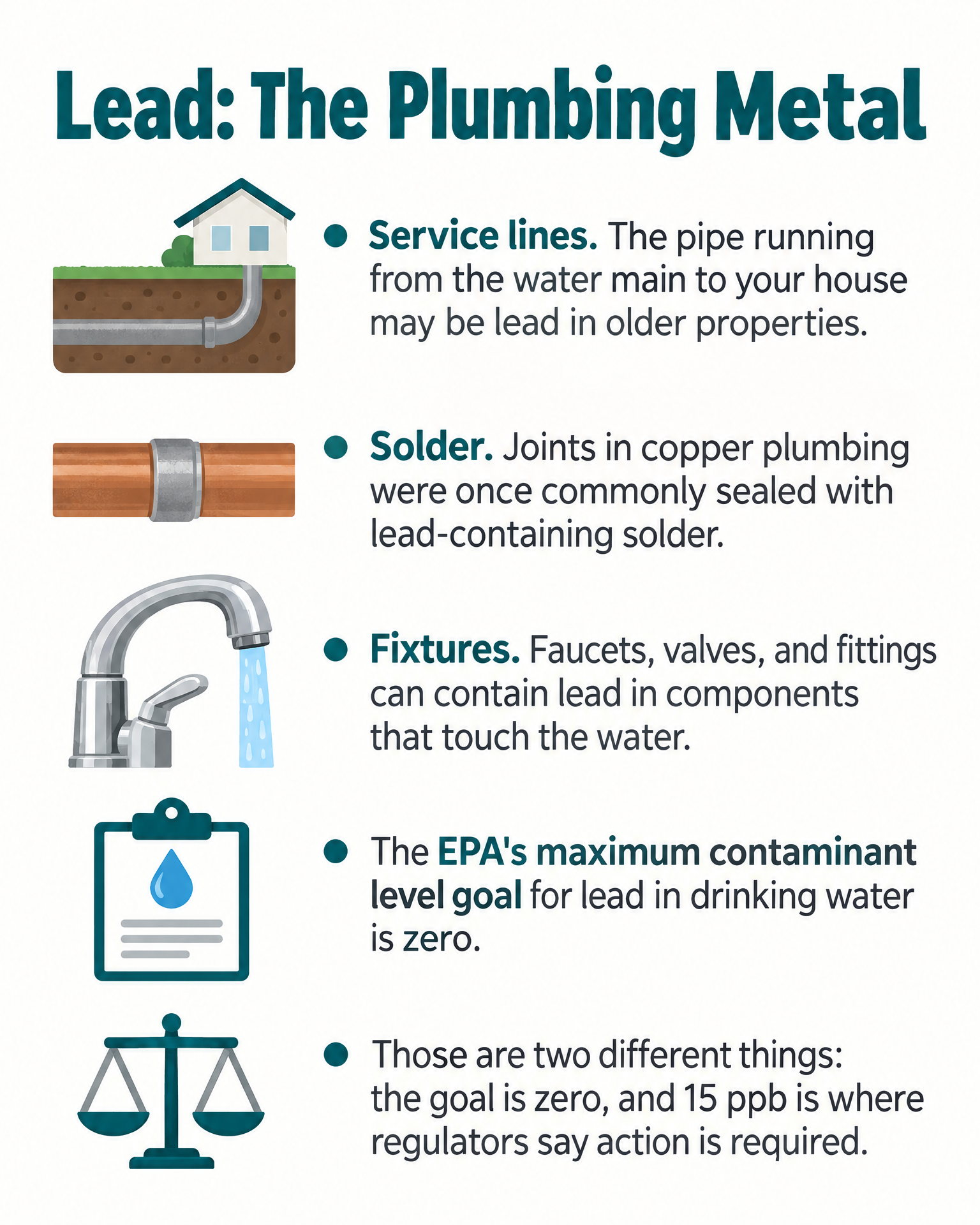
Lead isn’t typically a major feature of source water. It gets in through plumbing. Three places matter most:
- Service lines. The pipe running from the water main to your house may be lead in older properties. This is a single pipe carrying all the water you use.
- Solder. Joints in copper plumbing were once commonly sealed with lead-containing solder. The pipe may be copper, but the connections can tell a different story in older homes.
- Fixtures. Faucets, valves, and fittings can contain lead in components that touch the water.
Age of the home is the quickest rough clue. Older plumbing is more likely to include lead somewhere in the path. But it’s only a clue. Newer homes can have problem fixtures, and some older homes have had their plumbing replaced.
Lead gets the attention it does because of how the EPA frames it. The EPA’s maximum contaminant level goal for lead in drinking water is zero. That’s not a rounding choice. It reflects the position that there’s no level of lead exposure considered safe to aim for. Separately, the Lead and Copper Rule sets an action level of 15 ppb, a trigger point that requires water systems to take steps. Those are two different things: the goal is zero, and 15 ppb is where regulators say action is required.
Why does it matter so much for the body? Lead isn’t something the body simply flushes out and forgets. It can be stored in bones, which means exposure can add up over time and linger well beyond the glass of water that delivered it. And the CDC has not identified a safe blood lead level in children, which is why parents of young kids tend to take this one especially seriously.
Two simple habits help with plumbing-sourced lead, and neither costs anything. If water has been sitting in the pipes for hours, run the tap for 30 seconds to 2 minutes before drinking, to clear the stagnant water. And use cold water for drinking and cooking, since hot water tends to pull more metal from plumbing. For filtration, the certification to look for on lead reduction is NSF/ANSI 53. I get into that properly in a separate guide, so I’ll leave the detail there.
Arsenic: The Groundwater Metal
If lead is the plumbing metal, arsenic is the geology metal. It gets into water mostly by dissolving out of rock and soil, which makes it a groundwater story more than a pipe story.
In some regions, the rock and sediment underground naturally contain arsenic. As groundwater moves through them, it can carry some of that arsenic along. Nobody dumped it there, and nothing about the water looks off. That’s why arsenic shows up in discussions about private wells, where water comes straight from the ground to your house with no treatment plant in between.
The EPA’s drinking-water standard for arsenic, the maximum contaminant level, is 10 ppb. Public water systems are required to meet it. Private wells aren’t covered by that oversight, so a well owner is the only person who can find out where their own water stands.
A couple of useful points about arsenic:
- Inorganic arsenic is the toxic form. When people talk about arsenic as a health concern, that’s the form they mean.
- Water isn’t the only route. Arsenic can also come from rice and rice-based foods, and from some older pressure-treated wood. Water is one piece of a bigger exposure picture, which is worth remembering if you’re trying to understand your total load and not just what’s in the glass.
Because arsenic has no taste, smell, or color to give it away, the only way to know is to test. I cover the source, the risks, and the avoidance side in a dedicated deep dive, linked at the end.
What a Consumer Confidence Report Actually Tells You
If you’re on city water, your utility publishes a Consumer Confidence Report, often called a CCR or water quality report. It’s the document most people mean when they say “the city report.” It’s worth reading, and it’s also worth understanding its limits.
What it tells you. The report summarizes what the utility found when it tested the water it delivers and compares those results with the legal limits. You’ll see the source of your water, the contaminants detected, the levels found, and whether the system stayed within the rules. For lead, you’ll typically see reference to the action level and how the system’s sampling compared. If you want to know whether your utility is meeting its obligations, this is where to look.
What it can’t tell you. It stops at the system. The report describes the water in the utility’s pipes and the results from the homes it sampled. It cannot tell you what’s happening inside your plumbing. It doesn’t know whether your house has a lead service line, whether your fixtures contain lead, or whether your solder is old. Those are the exact factors that decide what ends up in your glass.
A few tips for reading it:
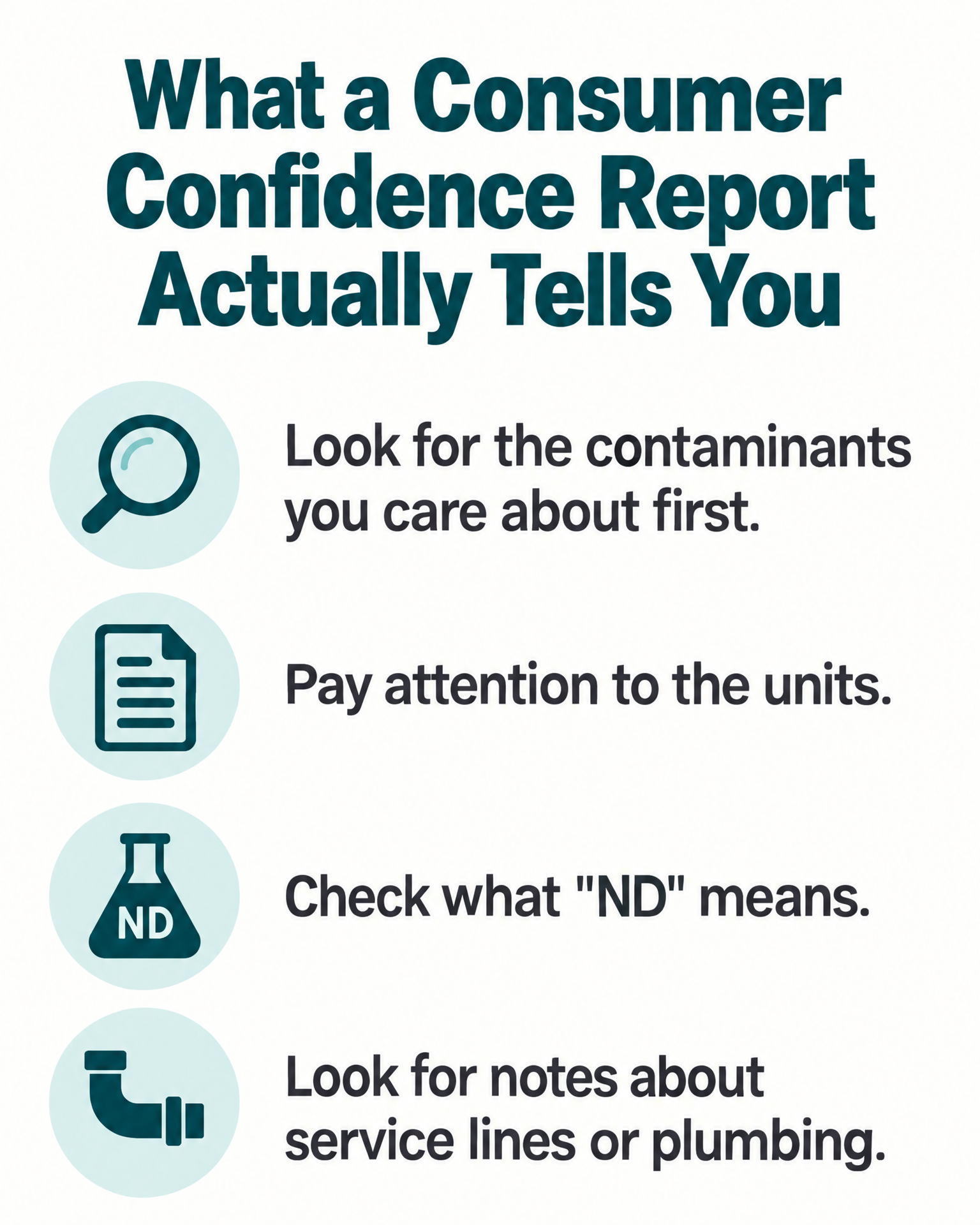
- Look for the contaminants you care about first. Find lead and arsenic and see what’s listed, rather than reading the whole thing top to bottom.
- Pay attention to the units. Levels are shown in parts per billion or parts per million, and mixing them up is the easiest way to misread a result.
- Check what “ND” means. It stands for “not detected,” which is good, but it means below what the test could detect, not necessarily zero.
- Look for notes about service lines or plumbing. Some reports include guidance on lead from household plumbing, which tells you the utility sees it as a live issue in its area.
Think of the CCR as a report card for the system. It’s good information, but it’s not a test of your tap.
Well Water: You’re Your Own Water Department
Private well owners don’t get a report, and nobody is monitoring the water for them. There’s no utility, no required testing on a schedule someone else keeps, and no one who’ll call if something changes. Testing is the well owner’s own job.
That sounds heavy, but it’s manageable once you treat it as routine maintenance, like checking the furnace.
Test regularly. There’s no substitute for a baseline test of your well, followed by periodic retesting. Water quality in a well can shift over time, so a result from years ago tells you little about today.
Test after changes. This is the part people skip. Retest if something changes in or around the well or the household plumbing: new plumbing work, repairs to the well or pump, a change in the water’s taste, color, or smell, nearby construction or land disturbance, or flooding. Also test if someone in the household has symptoms that make you want answers or if you’re bringing a baby into the home.
Test for what’s relevant where you live. Arsenic is a common concern for wells because of natural geology. Local knowledge helps here: your county or state health office and local well-testing resources can tell you what tends to turn up in your area, so you’re not paying to test for things that don’t matter or missing things that do.
Use a proper lab. Look for a certified laboratory and follow its sampling instructions carefully. How you collect the sample can affect the result, especially for metals that come from plumbing.
If a result comes back higher than you’d like, that’s useful information, not a verdict. It tells you what to address, and there are treatment options aimed at specific contaminants. The point of testing is to replace the unknown with something you can act on.
Straight Talk: Clean at the Plant Is Not the Same as Clean at Your Tap
I run ZeoliteForDetox.com, and this is the point I most want people to take with them.
A water system can be fully compliant with every rule and still deliver water to some homes that carries metal from the last stretch of pipe. Compliance describes the system. It doesn’t describe your kitchen sink. If you live in an older home, or you know your plumbing has some age on it, that gap is real.
But the answer to that isn’t panic. Most people don’t need to throw out the plumbing or stop drinking water. What you need is information about your own tap, and you get that by testing, not guessing. A test turns “I wonder what’s in my water” into a number you can read. If the number is fine, you can stop worrying. If it isn’t, you know what to fix, and the fixes (flushing, using cold water, certified filtration, replacing a pipe or fixture) are all practical.
If you’ve got specific health questions, like a young child in an older home or symptoms you’re trying to explain, talking to your doctor about testing is a sensible step alongside the water test.
Questions People Ask Me
Can I tell if my water has heavy metals by looking at it or tasting it?
No. Lead and arsenic don’t reliably change how water looks, smells, or tastes. Clear, good-tasting water can still carry metals. Testing is the only dependable way to know.
If my city meets EPA standards, is my tap water safe from lead?
Not automatically. Meeting standards describes the water system as a whole. Lead usually enters from plumbing near or inside your home, which a system-wide report can’t see. If you have older pipes, solder, or fixtures, a test at your own tap is the way to find out.
How often should I test my well?
Test it regularly, and test again whenever something changes: plumbing work, repairs to the well or pump, a change in the water, nearby disturbance, flooding, or a new baby in the house. Since no one else tests a private well for you, the schedule is yours to keep.
Will running the tap really help with lead?
It helps when water has been sitting in the pipes. Flushing the tap for 30 seconds to 2 minutes after the water’s been stagnant clears out the water that’s had the most contact with the plumbing. Using cold water for drinking and cooking helps too. These habits reduce lead coming from plumbing. They don’t replace testing, and they’re not a fix if there’s a lead source you need to deal with directly.
Where to Go Next
If lead is your main concern, start with the reduce lead in your water playbook, which walks through practical steps from the tap outward. When you’re ready to evaluate filtration, the certified lead-reducing filters guide explains what certification means and what to look for, so you can compare options based on the standard and not the marketing.
If you’re on a well or live somewhere with arsenic-bearing geology, the arsenic deep dive covers sources, risks, and how to cut your exposure from water and food alike.
And if you’re still getting your bearings on the bigger picture of metals and the body, the start-here companion on what heavy metals are lays the groundwork for everything else.
Recent Posts
You're standing in the water aisle, or scrolling a product page, and every box says some version of "reduces lead." The pitcher says it. The faucet attachment says it. The no-name filter at half the...
If you're pregnant, trying, or raising small kids, you've probably run into the headlines. Lead in this, arsenic in that, mercury in something you were told was healthy last year. Each one reads like...