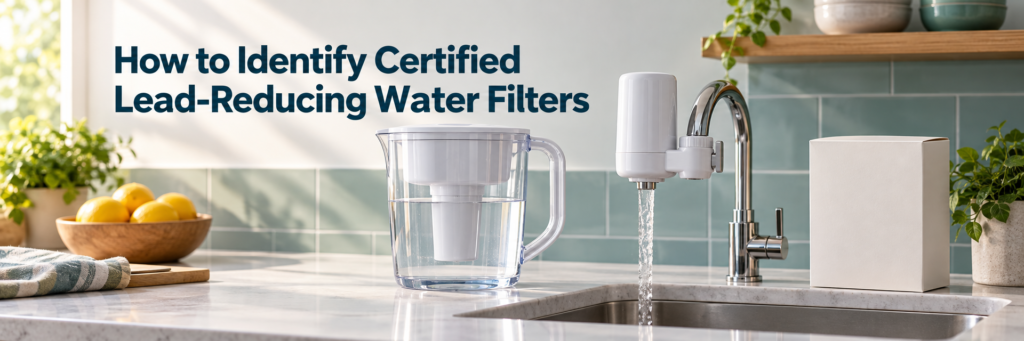
You’re standing in the water aisle, or scrolling a product page, and every box says some version of “reduces lead.” The pitcher says it. The faucet attachment says it. The no-name filter at half the price says it too, with a nice picture of a water droplet.
They can’t all be equal, but nothing on the front of the box tells you which ones are. The words look the same whether the product has been independently tested or the brand just liked the sound of the sentence. Guess wrong and you get a filter that makes your water taste fine while doing little about the thing you bought it for.
I run ZeoliteForDetox.com, and this is the article I’d hand a friend who asked me how to shop for this. It shows you what separates a tested, certified claim from packaging copy, where to check in a couple of minutes, and which warning signs to watch for. By the end, the water aisle should look a lot less like a guessing game.
Table of Contents
“Reduces Lead” Is a Claim. Certification Is a Check.
Any brand can print “reduces lead” on a box. Nothing stops them. It’s a marketing sentence, and it carries exactly as much proof as the company chooses to attach to it, which is often none.
Certification is a different animal. A product is submitted to an independent certifier, tested against a named written standard, and either meets it or doesn’t. It’s pass/fail. If it passes, the model goes on a public list and earns the right to carry the certifier’s mark. The claim now has a standard behind it and a record anyone can look up.
That gap matters because of what lead is. EPA’s maximum contaminant level goal for lead in drinking water is zero. The Lead and Copper Rule action level is 15 ppb, which is the point where utilities have to take action. It’s a regulatory trigger, not a line below which lead stops mattering. When the goal is zero, you want a filter whose lead claim has been checked by someone other than the company selling it.
So the first habit to build is simple. When you see “reduces lead,” read it as the start of a question, not the answer. The question is: certified to what, and where can I confirm it?
The Three Standards That Matter
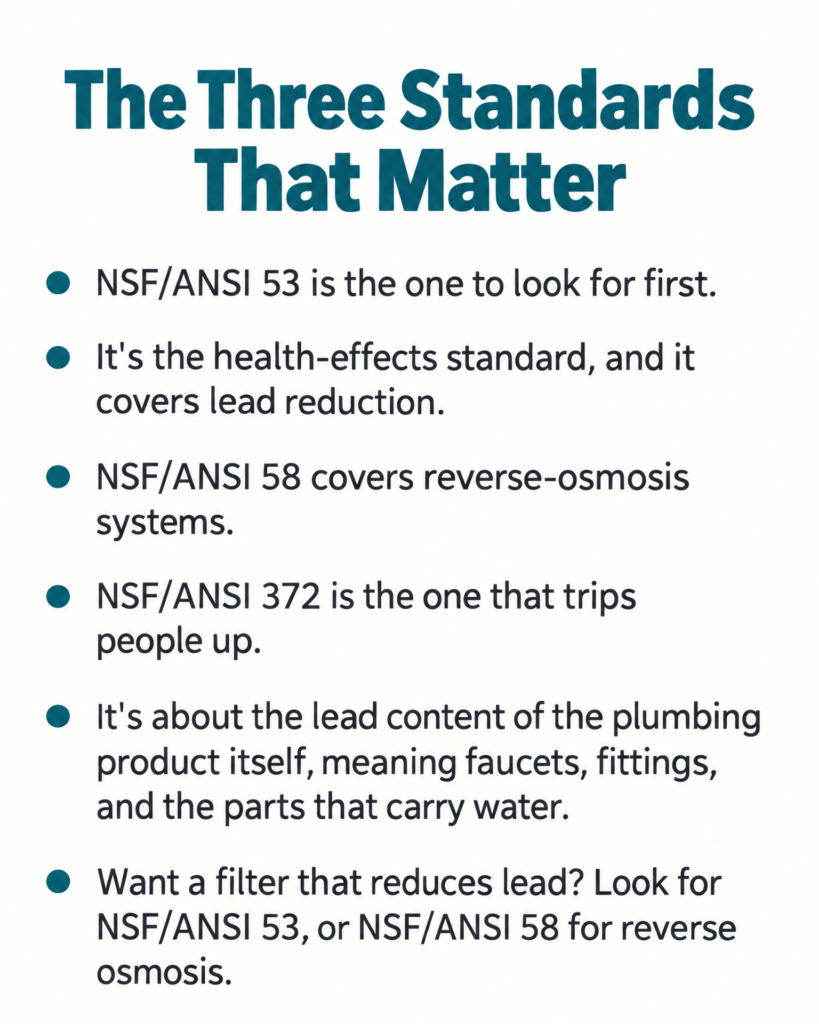
Plenty of acronyms and badges show up on filter packaging. For lead, three standards do the real work, and mixing them up is the most common mistake shoppers make.
NSF/ANSI 53 is the one to look for first. It’s the health-effects standard, and it covers lead reduction. When a pitcher, faucet-mount, or under-sink filter is certified to this standard for lead, it has been tested and has met the requirements for that claim. This is the standard that tells you the filter itself was evaluated for reducing lead in your water.
One detail here is easy to miss. The standard covers a range of health-related contaminants, and a filter is certified only for the ones it was tested and approved for. A filter can be certified under NSF/ANSI 53 and still not carry certification for lead. You want lead specifically named in the certified claims, not just the standard number somewhere on the box.
NSF/ANSI 58 covers reverse-osmosis systems. If you’re looking at an under-sink RO unit, this is the standard that applies to it. Same logic as above: confirm the specific system and the specific claim, in this case lead reduction.
NSF/ANSI 372 is the one that trips people up. It’s about the lead content of the plumbing product itself, meaning faucets, fittings, and the parts that carry water. It is not a filtration performance standard. A product certified to 372 is telling you it doesn’t contribute much lead from its own materials. That’s useful for a faucet. It says nothing about whether a filter can pull lead out of the water passing through it.
Here’s the shorthand:
- Want a filter that reduces lead? Look for NSF/ANSI 53, or NSF/ANSI 58 for reverse osmosis.
- Looking at plumbing parts? NSF/ANSI 372 is about the lead in the product, not what it removes.
Because certification is pass/fail against a standard, you don’t need to compare one product’s “percent removed” to another’s. A certified model met the standard for its claim. Your job is confirming that the certification is real and covers lead.
How to Verify a Filter in Two Minutes
You don’t need to be a water-quality person to do this. You need a model number and a browser.
Step one: find the exact model number. It’s printed on the box, the product page, or the filter housing. For many products there are two numbers to track: the filter unit and the replacement cartridge. Write down both.
Step two: look the model up in NSF’s official listing database. This is the public record. Search the exact model and open its listing. The listing tells you what the product is actually certified for, and which standards. If the model isn’t there, it isn’t certified in that database, no matter what the box says.
Step three: check the claim against the listing. Look for lead reduction among the certified claims under the right standard. Then compare it to the packaging. The mark on the box and the standard named next to it should match what the listing shows.
Step four: confirm the cartridge. In many systems, the replacement cartridge is what carries the certification. Buying the right housing and then a cheaper off-brand cartridge can quietly void the whole point of the exercise. Verify the cartridge model by number too.
The big thing to hold onto is that certification applies to specific models, not a whole brand line. A company can have one certified pitcher and five others that aren’t. A respected brand name on the box doesn’t carry over. The model number is the only thing that matters, so check it every time, even for a brand you’ve bought before.
That’s the whole process. It takes a couple of minutes, and it moves you from trusting a sentence to confirming a record.
Picking a Format: Pitchers, Faucet-Mount, Under-Sink, and Reverse Osmosis
Once you know how to confirm certification, the next question is what kind of filter fits your kitchen. Certified options exist in each format, and the right pick comes down to how you live.
Pitchers are the easy entry point. There’s no installation, they’re affordable up front, and you can use one in a rental. The trade-off is capacity. You fill, you wait, you refill, and a busy household can burn through a pitcher fast. They also take fridge space.
Faucet-mount filters attach to the tap and give you filtered water on demand. They’re quick to install and good for people who don’t want to wait on a pitcher. They work best on standard faucets, and many are rated for cold water only, so read the instructions before running anything else through them.
Under-sink filters tuck out of sight and usually deliver filtered water through a dedicated tap or the existing one. They handle more volume and suit households that cook and drink a lot of tap water. Installation takes more effort, and cartridges can cost more.
Reverse-osmosis systems sit at the more involved end. They’re certified under their own standard, NSF/ANSI 58, typically include a storage tank, and come with more parts and more setup. They suit people who want a more comprehensive system and don’t mind the footprint.
Whatever format you choose, think about two practical things before you buy.
Cartridge cost and cadence. The sticker price of the housing is only part of the real cost. Every system has replacement cartridges, and you’ll be buying them for as long as you use it. Before you commit, look at what the cartridge costs, how often it needs swapping, and whether it’s easy to get. A cheap pitcher with expensive, frequent refills can cost more over time than a pricier system with long-lasting cartridges.
Why an expired cartridge quietly stops performing. A cartridge has a limited capacity. Once it’s used up, it stops doing the job it was certified to do, and nothing about the water will tell you. It won’t look different. It often won’t taste different. You’ll just be drinking water you think is filtered. That’s why replacement timing matters more than almost anything else once the filter is on your counter or under your sink. Set a reminder when you install it, and replace on schedule rather than waiting for the water to complain.
A certified filter with a spent cartridge isn’t a certified result anymore. Keep the schedule.
Red Flags on a Product Page
Once you’ve done this a few times, weak listings start to stand out. Here’s what to watch for.
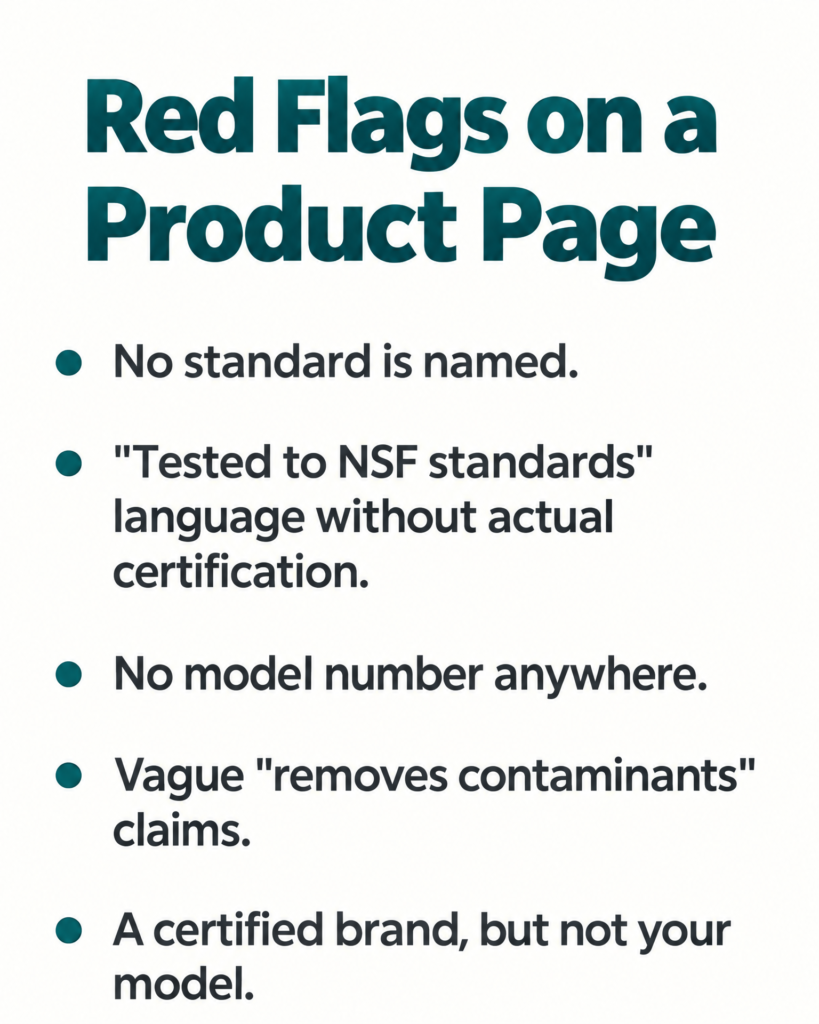
No standard is named. If a page says “reduces lead” and never mentions NSF/ANSI 53, 58, or any standard at all, that’s the biggest flag. A company with a certification wants you to see it. Silence is usually deliberate.
“Tested to NSF standards” language without actual certification. This one is sneaky. Testing a product against a standard’s methods is not the same as having it independently certified and listed. The wording sounds close enough to fool a quick read. If the page says “tested to” or “meets” or “in line with” instead of “certified,” go straight to the database and see whether the model is listed.
No model number anywhere. If you can’t find the exact model on the page, you can’t look it up, and that’s a problem. Legitimate certified products make the model easy to find. If it’s missing from the page and the box, treat that as the answer.
Vague “removes contaminants” claims. Sweeping language about “impurities,” “toxins,” or “contaminants” tells you nothing. Real certification is specific: this contaminant, this standard, this model. Broad, fuzzy promises usually mean there’s nothing specific behind them.
A certified brand, but not your model. A page might show a legitimate-looking mark for the brand’s other product. Always return to the model number you’re buying.
Any one of these is a reason to slow down and check. Two or more, and you can move on to the next option.
Straight Talk: The Same Mindset Applies to Any Health Product
Here’s the part I’d say to a friend over coffee. A certified filter tells you the product was tested to a standard. It doesn’t tell you what’s in your water. If you’re worried about lead at home, the water itself is the thing to find out about, and if you’re worried about your own exposure, that’s a conversation for your doctor.
The bigger takeaway is the habit. Everything in this article, from separating a claim from a check to finding the named standard to looking up the exact model to distrusting vague language, works on far more than filters. It works on any health product that makes a promise. Ask what the claim rests on, who checked it, and whether you can look it up yourself. I apply the same evaluation mindset to supplements, and that’s why I built the zeolite supplement buying checklist.
Filters are a good place to practice, because the answers are public and quick to find.
Questions People Ask Me
Is “NSF-tested” the same as “NSF-certified”?
No. “Tested” can describe almost anything, including a company’s own testing. “Certified” means an independent body evaluated the product against a standard and listed the model. Look the model number up in NSF’s listing database, and trust the listing over the wording on the box.
If a filter is certified under NSF/ANSI 53, does that automatically mean it reduces lead?
Not automatically. The standard covers multiple health-related contaminants, and each product is certified only for the specific claims it passed. Open the listing for your exact model and confirm that lead reduction is among them.
What’s the difference between NSF/ANSI 53 and NSF/ANSI 372?
NSF/ANSI 53 is about filters reducing contaminants, lead included. NSF/ANSI 372 is about the lead content of plumbing products themselves, like faucets and fittings. One is about what a filter removes. The other is about how much lead a product’s own materials contribute. Shoppers mix them up all the time.
Does certification cover the whole brand or just one product?
Just the specific models listed. A brand can have a certified pitcher and an uncertified faucet-mount. Always check the exact model number, and check the replacement cartridge number too.
How do I know when to replace the cartridge?
Follow the manufacturer’s schedule for that cartridge, and set a reminder the day you install it. A spent cartridge stops doing what it was certified to do without any change you can see or taste, so waiting for a sign usually means waiting too long.
Where to Go Next
Now that you can tell a certified claim from a printed one, the next step is putting it to work at home. The practical lead-in-water playbook walks through what to do with your own tap water, from checking your situation to choosing and using a filter well. If you want to understand why lead and other metals show up in water in the first place, where metals in drinking water come from covers the sources, from the source water to the pipes in your home.
Recent Posts
If you're pregnant, trying, or raising small kids, you've probably run into the headlines. Lead in this, arsenic in that, mercury in something you were told was healthy last year. Each one reads like...
Another recall notice lands in your inbox or your feed. Lead in a toy. Lead in kids' jewelry. A brand name you may or may not recognize, a photo of a product that looks a lot like something in your...