
You’ve heard the word “lead” next to “tap water,” and now you can’t stop thinking about it. Maybe a news story about your city set it off. Maybe your house is old, or a neighbor got a test result back. Either way, you’ve already read enough scary headlines. What you want is a plan.
Most articles on this topic stop at the alarm. They tell you lead is dangerous, tell you to “contact a professional,” and leave you with the same worry you started with. That’s frustrating, because lead in household water is one of the more fixable problems in your home.
I run ZeoliteForDetox.com, and this article is the playbook I wish more people had: what to find out first, what you can do today for free, what to look for in a filter, what to skip, and what’s realistic whether you rent or own. Work through it in order and you’ll know where you stand and what to do about it.
Table of Contents
First, Find Out What You’re Dealing With
Start here, because everything else depends on it. Lead usually gets into drinking water from plumbing, not from the source water. Service lines, solder, and fixtures are the usual culprits. Water can leave the treatment plant clean and pick up lead on the way to your glass. That’s why the house next door can test differently from yours.
So you need three pieces of information.
Test the tap. This is the only way to know what’s coming out of your faucet. Use a state-certified lab, or ask your water utility whether it offers testing. Some do. Follow the lab’s instructions on how and when to collect the sample, because the method matters. A kitchen tap that sat overnight can tell you something different from one that has been running.
Find out whether your home has a lead service line. The service line is the pipe that runs from the main under the street into your house. If yours is lead, that’s the most important thing to know. Your utility is the best place to start. Many keep records of what’s under the street and up to your property. A plumber can also identify the material when they look at where the line enters your home.
Ask the utility directly. Call or check the website. Ask whether they have lead service line records for your address, whether they’ve tested water in your area, and whether they offer free or low-cost testing. Also ask for their latest water quality report. It won’t tell you what’s in your pipes, but it shows how the water leaves their system.
Here’s the benchmark to keep in mind. EPA’s maximum contaminant level goal for lead in drinking water is zero. The Lead and Copper Rule action level is 15 ppb. The goal is zero because there’s no level of lead you’re aiming to hold on to. The action level is the point where utilities have to act. If your result comes back under 15 ppb, that doesn’t mean the job is done. It means you know your number and can decide how far to take the steps below.
If you want the bigger picture of what else can turn up in tap water, I cover it in heavy metals in drinking water.
The Free Moves That Work Today
You don’t have to wait for test results to start. These three habits cost nothing, take seconds, and cut the lead your plumbing adds to your water.
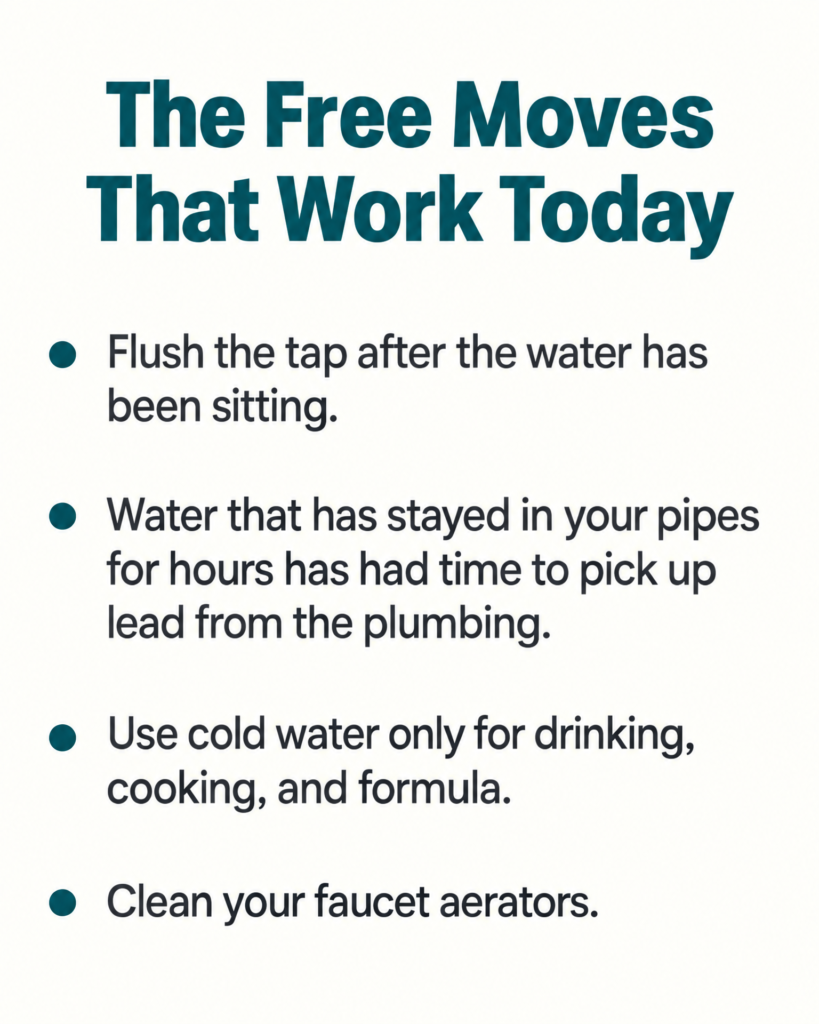
Flush the tap after the water has been sitting. Water that has stayed in your pipes for hours has had time to pick up lead from the plumbing. First thing in the morning, or after you’ve been out all day, run the cold tap for 30 seconds to 2 minutes before you drink or cook with it. You’re pushing the stagnant water out and pulling fresh water through.
A few ways to make this painless:
- Do it while you’re doing something else, like starting the coffee routine, getting dressed, or unloading the dishwasher.
- Catch the flushed water in a bucket or pitcher and use it for plants or cleaning. It’s fine for that.
- Think of it as part of your morning, not a chore.
Use cold water only for drinking, cooking, and formula. Hot water from the tap is the wrong choice for anything you’ll consume. Use cold water, and heat it on the stove or in a kettle if the recipe calls for hot. This applies to baby formula too. Mix it with flushed cold tap water, not water from the hot side.
Clean your faucet aerators. The aerator is the little screen at the tip of your faucet. Over time it catches sediment and debris from your pipes, and that debris can include lead particles. Unscrew it, rinse it out, and put it back. Doing this every so often is a good habit. Clean the kitchen faucet first, since that’s the one you drink from.
Together, these steps lower what’s reaching your glass. They don’t replace testing or a filter, but they’re the right place to start while you gather information.
Filters That Actually Reduce Lead
A good filter is the next layer of protection, especially if you’ve confirmed lead in your water or you can’t yet change your plumbing. The key is that filters aren’t interchangeable. Plenty of them improve taste and do nothing for lead.
Here’s what to look for:
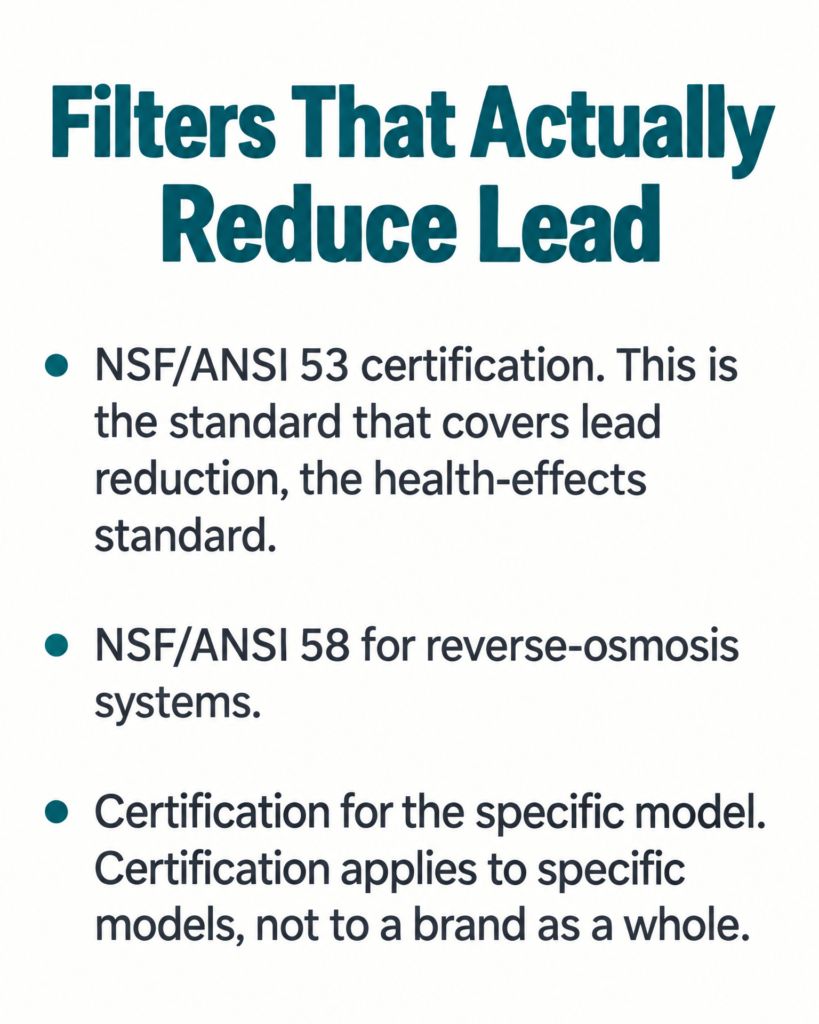
- NSF/ANSI 53 certification. This is the standard that covers lead reduction, the health-effects standard. If a filter claims to reduce lead, it should be certified to NSF/ANSI 53 for that claim.
- NSF/ANSI 58 for reverse-osmosis systems. If you’re looking at an RO system, this is the standard that applies.
- Certification for the specific model. Certification applies to specific models, not to a brand as a whole. A company can make one certified filter and ten that aren’t. Check the exact model number, and confirm the certification lists lead reduction.
Don’t rely on marketing phrases like “removes contaminants” or “advanced filtration.” Look for the certification and the model.
I keep the deep dive on this in one place so this article stays a playbook: my guide to certified lead-reducing water filters walks through how to read certifications, what filter types exist, and how to match one to your kitchen.
What Doesn’t Work
Some of the most common instincts make the problem worse or give you false comfort. Skip these.
Boiling your water. This is the big one, and I’ll say it plainly: boiling does not remove lead. It concentrates it. As water boils off, the lead stays behind in a smaller volume, so the water left in the pot can have a higher concentration than what you started with. Boiling is great for killing germs. It does nothing about lead. If you’ve been boiling water because you worry about lead, switch to the steps in this article.
Basic pitchers without lead certification. The standard countertop pitcher in many kitchens is built for taste and odor, not lead. Unless the specific model is certified to NSF/ANSI 53 for lead reduction, don’t assume it does anything for lead. A filter that makes water taste better can leave you feeling protected without actually being protected.
Assuming clear, good-tasting water is safe. Lead doesn’t change how water looks, tastes, or smells. Don’t use your senses as a test. Use a lab.
Waiting for the problem to resolve itself. Lead from plumbing doesn’t fade on its own. If it’s in your pipes, it stays until the pipes or the fixtures change. Take action now, not later.
Renters vs. Owners
What you can do depends on what you control. Both situations have good options.
If you rent, you can’t swap out pipes, but you have more leverage than you think:
- Do every free move above. They need no one’s permission.
- Test your tap. Many labs will take a sample from any household, and some utilities will help.
- Ask your landlord or property manager whether the building has a lead service line, lead solder, or older fixtures. Put the question in writing so there’s a record.
- Ask the utility what they know about your address.
- Use a certified filter at the tap you drink from. A countertop or faucet-mounted model that’s certified for lead is realistic in a rental, and you can take it with you when you move.
- Share your results with your landlord if the test comes back high. A written lab result is hard to dismiss.
If you own, you have more ways to fix the problem at its source:
- Find out whether your service line is lead, then plan around it. Depending on where you live, responsibility for the line can be split between the utility and the property owner, so ask which part belongs to whom.
- Look into your city’s help. Many cities run lead service line replacement programs, and some offer assistance with the cost. Check with your utility or local government before you pay for anything yourself.
- Replace old fixtures and plumbing components that may contribute lead. A licensed plumber can tell you what’s worth changing in your home.
- Pair permanent fixes with a certified filter while you wait. Replacement projects take time, and a filter covers the gap.
In both cases, the sequence is the same: find out, use the free moves, filter with a certified model, and push for a permanent fix where you have the power to.
Straight Talk: You Can’t Taste It and You Can’t See It
I’ll be direct about the one thing that makes lead in water so frustrating. You can’t taste it, you can’t smell it, and you can’t see it. Clear, cold, great-tasting water can still carry it. That’s why guessing doesn’t work, and why I keep coming back to testing.
Test first, then act. Without a test result, you’re either worrying about something that may not be there or ignoring something that is. With a result, you can decide how far to go. If you’re pregnant, or you have young children in the home and your water tests above the action level, talk to your doctor about what’s appropriate for your family. That’s a conversation worth having with someone who knows your situation.
Don’t let the invisibility of lead push you toward panic or toward shrugging it off. Test, use the free moves today, and add a certified filter. Those steps put you in good shape.
Questions People Ask Me
How often should I flush the tap?
Any time the water has been sitting for a while, like first thing in the morning or when you get home after a long day. Run the cold tap for 30 seconds to 2 minutes before drinking or cooking with it. If you use water throughout the day, the pipes are getting regular turnover and you don’t need to flush every time you fill a glass.
Is it okay to use hot tap water if I’m going to boil it anyway?
No. Start with cold water. Hot tap water from the faucet is not the water to cook or drink from, and boiling doesn’t fix the lead in it. Boiling concentrates lead instead of removing it. Use flushed cold water and heat it yourself.
Does a filter pitcher take care of lead?
Only if that specific model is certified to NSF/ANSI 53 for lead reduction. Many pitchers aren’t, and a pitcher that improves taste isn’t necessarily doing anything about lead. Check the model number and the certification before you rely on it.
Where does lead in my water come from?
Usually from your plumbing, not the source. Service lines, solder, and fixtures are the usual contributors. That’s why two homes on the same street can have different results, and why testing your own tap matters more than reading a citywide report.
If my test comes back low, am I done?
You’re in a better position, but keep the free habits going, especially flushing after the water has been sitting. EPA’s goal for lead in drinking water is zero, and the 15 ppb action level is the point where utilities have to act, not a line below which exposure doesn’t matter. Retest if your plumbing changes or your utility announces work on your street.
Where to Go Next
You now have the sequence: test the tap, learn about your service line, use the free moves, filter with a certified model, and fix the source where you can. When you’re ready to evaluate products, start with the certified lead-reducing water filters guide, which shows you how to read the certifications and match a filter to your setup, so you’re choosing from facts, not packaging.
Water isn’t the only way lead gets into a home. If your house is older, read lead paint and dust in older homes next. And if you want to look at the whole house, the home toxins checklist will help you go room by room and decide what to tackle first. For more on what else can show up in a glass of tap water, see heavy metals in drinking water.
Recent Posts
You're standing in the water aisle, or scrolling a product page, and every box says some version of "reduces lead." The pitcher says it. The faucet attachment says it. The no-name filter at half the...
If you're pregnant, trying, or raising small kids, you've probably run into the headlines. Lead in this, arsenic in that, mercury in something you were told was healthy last year. Each one reads like...