
The short answer: Good evidence for a detox supplement is a randomized, placebo-controlled trial in humans, run on the exact product, published where anyone can check it, and measuring a real health outcome rather than a lab number. Test-tube binding, animal studies, purity reports, and patents all offer useful context. None of them shows a product works inside a human body. For oral zeolite detox products, that top rung of evidence is essentially empty.
Key takeaways
- Evidence comes in tiers. A claim is only as strong as the highest tier that genuinely supports it.
- A certificate of analysis tells you what is and isn’t in the bottle. It says nothing about whether the product works.
- A “clinical trial” citation has to clear five checks before it counts for anything.
- A patent proves someone filed paperwork, not that anyone got results.
- A blood or urine number that moves (a surrogate endpoint) is not the same as better health.
- Supplements are not a treatment for heavy-metal poisoning. Suspected poisoning belongs with a clinician or a poison control center.
Table of Contents
You’re not gullible. The marketing is just good.
Most people searching for a detox supplement aren’t naive. They’re tired, or worried, or quietly curious about whether something they read could be true. Then they land on a page that looks like science: lab-tested. Clinically studied. Patented.
Those words sound like evidence. Most of the time they’re just its packaging.
“Does zeolite detox work?” is a question no sales page can settle. A better one is “what would it take to know?” You can answer that one. Once you can, you can size up any detox product, not just this category.
So this guide is a framework, not a verdict. It won’t declare any product effective or useless. It shows what kind of proof each claim would need, and what to do when that proof is nowhere to be found.
If you’d like the chemistry first, our explainer on what zeolite is and how it works covers how binding happens. This piece asks something different: how far can that chemistry carry a health claim?
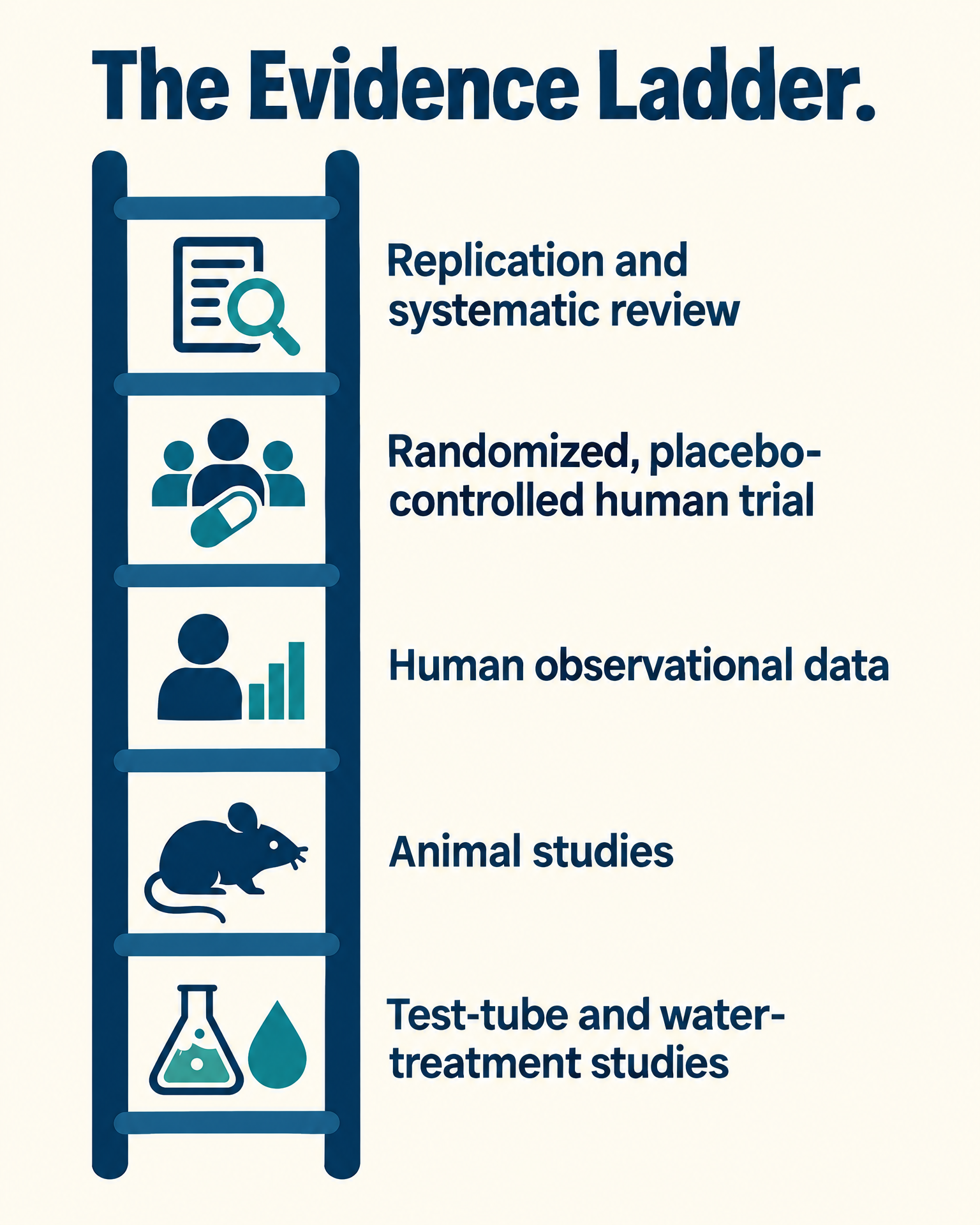
The evidence ladder: five rungs and one very large gap
Picture evidence as a ladder. Each rung answers a different question, and you can’t skip one and still say you’ve reached the top.
| Rung | Type of evidence | What it can show | What it cannot show |
|---|---|---|---|
| 1 | Test-tube / water-treatment studies | What a mineral can bind in a beaker or filter | Anything about a living body |
| 2 | Animal studies | Behavior in a living gut, with dosing and tissue measurements | Whether the result transfers to humans |
| 3 | Human observational data | Associations in real people (surveys, testimonials, before/after reports) | Cause and effect |
| 4 | Randomized, placebo-controlled human trial on the actual product | Whether the product causes an outcome beyond placebo | Anything beyond the limits of its design and endpoint |
| 5 | Replication and systematic review | Whether results hold across studies and teams | Nothing at all if rung 4 is missing |
Rung 1: Everything works in a beaker
This is where zeolite’s reputation begins. Zeolites are porous, charged mineral structures, and under controlled conditions they can pull certain ions, like ammonium and some metals, out of water. That’s real chemistry. It’s also why zeolites show up in filtration systems.
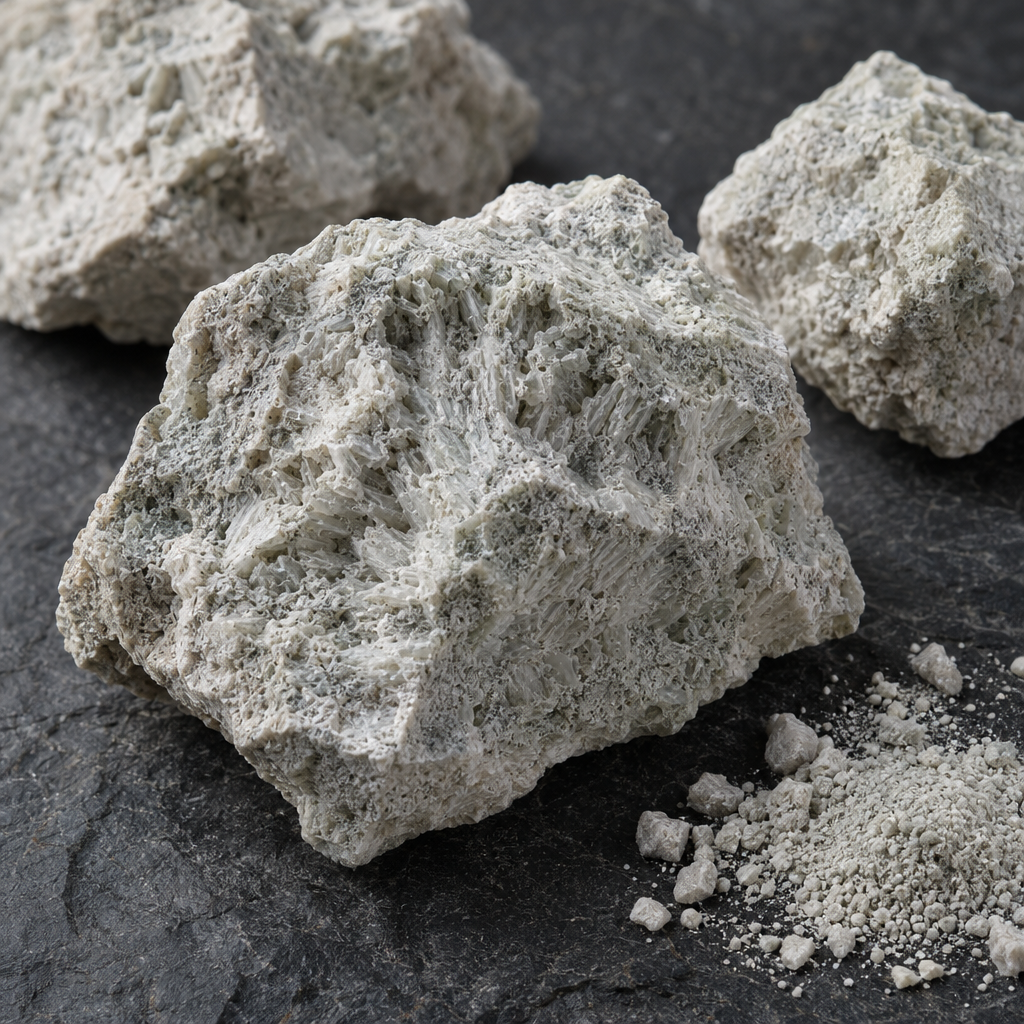
But a beaker has no stomach acid. No digestive enzymes, no food, no gut lining, no bloodstream, no kidneys. When a mineral binds something in water, you’ve learned what is possible in water. Laboratory binding is not proof of detoxification in the human body. The mechanism is laid out in our explainer on how zeolite binds metals.
Rung 2: A living gut, but not yours
Animal studies give you what the beaker can’t: a working digestive tract, real physiology, tissue you can measure. They’re genuinely useful for forming hypotheses and catching early safety signals.
Still, an animal’s gut isn’t a human gut. Doses differ, and so do diets, gut bacteria, body size, exposure routes, and metabolism. Plenty of promising animal results never survive the leap to people. Animal data raises the question. It doesn’t answer it.
Rung 3: Where evidence starts to feel convincing, and starts to mislead
Here we meet real people: before-and-after reports, testimonials, uncontrolled case series, surveys. That’s exactly why it feels so persuasive. A stranger says they felt lighter, clearer, better, and you believe them, because why wouldn’t you?
The trouble is that this kind of data is full of traps.
- Placebo response. Expecting to feel better can make people feel better.
- Regression to the mean. People try remedies when symptoms or test results are at their worst, and extremes tend to drift back toward average on their own.
- Concurrent changes. Someone who starts a detox product often changes their diet, sleep, water intake, or exposure sources at the same time.
- Selection bias. Satisfied customers write reviews. Disappointed ones usually don’t.
- Confounding. Something other than the product explains the change.
Observational data can point toward a good question. It can’t establish that a product caused anything.
Rung 4: The trial that can actually answer the question
This is the rung that can support an effectiveness claim, and it earns that status through design. Random assignment spreads the confounders (diet, expectations, baseline health) evenly across groups. A placebo keeps participants, and ideally researchers, from knowing who got what. When the groups then differ in outcome, the product is far more likely to be the reason.
To support a claim about a specific product, the trial has to test that product, or one demonstrably equivalent, in humans, using an outcome that matters.
For oral zeolite detox products, this rung is essentially empty. We aren’t saying human research on zeolite doesn’t exist, or never will. We’re saying we haven’t found properly controlled, checkable trials on these consumer products that would back up a detoxification claim. Where a trial is cited, it has to survive the checks below.
Rung 5: The part where other people get the same result
One trial, even a good one, is a starting point. Confidence arrives when independent teams reproduce the finding and a systematic review pools the results. Without rung 4, there’s nothing for rung 5 to build on.
Three pieces of paper that get waved around as proof
Detox marketing leans on three kinds of document. Each proves something. None proves what the marketing implies.
The certificate of analysis (COA), or “lab report”
What it proves: What is, and isn’t, in the product. A COA usually reports tests for contaminants such as heavy metals and microbes, or for composition. That’s purity, and it matters for safety. A mineral sold to bind metals shouldn’t be carrying troublesome levels of metals itself.
What it doesn’t prove: That the product does anything in your body. A spotless bottle of an ineffective product is still ineffective. Purity answers “is this safe to swallow?” It never answers “does this work?”
Three questions to put to any COA:
- Is it batch-specific? The report should trace back to the lot number on your bottle. One sample from one day says little about the batch you actually bought.
- Who ran the test? An independent, accredited lab carries more weight than an in-house result.
- What was it tested for? A report covering one contaminant is not a clean bill of health.
The “clinical trial” citation
“Clinically studied” may be the most elastic phrase in supplement marketing. It can mean a rigorous double-blind trial. It can also mean a handful of people, no control group, and a press release.
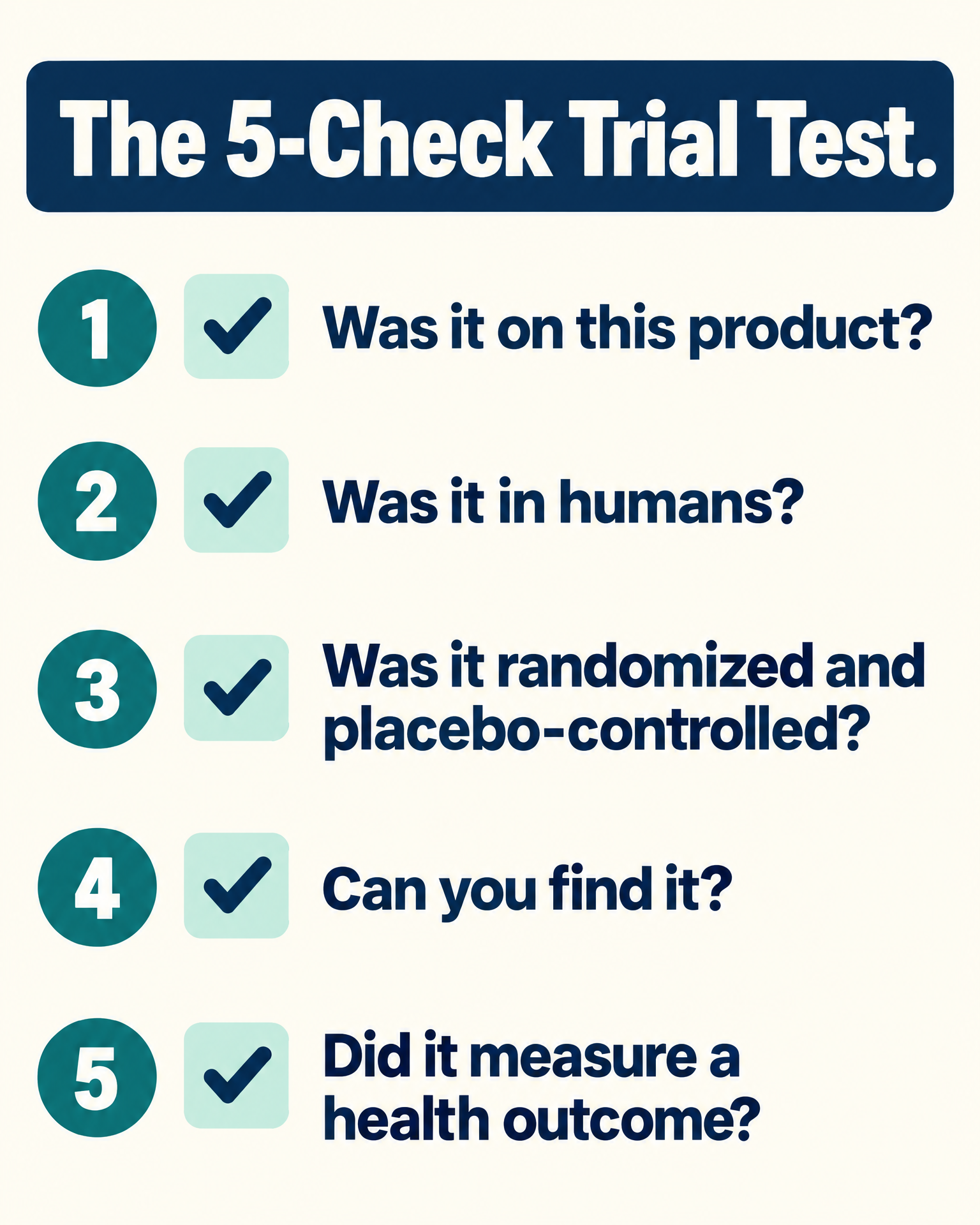
Run every trial citation through five checks:
- Was it on this product? A trial on a different formulation, dose, or form doesn’t transfer. “Zeolite” is not one standardized substance.
- Was it in humans? Cell and animal work sits on a lower rung, however it’s described.
- Was it randomized and placebo-controlled? Without both, you can’t separate the product’s effect from expectation and chance.
- Can you find it? You should be able to trace it through a journal, a DOI, a trial registry entry, or at the very least authors, title, and year that lead to a real record. A citation you can’t trace is a citation you can’t evaluate.
- Did it measure a health outcome or a surrogate number? Feeling or functioning better is an outcome. A shifted lab value is a surrogate (more on that shortly).
A citation has to pass all five to support an effectiveness claim. Four out of five is a partial result, not a partial win.
The patent, or the “proprietary process”
What it proves: That someone filed paperwork describing a process or composition, and an office judged it novel enough to protect. Patents are about novelty and ownership, not clinical performance. Plenty are granted for ideas that were never tested in a single person.
What it doesn’t prove: That the product works, that it’s safe, or that the promised benefits are real. And “proprietary” often translates to “we won’t show you the details,” which is the opposite of verifiable.
A patent is a document about a claim. It isn’t evidence for the claim.
When the number moves and your health doesn’t: surrogate endpoints
A surrogate endpoint is a lab measurement standing in for a health outcome. Surrogates can be excellent, but only after research has shown that moving the number reliably improves how people feel, function, or survive.
Here’s a simple way to see the problem. Step on a scale after a sauna and the number drops. You haven’t lost fat. You’ve lost water. The measurement changed, and the thing you cared about didn’t.
Detox claims are especially prone to this, for a few reasons.
- Urine and stool numbers swing for many reasons. A higher metal reading in a sample might reflect what was already passing through the gut, what was in the product itself, or how the sample was collected. It doesn’t necessarily mean the body’s burden went down.
- Blood numbers can fall for reasons that have nothing to do with the product. If someone also cuts an exposure source, like a contaminated water supply, their levels may drop regardless.
- “Provoked” or “challenge” urine testing draws widespread criticism. Clinical toxicology groups have cautioned against interpreting metal levels after a provoking agent, because those tests lack validated reference ranges and can mislead.
- A biomarker of exposure is not a measure of harm or recovery. A blood lead level tells clinicians about recent exposure. It’s a tool for managing exposure, not proof that a supplement improved anyone’s health.
So when a claim says a product “lowered” or “reduced” something, stop and ask three things. Is this number a validated stand-in for health? Did the people in the study feel or function better? Compared with whom?
For how this plays out with metals specifically, see our deeper look at whether zeolite removes heavy metals from the human body.
Putting the framework to work on real zeolite products
Frameworks are easy to nod along to. The test is what happens when you use one.
As of our verification on 2026-10-29, across the six major zeolite products we compared:
- None publishes a batch-specific certificate of analysis that a buyer can match to their own bottle.
- Two brands publish single-sample purity lab reports.
- One brand’s page cites a 2025 randomized trial on serum lead, but a reader cannot verify that trial from the citation provided.
What the COA numbers mean
Zero out of six offering batch-specific reports means that, for any given bottle, a buyer can’t confirm the purity testing describes the product in their hands. The two single-sample reports are better than nothing. They show a product was clean on at least one occasion. But one sample is a snapshot, not a promise about every batch. And either way, these are purity documents. They speak to safety, not to whether anything is being detoxified.
What the trial citation means
“A 2025 randomized trial on serum lead” sounds like the real thing, and it might be. We’re not claiming the trial doesn’t exist. The point is narrower: as cited, a reader can’t check it. Run the five checks:
- On this product? Unknown without the paper.
- In humans? Unknown.
- Randomized and placebo-controlled? The page says “randomized,” but placebo control, blinding, and sample size can’t be confirmed.
- Checkable? Not from the citation provided. This is the check that fails first, and it blocks everything after it.
- Health outcome or surrogate? Serum lead is a surrogate. It measures lead in blood, not improved health.
A claim that can’t pass check 4 can’t be assessed on the other four. An unverifiable citation hands a reader nothing to evaluate, whatever the underlying study might show.
What this example does and doesn’t say
It doesn’t say any product is ineffective, and it doesn’t say any brand is acting in bad faith. It says the documentation available to a buyer doesn’t reach the top of the ladder. Missing proof isn’t proof of absence. It means the claim hasn’t earned your confidence yet.
To see how the six products compare on what can be compared, like ingredients, form, and what each brand discloses, head to our six-product comparison.
A five-minute evidence audit for any detox product
Use it on a sales page, an ad, or a friend’s enthusiastic recommendation.
- Pin down the claim. Write it in one sentence. “Removes heavy metals” and “supports wellness” are very different promises, and they demand very different evidence.
- Find the highest rung actually cited. Beaker? Animal? Testimonials? A human trial?
- If a trial is cited, run the five checks. Product, humans, randomized and placebo-controlled, checkable, health outcome.
- If a lab report is cited, ask what it proves. Batch-specific? Independent? Purity only?
- If a patent is cited, file it under “paperwork.”
- Listen for surrogate language. “Lowers levels” and “increases excretion” describe numbers, not health.
- Match the confidence to the evidence. Words like “proven” and “clinically shown” shouldn’t outrun the rung you found.
Where this framework stops
Learning to read evidence isn’t an argument that every supplement is useless, and it isn’t a recommendation either way. A few boundaries are worth stating plainly.
- Lack of high-quality evidence is not proof of harm, or of no benefit. It means uncertainty.
- Supplements are not a treatment for heavy-metal poisoning. If you suspect metal exposure or poisoning, whether from water, work, a hobby, or a product, contact a healthcare professional or your local poison control center. Real exposure is diagnosed with appropriate testing and managed medically, including removing the source.
- Talk to a clinician before starting any supplement, especially if you’re pregnant, have kidney disease, take medications, or are giving anything to a child. Minerals that bind substances in the gut can, in principle, also affect how other things are absorbed.
Questions you’re probably asking yourself
So what would actually convince me that a detox supplement works?
Replicated, randomized, placebo-controlled human trials on the exact product, measuring health outcomes and published where others can verify them. Lab, animal, and observational data can suggest hypotheses, but they can’t establish that something works.
The label says “lab-tested.” Doesn’t that mean it works?
No. Lab testing usually speaks to purity: whether contaminants or ingredients match the label. It doesn’t show the product produces a health benefit. A batch-specific, independent COA is a good safety signal, and it’s only that.
It’s patented. Surely that counts for something?
It counts as paperwork. A patent shows a process or composition was filed and judged novel. It doesn’t require any clinical evidence of effectiveness or safety.
How do I know whether a clinical trial citation is real, and whether it applies to what I’m buying?
Start by seeing if you can find it through a journal, DOI, or trial registry. Then confirm it studied this product in humans, used randomization and a placebo, and measured a health outcome. If you can’t trace it, treat it as unverified.
What does “surrogate endpoint” even mean here?
It’s a lab measurement, like a blood or urine value, used in place of a real health outcome. It only matters if changing that number has been shown to improve how people feel or function.
Zeolite binds metals in water. Doesn’t that mean it detoxifies my body?
No. Binding in water shows what a mineral can capture under laboratory conditions. Inside a person, you add digestion, absorption, metabolism, and elimination, and only well-designed human trials can show whether any of that changes the picture. Our article on whether zeolite removes heavy metals from the human body goes further.
What if I think I’ve been exposed to heavy metals? Can a zeolite supplement help?
It isn’t a treatment for heavy-metal poisoning. Suspected poisoning calls for prompt medical evaluation, and a supplement is no substitute for diagnosis or treatment.
Why does a missing batch-specific COA matter so much?
Supplement contents can vary from batch to batch. Without a report traceable to your lot number, you can’t confirm the purity testing describes the bottle in your hands.
Products / Tools / Resources
Nothing here is a miracle. These are the things worth bookmarking if you plan to check claims for yourself.
Tools for verifying a claim
- PubMed: The first place to paste a trial’s title or authors. If a “published study” doesn’t turn up here or in a journal’s own archive, keep digging before you believe it.
- ClinicalTrials.gov: A registry of studies, including ones still running. It’s handy for checking whether a trial was actually registered and what outcome it said it would measure.
- DOI lookup (doi.org): If a citation includes a DOI, this takes you straight to the paper, or shows you it leads nowhere.
- Cochrane Library: Home of systematic reviews, the rung 5 material. It’s worth a search before you trust any health claim.
Reliable reading
- NIH Office of Dietary Supplements: Plain-language fact sheets on supplements and ingredients, written without a sales agenda.
- Our own pages: what zeolite is and how it works, whether zeolite removes heavy metals from the human body, and the six-product comparison.
Third-party seals and testing
- USP Verified and NSF Certified marks: These come from independent programs that check whether what’s in the bottle matches the label. They’re purity-and-quality signals, not proof of effectiveness, but they’re far more meaningful than a logo a company designed for itself.
- ConsumerLab: A subscription service that runs independent tests on supplements. It’s useful if you want a second opinion on contents.
If you’re worried about real exposure
- Poison control: In the United States, the Poison Help line is 1-800-222-1222. Outside the U.S., search for your national or regional poison control center.
- Your clinician or a local public health office: They can order appropriate testing and help you track down the source, which matters far more than anything you can buy.
One last small tool
- A single index card: Copy the seven steps of the five-minute evidence audit onto it and keep it near your computer. Next time a confident sales page appears, you’ll already know what to look for.
Recent Posts
Do Detox Supplements Affect Medications or Essential Minerals?
The short answer: They might. Nobody has shown whether oral zeolite detox supplements interfere with prescription drugs or essential minerals in people, and that silence isn't reassurance. If you...
ROOT Clean Slate vs. Advanced TRS: Which Bottle Earns Your Money?
An independent, label-first buying guide from zeolitefordetox.com Disclosure: ROOT Clean Slate links on this page may be referral links, and we may earn a commission at no extra cost to you. There...