Picture three browser tabs open at once. The first bottle promises “nano-sized zeolite.” The second is “micronized for maximum absorption.” The third doesn’t bother with specifics. It just says finer particles are “more bioavailable.”
Three pages, one message: smaller must be better.
It’s an appealing idea, and part of it is true. The physics holds up in a beaker. What happens between the beaker and your bloodstream is where the evidence thins out, and where the marketing tends to speed up. This guide pulls the two apart so you can weigh any zeolite particle size claim on your own.
Safety note: Zeolite supplements are not a treatment for heavy-metal poisoning. If you suspect poisoning, contact a clinician or your local poison control service (in the U.S., Poison Help: 1-800-222-1222). Diagnosis and treatment, including chelation when it’s medically indicated, belong in a doctor’s hands.
Table of Contents
So, Does Smaller Zeolite Actually Detox Better?
Does smaller zeolite particle size mean more effective detox? Not demonstrably.
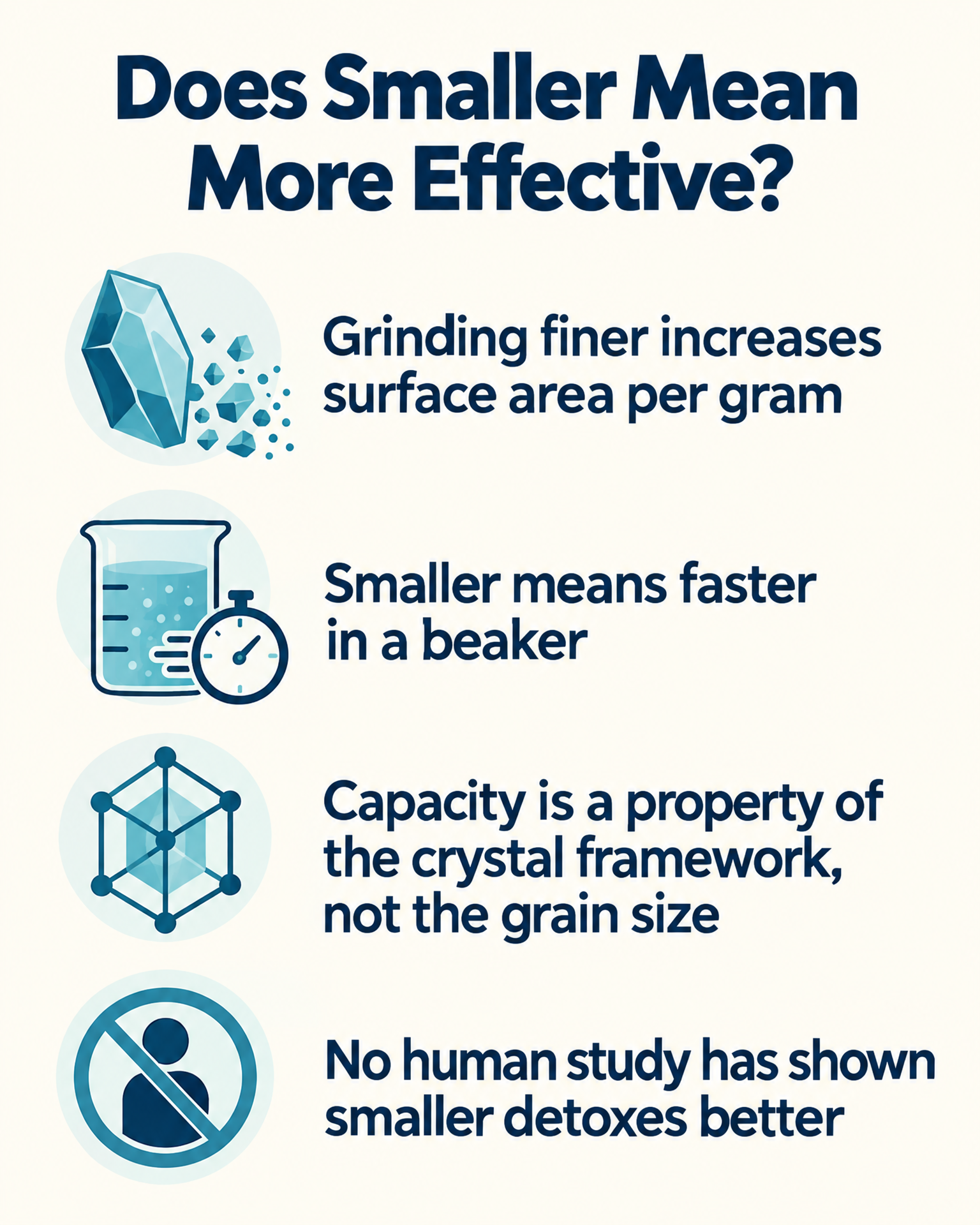
Grinding zeolite finer increases surface area per gram, and that can speed up ion binding in lab and water-filtration settings. But no human clinical study has shown that smaller zeolite particles produce better detoxification outcomes in people. Claims that nano-sized zeolite reaches cells or the bloodstream are unproven, and oral zeolite is not established to be absorbed as intact particles.
Both halves of that answer are true at once. The rest of this piece shows how.
The Part of the Story That’s Real: Surface Area and Speed
Particle size matters in materials science, and zeolite is no exception. The claim isn’t invented. It’s just stretched.
More surface from the same mass
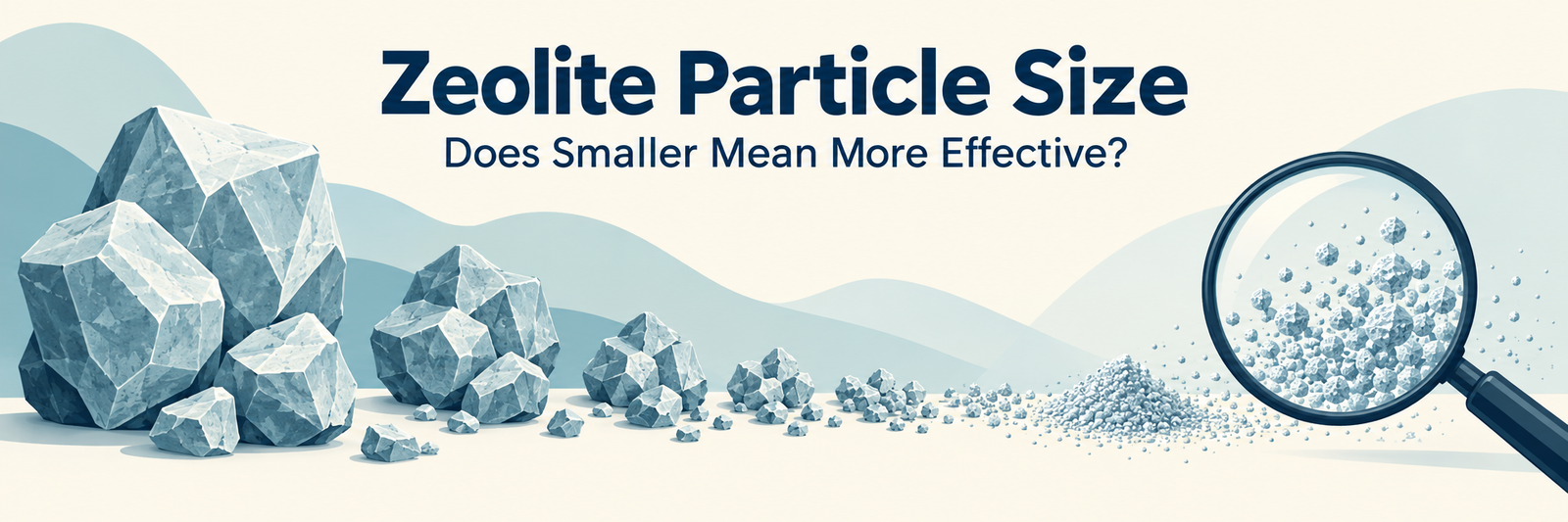
Take a gram of mineral and grind it finer. The weight stays put, but you’ve exposed far more surface. For roughly spherical particles, specific surface area scales inversely with diameter: halve the diameter and you roughly double the surface area per gram.
That’s the kernel of truth inside every “smaller is better” pitch.
What zeolite is, and why it complicates the picture
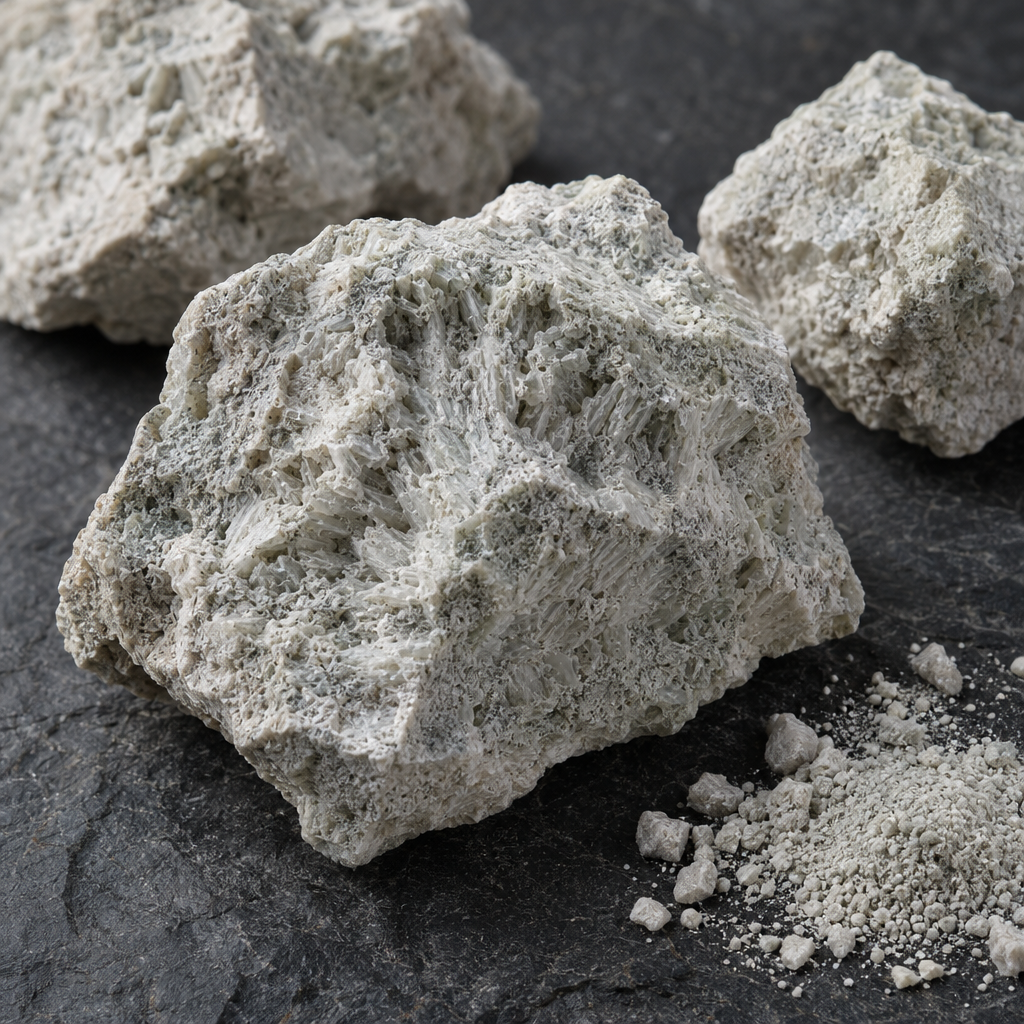
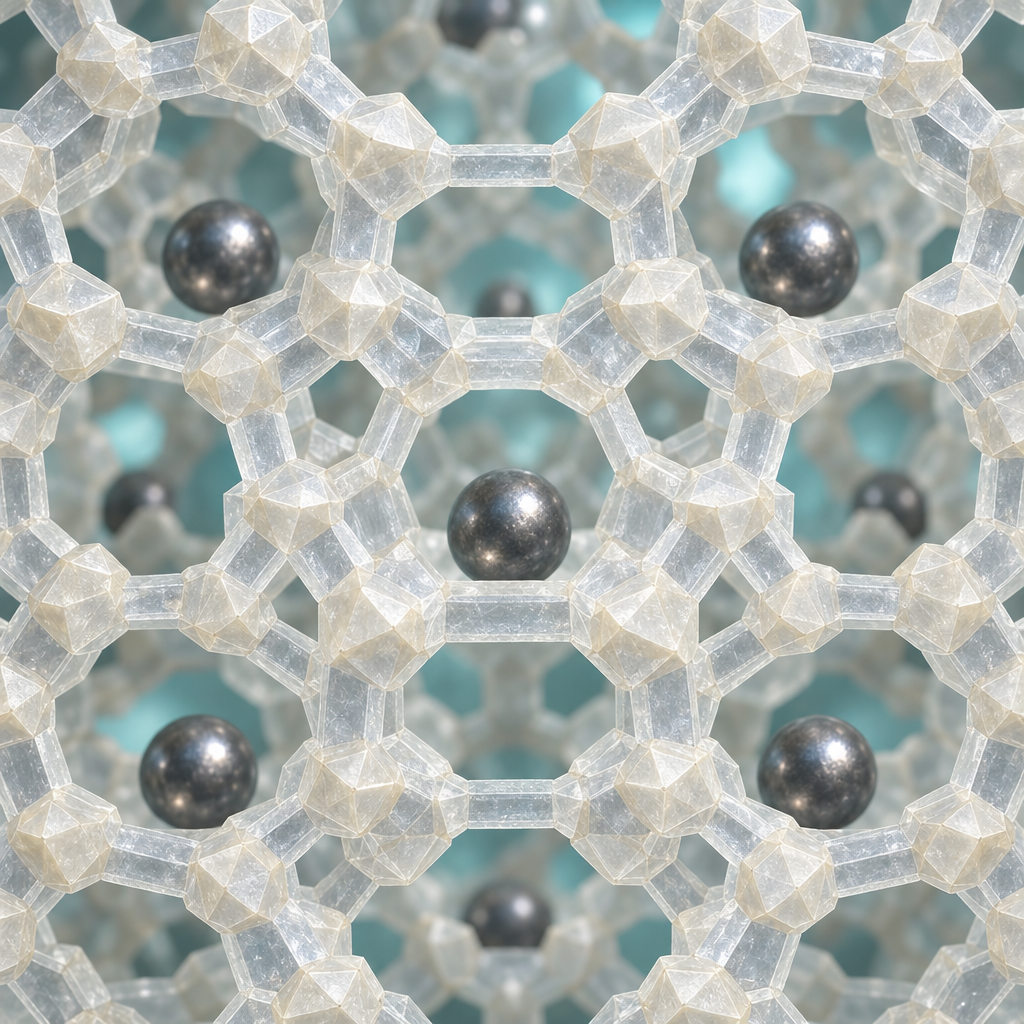
Zeolites are crystalline aluminosilicate minerals with a porous framework. Clinoptilolite, the type most often discussed in detox supplements, is threaded with channels and cages on the sub-nanometer scale. Positively charged ions such as potassium, sodium, and calcium sit loosely inside that lattice, and the framework can trade them for other cations. That trade is called cation exchange. (For the mechanism in more depth, there’s this explainer on what zeolite is and how it binds metals.)
Marketing tends to blur two separate properties into one. Keeping them apart changes how you read everything else:
| Property | What it describes | Does grinding change it? |
|---|---|---|
| Capacity (cation exchange capacity) | How many ions the framework can hold in total | Largely a property of the crystal framework and its purity, not the grain size |
| Rate (kinetics) | How quickly ions reach binding sites | Often yes. Smaller grains shorten the path ions travel into the particle |
Finer grinding can help a material reach its binding limit sooner, because ions have less distance to diffuse. It doesn’t necessarily raise the limit itself. “Smaller means faster in a beaker” is defensible. “Smaller means stronger” is a different claim, and it needs different evidence.
Where the logic holds up
The surface-area argument comes from places where researchers control nearly everything:
- Beaker experiments, with a defined solution, a known ion concentration, and a measured contact time.
- Water and wastewater filtration, where zeolite is studied as a medium for removing ammonium and some metal ions.
- Industrial uses such as soil amendment, gas separation, and catalysis.
In those settings you set the pH, the competing ions, the flow, and the contact time. A human body gives you none of those dials.
Where the Logic Breaks: From Beaker to Body
If a finer powder binds ions faster in water, it feels like it should do something similar inside you. That intuition skips several steps, and every one of them is a place the claim can fail.
The gut is not a clean beaker
A beaker might hold one target ion in simple water. Your digestive tract holds stomach acid, bile, enzymes, whatever you ate for lunch, and a crowd of competing ions, especially sodium, potassium, calcium, and magnesium, at concentrations far above any trace contaminant. Zeolite’s exchange sites get shared among all of them. Binding behavior measured in a controlled solution can’t simply be assumed to carry over to that environment.
Nobody has shown that oral zeolite gets in as intact particles
This is the point that most undercuts the “smaller means it gets in” story.
Nano marketing often implies that tiny particles slip across the intestinal wall, enter circulation, and reach cells. For oral zeolite, that’s unproven. There’s no established finding that ingested clinoptilolite is absorbed as intact particles in meaningful amounts, and no demonstration that nano-sized zeolite reaches cells or the bloodstream in people.
If that pathway isn’t established, “smaller gets further” has nothing to stand on. And if it ever were established, it would raise safety questions of its own, because anything that crosses into the body deserves a different level of scrutiny than something that simply passes through.
Binding in a beaker is not detoxification in a person
In a clinical sense, detoxification means a measurable reduction in a harmful burden, with a meaningful health outcome attached. Showing that a mineral captures an ion in solution is a step toward that, not the destination. Between the two sit absorption, distribution, competing binding, excretion, and clinical relevance.
No human trial has tested the specific claim
To our knowledge, no human clinical study has shown that smaller zeolite particles produce better detoxification outcomes than larger ones. A claim can be plausible and still unproven. Plausibility is where research begins, not where it ends.
What the Labels Actually Tell You (and What They Leave Out)
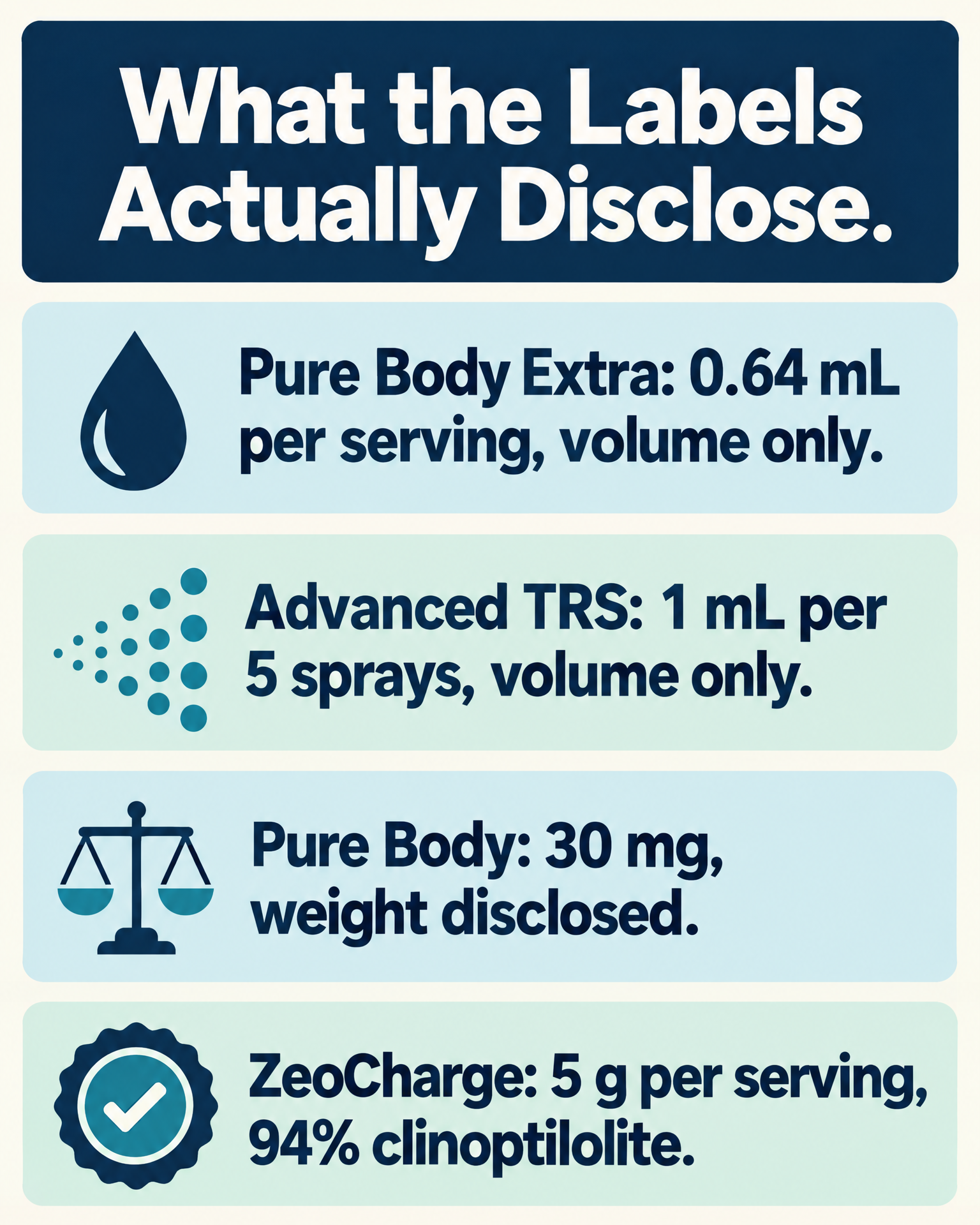
The easiest way to test a particle-size claim is to look at what the label is willing to put in writing. The figures below were verified on 2026-10-29. Formulations and labels change, so check current packaging before relying on them.
| Product | Form | What the label discloses | Weight disclosed? | Particle size disclosed? |
|---|---|---|---|---|
| Pure Body Extra | Spray | 0.64 mL of zeolite per serving | No (volume only) | No |
| Advanced TRS | Spray | 1 mL per 5 sprays | No (volume only) | No |
| Pure Body | Drops | 30 mg | Yes | Not part of the verified figures |
| ZeoCharge | Powder | 5 g per serving, standardized to 94% clinoptilolite | Yes | Not part of the verified figures |
The trouble with a milliliter
Both leading sprays disclose zeolite by volume. A milliliter measures space, not mass. Unless you know the concentration of the suspension, you can’t turn 0.64 mL or 1 mL into milligrams, and without a weight you can’t compare doses across products.
Neither spray gives a particle size, either. So the “nano” or “micronized” on a spray’s page has no number behind it. That doesn’t make a spray ineffective or unsafe. It means the figures you’d need to evaluate the size claim aren’t there.
Weight, purity, and size are three different things
The other two products show different kinds of disclosure:
- Pure Body drops list a weight, 30 mg. That’s a real, comparable unit, but it says nothing about composition or grain size.
- ZeoCharge lists both a weight, 5 g per serving, and a purity standard, 94% clinoptilolite. That tells you what fraction of the powder is the target mineral. It still isn’t a size figure.
The gap between 30 mg and 5 g is roughly 167-fold in mass. Resist the urge to read that as a ranking. The forms differ, the marketing purposes differ, and mass alone doesn’t establish effect. What the gap really shows is how far apart these disclosure units sit. Until you know what each number measures, head-to-head comparison is guesswork.
If you’d like to see six zeolite products lined up on their disclosed details, this six-product comparison puts them in one place.
Five Questions to Ask Before You Believe “Nano” or “Micronized”
You don’t need a chemistry degree for this. You need a sequence of questions, asked in order.
1. What is the claim, exactly?
Sort it into one of these:
- “Smaller particles have more surface area.” True physics.
- “Smaller particles bind faster.” Plausible under lab conditions.
- “Smaller particles bind more.” Less certain, since capacity depends heavily on the framework and purity.
- “Smaller particles are absorbed or reach cells.” Unproven for oral zeolite.
- “Smaller particles detoxify better in people.” No human study has shown this.
Plenty of product pages slide from the first rung to the fifth inside a single paragraph. Train yourself to notice the moment it happens.
2. What’s disclosed, and in what units?
- Is the zeolite listed in milligrams or grams, or only in milliliters?
- Is the material identified as clinoptilolite, and is a purity percentage stated?
- Is there an actual particle-size figure, such as a median diameter or a size distribution, or just an adjective like “nano”?
- Does the label say how the size was measured? Laser diffraction and dynamic light scattering are common methods. An adjective is not a measurement.
“Nano” is a different kind of statement than “median particle diameter of X, measured by Y.” The first is branding. The second can be checked.
3. Is the size term being used consistently?
By common scientific convention, “nano” means dimensions of roughly 1 to 100 nanometers, and “micronized” usually points to the micrometer range. Marketing doesn’t always honor those boundaries, and something sold as “nano” may hold a wide spread of sizes. Without a distribution, a single descriptor tells you very little.
4. What would real human evidence look like?
A credible test of “smaller zeolite works better in people” would typically need:
- Same material, different sizes. The same zeolite, with only particle size varied and the sizes characterized.
- Matched dose by weight. Not by volume, and not by sprays.
- Randomization and a control group, ideally blinded.
- Clinically meaningful outcomes. Measures with an agreed link to health, not just a number that moves.
- Appropriate sample size and pre-registered endpoints.
- Safety monitoring, especially for smaller particles.
- Independent replication.
Be wary of outcome measures that sound objective but aren’t validated. Medical toxicology bodies, for example, have cautioned against “provoked” or post-challenge urine metal testing as a way to diagnose a body burden. A rising urine number after a supplement doesn’t, on its own, show that anything clinically meaningful happened.
5. Is anyone asking what’s in the product?
Particle size is one variable among several. Purity, source, and contaminant testing, including for naturally occurring trace metals in mined minerals, may matter more to your decision than grain size. Look for batch-level results from an independent laboratory.
Does Going Smaller Change the Safety Picture?
Smaller isn’t automatically riskier, and it isn’t automatically safer. What can be said:
- Behavior at the nano scale can differ from behavior at larger scales, which is why nanomaterials draw their own regulatory attention in many contexts.
- If a manufacturer claims nano particles are absorbed, that claim invites questions about where they go and what they do. A promise of more access should come with more safety evidence.
- If you’re pregnant, nursing, managing kidney disease, taking prescription medications, or considering this for a child, talk to a clinician before using any mineral supplement. Binding agents can interact with how other substances move through the gut.
Questions You’re Probably Already Asking
Is nano zeolite actually better than regular zeolite?
There’s no human evidence that it is. Smaller particles have more surface area and may bind ions faster in lab settings, but no human clinical study has shown better detoxification outcomes from smaller particles.
What does “micronized zeolite” even mean?
Generally, the mineral has been ground to very fine particles, typically in the micrometer range. Unless the label gives a measured size and distribution, it’s a descriptor, not a specification.
Can nano zeolite get into my bloodstream or cells?
That claim is unproven. Oral zeolite is not established to be absorbed as intact particles, and there’s no demonstrated evidence that nano-sized zeolite reaches cells or the bloodstream in people.
If the particles are smaller, doesn’t it hold more?
Not necessarily. Surface area per gram goes up, which can speed up binding. Total capacity depends largely on the crystal framework and the purity of the material, so smaller doesn’t automatically mean it can hold more.
Why do some sprays list milliliters instead of milligrams?
Sprays are liquid suspensions, so the dose is often described by volume. As verified on 2026-10-29, Pure Body Extra lists 0.64 mL per serving and Advanced TRS lists 1 mL per 5 sprays. Neither gives a weight or a particle size, so you can’t convert those figures into a mass.
How do the amounts compare across drops, sprays, and powder?
Pure Body drops disclose 30 mg. ZeoCharge powder discloses 5 g per serving, standardized to 94% clinoptilolite. Those figures aren’t directly comparable to the sprays’ volume-based doses, and none of them tells you how well a product works.
What should I be looking for on a zeolite label?
The amount in weight units, the type of zeolite (such as clinoptilolite), a purity standard, any measured particle-size information, and independent contaminant testing.
Can zeolite treat heavy-metal poisoning?
No. Supplements are not a treatment for heavy-metal poisoning. Suspected poisoning calls for medical evaluation and, where appropriate, clinician-directed treatment.
Products / Tools / Resources
None of this is a verdict on whether any product works. The products below are the ones discussed above, listed so you can look at their labels yourself. Figures were verified on 2026-10-29, so confirm them against current packaging.
Products worth reading the label on
- ZeoCharge (powder): Lists 5 g per serving, standardized to 94% clinoptilolite. Of the four, it gives you the most to evaluate: a weight and a purity standard. It doesn’t list a particle size.
- Pure Body (drops): Lists 30 mg. A real weight, easy to compare in principle, though nothing about composition or grain size.
- Pure Body Extra (spray): Lists 0.64 mL of zeolite per serving. Volume only, with no weight and no particle size.
- Advanced TRS (spray): Lists 1 mL per 5 sprays. Also volume only, with no weight and no particle size.
Reading and comparison
- What zeolite is and how it binds metals: the cation-exchange mechanism, if you want the chemistry underneath the size debate.
- Six zeolite products compared side by side: useful for seeing disclosed details in a single view.
Tools you already have
- The five-question checklist above. Run any product page through it before you buy. Pay particular attention to the claim ladder in question one.
- A written request to the manufacturer. Ask for a particle-size distribution with the measurement method (laser diffraction or dynamic light scattering), and for a recent independent certificate of analysis covering purity and trace-metal contaminants. A company confident in its numbers usually answers plainly.
If you’re worried about exposure
- Poison Help (U.S.): 1-800-222-1222. For suspected poisoning, call this or your local poison control service.
- A clinician. For testing, diagnosis, and any decision about treatment, including whether chelation is appropriate, start here rather than with a supplement label.
Recent Posts
What Counts as Good Evidence for a Detox Supplement? How to Read Detox Claims Like a Scientist
The short answer: Good evidence for a detox supplement is a randomized, placebo-controlled trial in humans, run on the exact product, published where anyone can check it, and measuring a real health...
Do Detox Supplements Affect Medications or Essential Minerals?
The short answer: They might. Nobody has shown whether oral zeolite detox supplements interfere with prescription drugs or essential minerals in people, and that silence isn't reassurance. If you...