
The short answer: Zeolite is a crystalline aluminosilicate, a rigid framework of silicon, aluminum, and oxygen with tiny pores and a permanent negative charge that lets it swap positively charged ions. Silica is silicon dioxide (SiO₂). It’s simpler, has no aluminum framework, and has no built-in cation-exchange behavior. Both contain silicon and oxygen, which is exactly why marketing smudges the line between them. They aren’t interchangeable, and evidence about one doesn’t carry over to the other.
Maybe you’ve stood in front of two tabs, or two bottles, trying to make sense of them. One promises clinoptilolite zeolite. The other promises “bioavailable silica.” Both talk about cleansing, resetting, purifying, as if they were the same product wearing different clothes.
They aren’t. What follows is the chemistry without the copy, so the next label you read makes more sense, and you can tell which claims a given kind of evidence can actually support.
Table of Contents
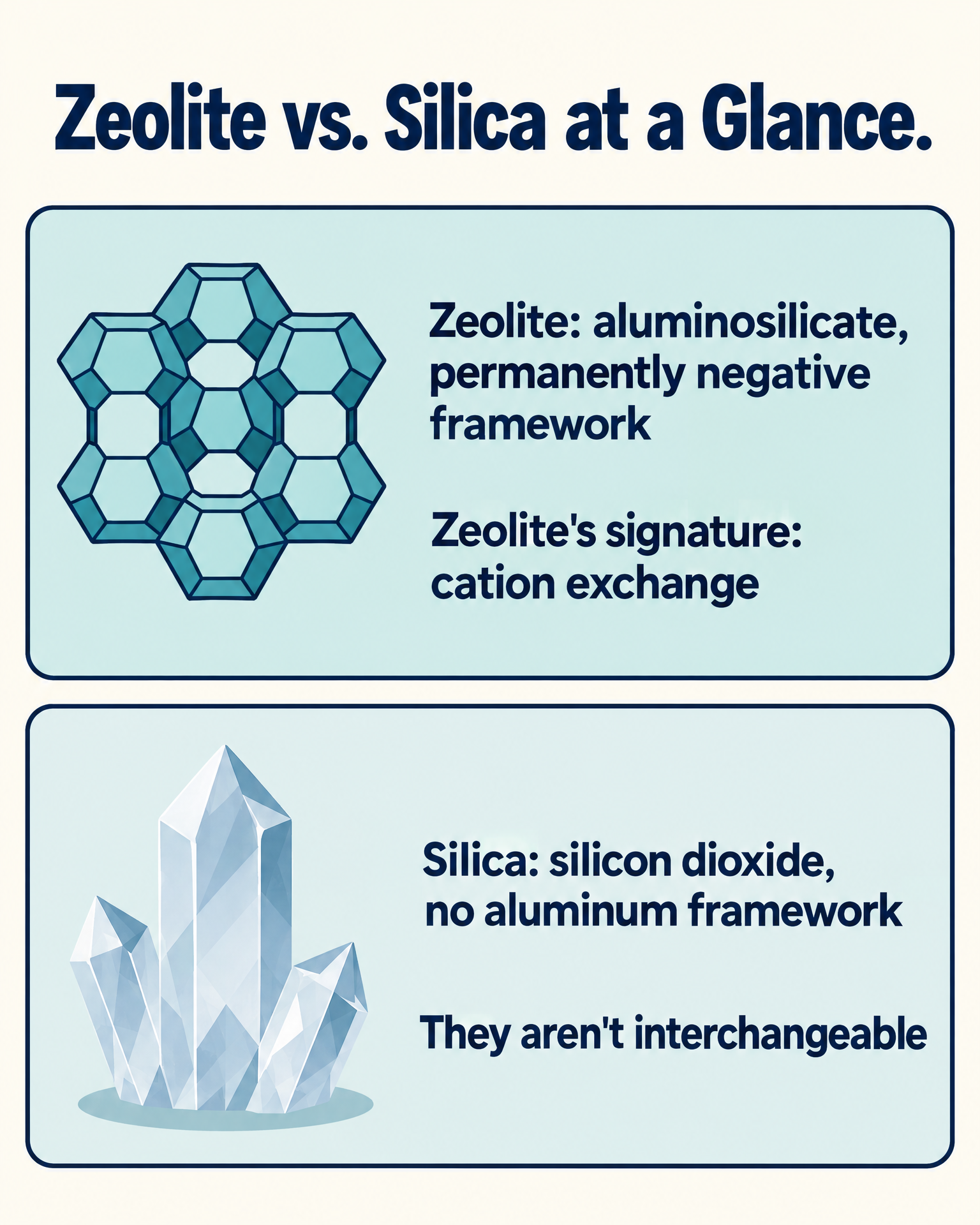
Zeolite vs. Silica at a Glance
| Feature | Zeolite (e.g., clinoptilolite) | Silica (silicon dioxide) |
|---|---|---|
| Chemical class | Microporous crystalline aluminosilicate | Oxide of silicon (SiO₂) |
| Contains aluminum in framework? | Yes | No (in pure form) |
| Structure | Ordered, cage- and channel-like crystal lattice | Crystalline (quartz) or amorphous (silica gel, fumed silica) |
| Framework charge | Permanently negative, balanced by exchangeable cations | Neutral in pure form |
| Signature behavior | Cation exchange and molecular sieving | Varies by form: dissolves as silicic acid, adsorbs water, acts as a flow agent |
| Where the lab data comes from | Water treatment, environmental remediation, industrial separations | Nutrition and materials science, depending on the form |
| “Bioavailable silica” on a label | Not what the phrase refers to | Usually orthosilicic acid in solution |
What Is a Zeolite, Exactly?
A zeolite is a microporous, crystalline aluminosilicate. That’s a mouthful, but each word tells you something about how the material behaves.
- Crystalline: The atoms sit in a repeating, ordered lattice. Nothing about it is random.
- Aluminosilicate: The lattice is assembled from linked tetrahedra, tiny four-cornered units with a silicon or aluminum atom at the center and oxygen at each corner.
- Microporous: Channels and cages thread through the structure, only a fraction of a nanometer wide. They’re small enough to let some ions and molecules in and keep others out.
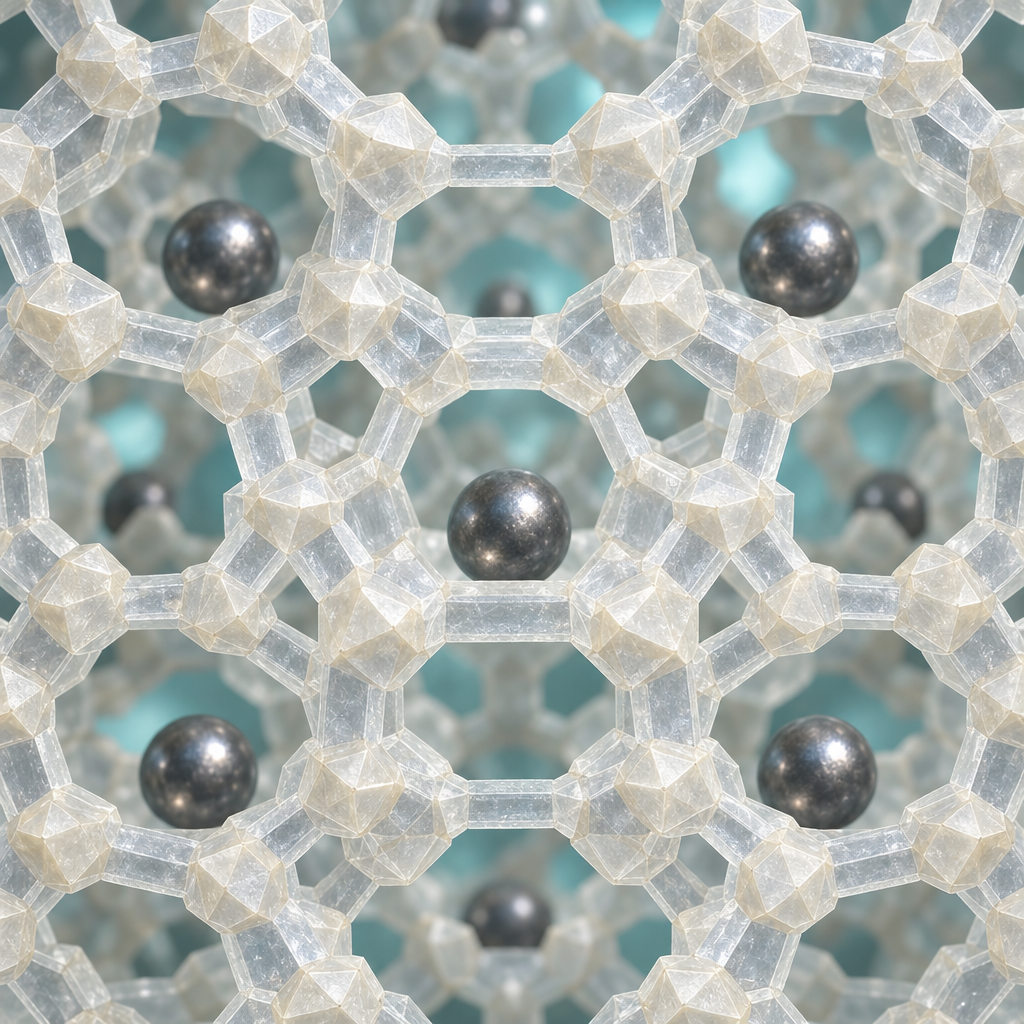
Picture a honeycomb built at the atomic scale, rigid and full of cavities, with a very particular idea of what’s allowed through the door.
The Hidden Charge That Changes Everything
Here’s the part that makes a zeolite a zeolite. Silicon in these tetrahedra carries a +4 charge. Aluminum carries +3. Wherever aluminum takes silicon’s place in the framework, the lattice ends up one positive charge short, and the framework itself becomes permanently negative.
Nature doesn’t leave that imbalance alone. Loosely held positive ions, called exchangeable cations, settle into the pores to even things out. Sodium, potassium, and calcium are common ones. They aren’t locked into the structure. When a zeolite meets a solution full of other positively charged ions, such as certain metal ions, a trade can happen: the zeolite picks up one species and lets another go.
That trade is cation exchange. It’s the main reason zeolites get studied for binding metal ions in laboratory and water-treatment settings.
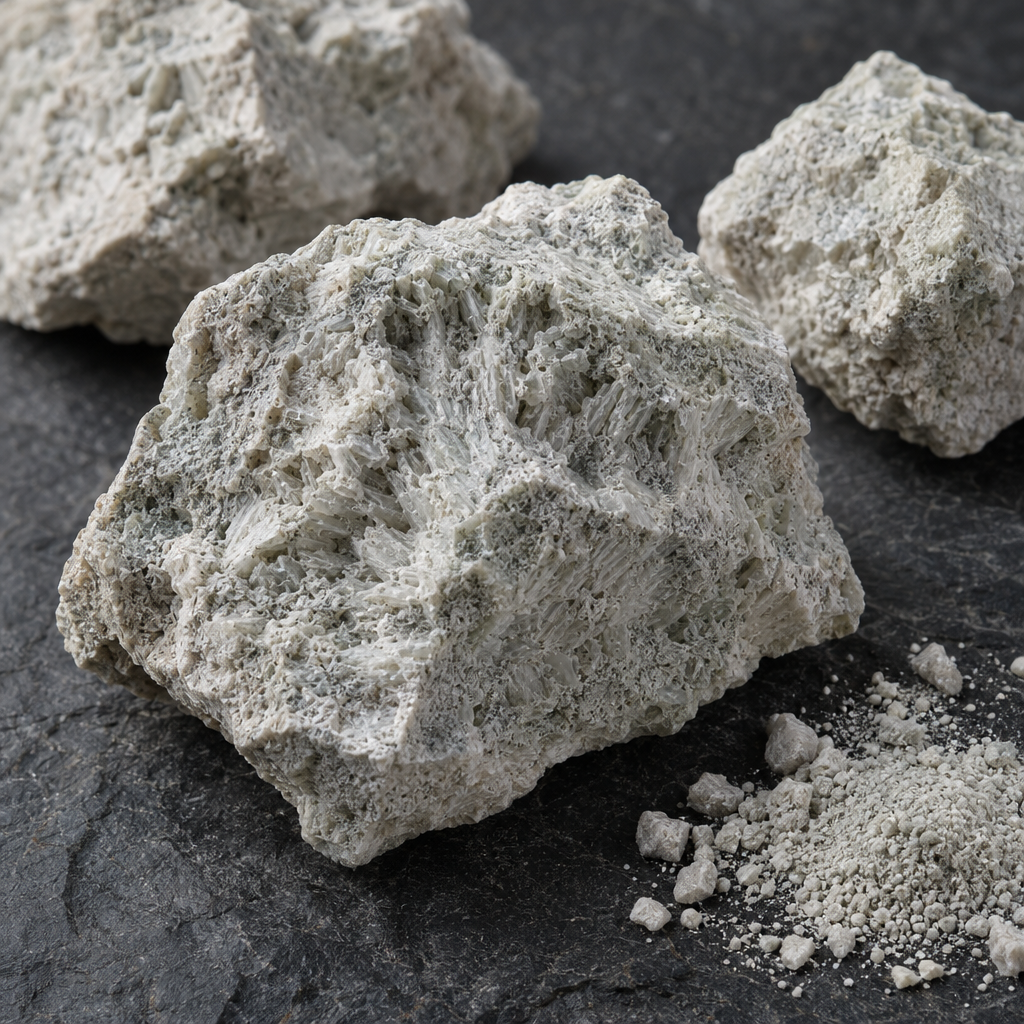
Clinoptilolite, the Workhorse
Clinoptilolite is the natural zeolite you’ll meet most often in commerce. It’s mined from volcanic-origin deposits and put to work in water filtration, agriculture, animal feed, and odor control. Its relatively high silicon-to-aluminum ratio and its affinity for certain cations are a big part of why those industries rely on it.
If you want the mechanism in more depth, this explainer on what zeolite is and how it works to bind metals walks through it step by step.
What Is Silica, and Why Does It Show Up Everywhere?
Silica is silicon dioxide, SiO₂. One silicon atom bonds to two oxygen atoms, and the pattern repeats in an extended network. It’s among the most abundant compounds in Earth’s crust. You’ve walked on it, probably today.
The catch is that silica isn’t one thing. It comes in many forms, and the form decides the behavior:
- Crystalline silica: quartz and sand
- Amorphous silica: silica gel (the little desiccant packets), fumed silica, and precipitated silica, often used as anti-caking and flow agents in powders and capsules
- Biogenic silica: diatomaceous earth and plant-derived silica such as horsetail or bamboo extracts
- Dissolved silica: silicic acid species in water, including orthosilicic acid
Pure silica has no aluminum in its framework, and that absence matters more than it first appears. Aluminum substitution is what gives a zeolite its permanent negative charge and its ion-exchange behavior. Without it, you don’t have that machinery. So when a label says “contains silicon dioxide,” it tells you nothing about whether the material can do what a zeolite does.
So What Does “Bioavailable Silica” Actually Mean?
Walk through the supplement aisle and this phrase turns up constantly. On most labels, “bioavailable silica” refers to orthosilicic acid, Si(OH)₄, in solution. It’s the small, soluble form of silicon that the body can absorb from the gut, and it’s the same form found in trace amounts in drinking water and some beverages.
A few things are worth holding onto here.
First, it’s a nutrition idea, not a binding idea. Orthosilicic acid comes up in conversations about dietary silicon intake. It isn’t an ion-exchange material.
Second, stability is a real problem. Left alone, orthosilicic acid tends to condense into larger, less soluble silica particles. Products use various stabilizers or formulations to keep it dissolved, which means two bottles carrying the same phrase can be quite different underneath.
Third, “bioavailable” is a friendly word that does a lot of quiet work. It can describe solubility or absorption without telling you how much is in there, what form it’s in, or whether anyone has shown a benefit in people.
The research on dietary silicon is small and mixed. It tends to look at bone, connective tissue, hair, and nails, not detoxification. If a product’s claims lean heavily on it, a little skepticism is only proportionate.
Cousins, Not Twins: How Zeolite and Silica Are Related
The confusion has a legitimate root. Both materials are built from silicon and oxygen.
- A zeolite’s framework is made partly of silica units, silicon-centered tetrahedra linked to aluminum-centered ones.
- Strip out the aluminum and the charge-balancing cations, and what’s left starts to look silica-like.
- Dissolve or chemically process an aluminosilicate under the right conditions, and silicon-containing species can end up in solution.
So the link is family resemblance, not equivalence. Silica is one ingredient in zeolite’s makeup. A zeolite is something more specific: an aluminum-bearing, charged, porous architecture. Saying “zeolite is basically silica” is a bit like saying a cathedral is basically stone. True at one level. Misleading at the level that matters.
When Language Gets Slippery: The ROOT Clean Slate Example
The overlap between these terms gets concrete with ROOT Clean Slate, a widely marketed detox product that sits right in the gray zone.
Here’s what can be said from the product’s own materials:
- Its maker describes it as derived from clinoptilolite.
- Its label lists silicon dioxide, and the amount is not quantified.
- Its product page never uses the word “zeolite.”
Put those together, and Clean Slate reads as a silica formulation with a clinoptilolite origin story, not a product described as clinoptilolite zeolite itself. Someone searching for zeolite could land on it. Someone reading “derived from clinoptilolite” could easily assume zeolite-like properties. The label doesn’t establish that.
Our full breakdown of ingredients, claims, and customer feedback is in this review of ROOT Clean Slate. Formulations and labels change, so check the current packaging before you buy anything.
What the Distinction Can’t Tell You
Knowing zeolite from silica clarifies what a product is. It doesn’t prove what a product does. Three limits are worth keeping in mind.
1. A silica product can’t borrow zeolite’s lab data
Laboratory binding studies describe specific materials under specific conditions: a defined zeolite, a defined particle size, a defined solution chemistry, a defined pH. If a product is a silica formulation, cation-exchange data from zeolite studies doesn’t automatically apply to it, even if the raw material it came from was a zeolite. Processing changes structure, and structure determines function. A finding that “clinoptilolite binds metals” supports a claim about clinoptilolite. It doesn’t stretch to every silica product downstream.
2. Binding in a beaker isn’t detoxification in a body
Even for true zeolite, a test tube isn’t a person. Binding in water treatment or a lab setting doesn’t establish that a supplement removes metals from human tissue, that it does so at safe doses, or that it improves any health outcome. Digestive chemistry, competing minerals, transit time, and the way the body stores and clears metals all complicate the picture. For no product does lab binding alone prove detoxification in people.
3. Supplements don’t treat heavy-metal poisoning
Heavy-metal poisoning is a medical problem. It’s diagnosed through clinical evaluation and testing and managed by qualified clinicians, sometimes with prescription chelation therapy under supervision. A supplement, whether zeolite or silica, is not a substitute. If you suspect exposure or poisoning, contact a healthcare professional or your local poison control service. Don’t put off care to try a product.
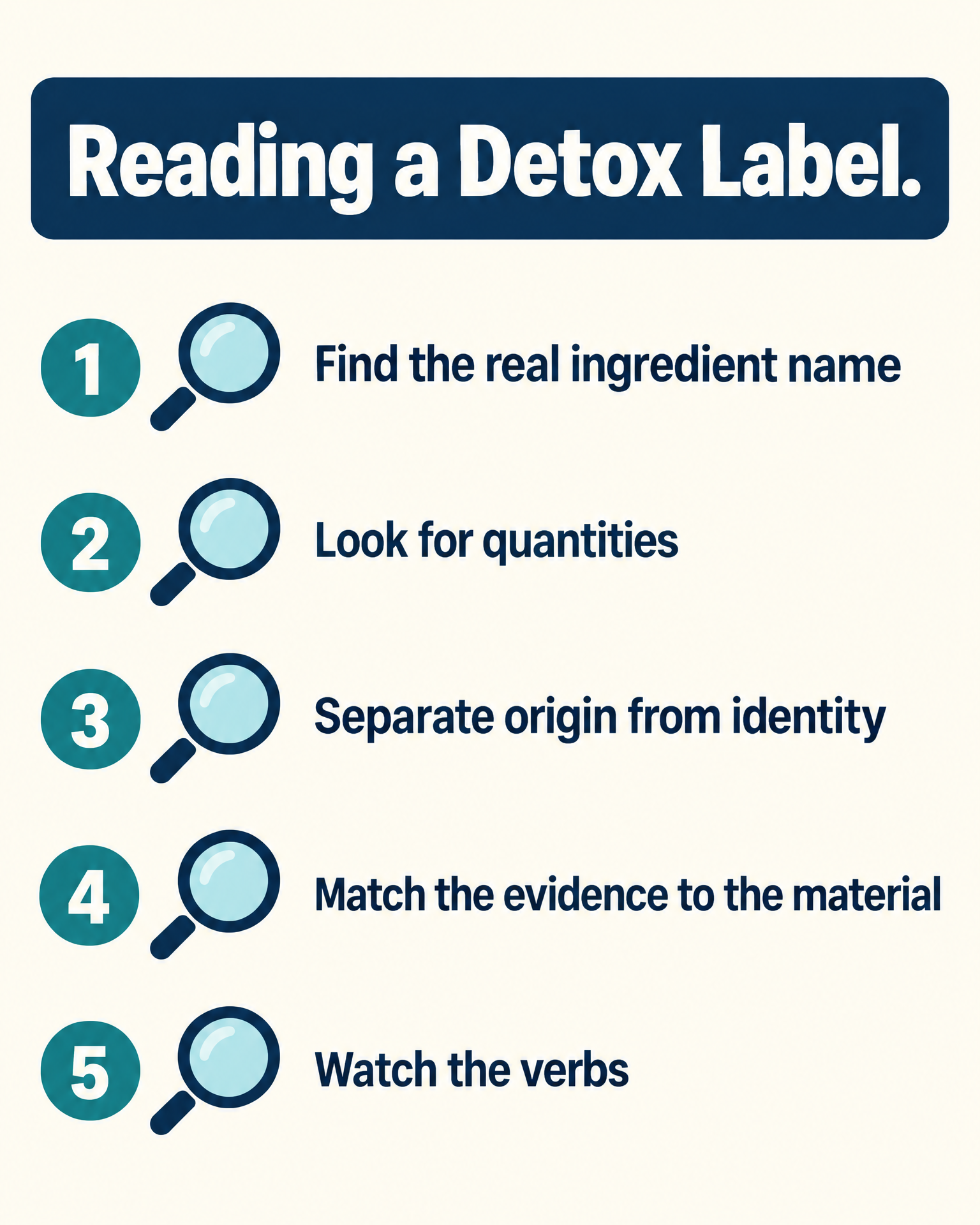
Reading a Detox Label Like You Don’t Trust It (Yet)
When the marketing starts to blur, a few habits keep you grounded:
- Find the real ingredient name. “Clinoptilolite” or “zeolite” is not the same as “silicon dioxide,” “silica,” or “orthosilicic acid.” The wording is the first clue.
- Look for quantities. An ingredient with no listed amount, like silicon dioxide with no number beside it, limits what you can evaluate.
- Separate origin from identity. “Derived from” describes a starting material. It doesn’t tell you what the finished product is.
- Match the evidence to the material. Ask which specific substance the cited studies tested, then ask whether that’s what’s in the bottle.
- Watch the verbs. “Supports,” “resets,” “cleanses,” and “detoxifies” are not clinical findings.
- Ask about testing. Reputable suppliers of any mineral product can usually document purity and contaminant screening. Natural mineral materials can carry trace impurities, so quality control matters.
- Talk to a clinician if you’re pregnant, managing a medical condition, or taking medications. Minerals can interact with how other substances are absorbed.
The Questions People Actually Ask
Wait, so is zeolite just silica?
No. Zeolite is an aluminosilicate with a porous crystalline framework and a permanent negative charge. Silica is silicon dioxide with no aluminum framework. Zeolites do contain silica units, but the two materials behave differently.
Clinoptilolite sounds like silica to me. Is it?
Not quite. Clinoptilolite is a natural zeolite, an aluminosilicate. It contains silicon-oxygen units, but it isn’t simply silica.
What am I actually buying when a label says “bioavailable silica”?
Usually orthosilicic acid in solution, a soluble form of silicon that can be absorbed from the gut. The phrase points to dietary silicon, not to the ion-exchange behavior of zeolite.
Why does zeolite grab onto metals in the lab at all?
Its framework carries a negative charge, balanced by exchangeable cations sitting in its pores. Those cations can swap with other positively charged ions in solution, including some metal ions. That’s why zeolites are used in water treatment.
If it works that well in a lab, doesn’t that mean it detoxes me?
No. Laboratory and water-treatment results show binding under controlled conditions. They don’t demonstrate detoxification, safety, or health benefits in people.
Is ROOT Clean Slate a zeolite?
Its maker describes it as derived from clinoptilolite, but the label lists silicon dioxide without quantifying the amount, and the product page never uses the word zeolite. It’s best understood as a silica formulation. Our Clean Slate review has the details.
Could a silica supplement do the same thing as zeolite?
Zeolite’s lab binding data can’t be assumed to apply to a silica product. Each material needs its own evidence.
What if I’m worried about heavy metals? Can a supplement handle it?
No. Heavy-metal poisoning needs medical evaluation and care. Supplements aren’t a treatment.
This article is for educational purposes and isn’t medical advice. Please consult a qualified healthcare professional about your health, testing, and treatment decisions.
Products / Tools / Resources
These are the things worth keeping within reach if you’re comparing zeolite and silica products, roughly in the order you’d use them.
Start here (our own guides)
- What Zeolite Is and How It Works to Bind Metals: the mechanism behind cation exchange, explained without the sales language.
- ROOT Clean Slate Review: a closer look at the ingredients, the claims, and what customers say. It’s a handy reference for seeing how “derived from clinoptilolite” plays out on a real label.
Tools for checking a product
- A Certificate of Analysis (COA) request. Any mineral supplier worth trusting should be able to send one, showing purity and contaminant screening. If they can’t or won’t, that tells you something.
- Third-party verification marks. Look for programs like USP Verified or NSF Certified on the packaging, or check the ConsumerLab database (subscription required) for independent testing results. These confirm that what’s on the label matches what’s in the bottle. They don’t prove a product works.
For going deeper on the science
- International Zeolite Association (IZA) Database of Zeolite Structures. The reference catalog of recognized zeolite frameworks, useful if you want to see how varied these materials really are.
- Mindat.org’s clinoptilolite entry. A solid, readable mineralogy page covering composition, deposits, and properties.
- NIH Office of Dietary Supplements. A reliable, plain-language place to look up what’s known (and not known) about dietary silicon and other minerals.
If you’re worried about exposure
- Poison Help line (U.S.): 1-800-222-1222. Free, confidential, and open around the clock. Outside the U.S., contact your local poison control center.
- Your doctor or a clinical toxicologist. Testing and treatment for suspected heavy-metal exposure belong in their hands, not on a supplement shelf.
Recent Posts
What Counts as Good Evidence for a Detox Supplement? How to Read Detox Claims Like a Scientist
The short answer: Good evidence for a detox supplement is a randomized, placebo-controlled trial in humans, run on the exact product, published where anyone can check it, and measuring a real health...
Do Detox Supplements Affect Medications or Essential Minerals?
The short answer: They might. Nobody has shown whether oral zeolite detox supplements interfere with prescription drugs or essential minerals in people, and that silence isn't reassurance. If you...