

You’re holding a lab report with a number on it, or you’re about to book the test and wondering what you’ll do with whatever comes back. Either way, the same question is sitting there: is 4 bad? Is 2 fine? The report gives you a figure, a unit, and maybe a flag. It doesn’t give you a plain-English explanation.
That gap is where worry grows. A result that looks small can feel like a loophole, and a result that looks big can feel like a verdict. Meanwhile the lab, the pediatrician’s office, and the internet each seem to say something slightly different. You end up reading forum threads at midnight trying to figure out whether you should be calm or alarmed.
That’s what this article is for. I’ll walk you through what a blood lead test measures, how the sample gets collected, what the reference values mean (and what they don’t), and what the test simply can’t answer. By the end, you’ll be able to read your number, or decide whether to get one, without guessing.
Table of Contents
What a Blood Lead Test Actually Measures
A blood lead test measures how much lead is circulating in your blood at the time of the draw. That makes it a good window into recent exposure. If lead has been coming into your body lately, from dust, water, soil, a workplace, or a hobby, blood is where it tends to show up.
Blood is not the whole story, though. Lead that enters the body doesn’t stay in the bloodstream. Over time, a large share gets stored in bone. Think of blood as the river and bone as the reservoir: the river tells you what’s flowing right now, and the reservoir holds the long-term store.
This matters because the two don’t always match. Someone with a long history of exposure can have a modest blood number today if the exposure has stopped, while the bone store remains. And someone with a fresh, ongoing exposure can show a higher blood number even if their lifetime total is small.
The blood lead test is still the standard screening tool, and for good reason. It’s widely available, it’s well understood, and it’s how doctors and public health agencies decide whether to start looking for a source. It just answers a specific question: what’s in circulation now?
The Two Ways Blood Is Drawn
There are two ways to collect the sample, and the difference matters more than most people expect.
Capillary (finger-stick or heel-stick). A small prick, a few drops of blood. It’s quick and easy, which is why it’s common for young children. The catch: lead dust on the skin can contaminate the sample and make the reading come back falsely high. A kid who’s been playing on a windowsill or in the yard can carry exactly the dust you’re trying to measure on their fingertip.
Venous draw. Blood taken from a vein, the way you’d have routine bloodwork done. It bypasses the skin-contamination problem, which makes it the more reliable sample.
That’s why an elevated finger-stick result is confirmed with a venous draw. It isn’t a sign anyone doubts you or the lab. It’s the normal process, because the first sample can overstate the truth. If you get a high capillary result, don’t panic and don’t ignore it. Get the venous confirmation and treat that number as the one that counts.
If you’re the one arranging a test and you have a choice, ask about the venous option. And if a capillary test is being done, handwashing beforehand helps cut down on surface contamination.
Reading the Number
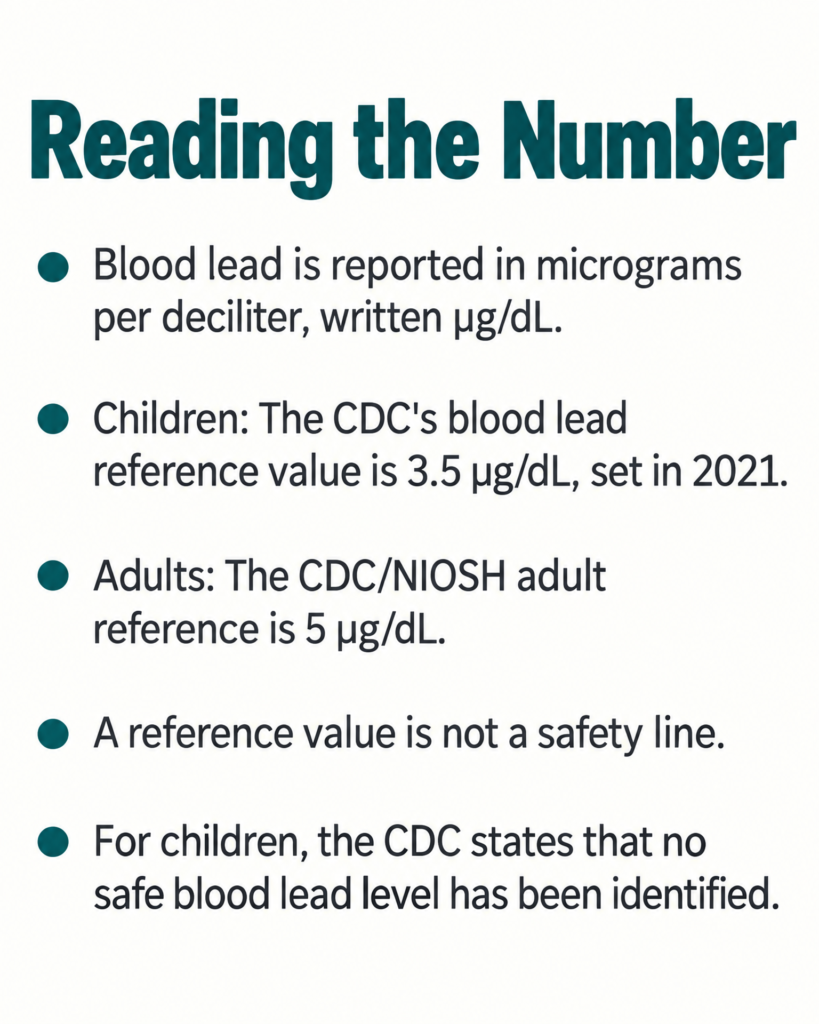
Blood lead is reported in micrograms per deciliter, written µg/dL. Here are the two reference values you’ll run into.
Children: The CDC’s blood lead reference value is 3.5 µg/dL, set in 2021. Adults: The CDC/NIOSH adult reference is 5 µg/dL.
Now the part people get wrong. A reference value is not a safety line. It isn’t a boundary where below is fine and above is a problem. It’s a statistical and public health tool: it marks the point at which a person’s level is higher than that of most people in the comparison group, and it tells health departments when to pay attention and follow up.
For children, the CDC states that no safe blood lead level has been identified. So a child’s result under 3.5 doesn’t mean lead is harmless at that level. It means the child’s level is below the point that triggers the standard public health response. It’s good news in a relative sense, but it isn’t a guarantee of zero risk.
Adults work the same way. A result under 5 is lower than the reference, not a certificate of safety. And a result over 5 doesn’t mean something is wrong with you in a way the number alone can describe. It means it’s time to ask where the lead is coming from and to talk with your doctor about follow-up.
So to go back to the opening question: whether 4 is bad or 2 is fine depends on who is being tested and what you do with the information. For a child, 4 sits above the reference value and warrants a source search. For an adult, it sits below the adult reference but is still lead in the blood, and context matters. Neither number tells you the whole story, and neither one is a pass.
Another practical point: a single number is a snapshot. Doctors often look at whether a level is rising or falling across repeat tests. A falling trend after you’ve removed a source is a good sign. A level that stays put suggests something is still feeding it.
What the Test Can’t Tell You
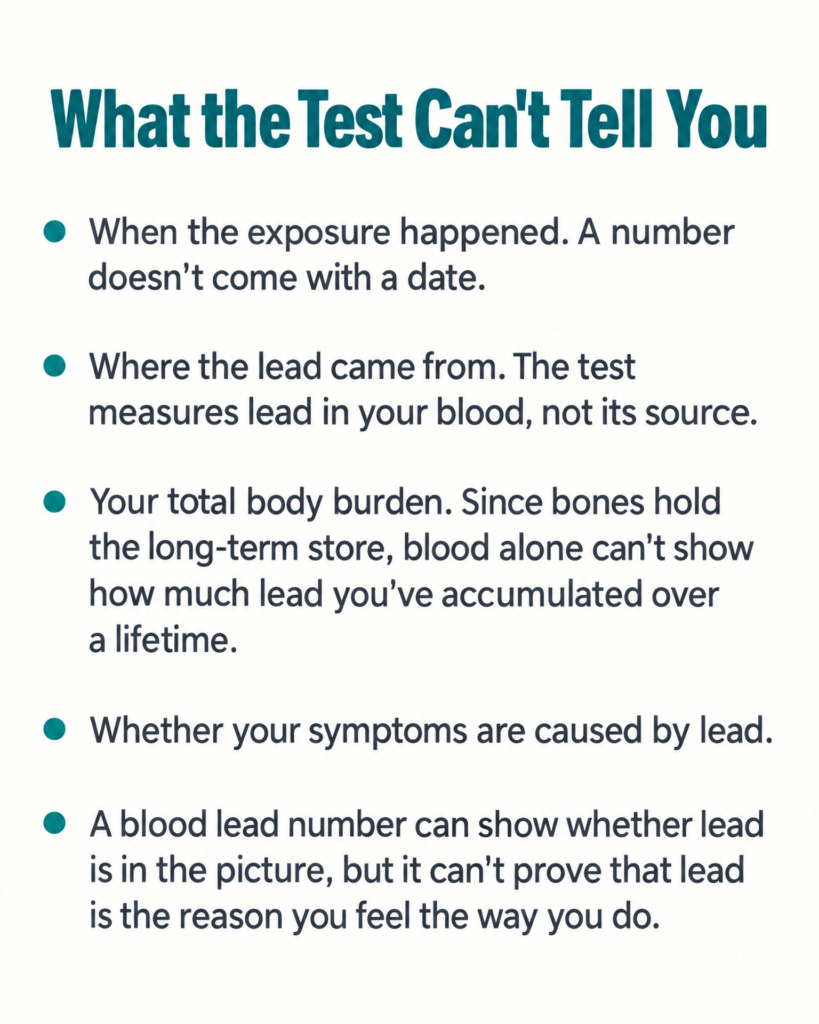
A blood lead test is useful, but people ask it to do jobs it can’t do. Here’s what it can’t tell you.
When the exposure happened. A number doesn’t come with a date. You can’t tell whether it came from last week’s renovation or a slow, steady source over months. Because blood reflects recent exposure, the number leans toward the recent, but it doesn’t pinpoint a moment.
Where the lead came from. The test measures lead in your blood, not its source. Paint, dust, soil, old plumbing, imported ceramics, certain traditional remedies or cosmetics, workplace materials, and hobby supplies can all contribute. The number is silent on which one it is.
Your total body burden. Since bones hold the long-term store, blood alone can’t show how much lead you’ve accumulated over a lifetime. Someone with a low blood level can still carry a significant bone reserve from the past. That matters especially around pregnancy, because lead stored in bone can be released during pregnancy.
Whether your symptoms are caused by lead. This is the big one. Fatigue, headaches, trouble concentrating, stomach trouble: these are common complaints with a long list of possible causes. A blood lead number can show whether lead is in the picture, but it can’t prove that lead is the reason you feel the way you do. A low result can help rule lead in or out as a contributor. A high result is a reason to investigate, not an answer on its own.
If fatigue is what’s driving your interest in testing, my breakdown of the broader question is in the companion piece linked at the end.
Who Should Get Tested
Not everyone needs a blood lead test, but some people have clear reasons to ask for one.
Kids in older housing. The federal ban on lead-based paint in housing came in 1978, so homes built before 1978 may have lead paint. As paint ages, it chips and turns to dust, and young children get that dust on their hands and then in their mouths. Children also absorb far more of the lead they swallow than adults do, which is why the focus on kids is so strong. If your child lives in or spends lots of time in a pre-1978 home, ask their pediatrician about testing.
Workers with exposure. Construction, renovation and demolition, painting and paint removal, battery work, metal recycling, auto repair, firing ranges, and some manufacturing can all involve lead. Workers in those settings are the people the adult reference value was built around. Hobbyists who cast bullets, make stained glass, or work with lead-containing materials belong on this list too.
Children (or adults) with pica. Pica is the habit of eating non-food items like dirt, paint chips, or plaster. If someone in your household does this, particularly in an older home, testing is a sensible step.
Pregnancy concerns. Because lead stored in bone can be released during pregnancy, anyone who is pregnant or planning a pregnancy, and who has had past exposure or lives or works around possible sources, should talk to their provider about whether testing makes sense.
If you fit any of these, bring it up at your next appointment. If you’re just curious with no exposure history, it’s a different conversation, and your doctor can help you weigh whether a test would tell you anything useful.
Straight Talk: A Number Starts a Source Hunt
I run ZeoliteForDetox.com, and here’s what I’d tell a friend holding that lab report: a result is the start of a source hunt, not a shopping trip.
If the number is elevated, the most valuable thing you can do is find and remove where the lead is coming from. That might be peeling paint, a renovation, a workplace habit, old plumbing, or a hobby. Work with your doctor and your local health department, who often have resources for inspecting homes. Until the source is dealt with, nothing else you do addresses the actual problem.
That’s the whole point of the test. It tells you to go looking.
Questions People Ask Me
Is a result below the reference value safe?
It’s reassuring, but not a guarantee. For children, the CDC says no safe blood lead level has been identified, so a number under 3.5 µg/dL means the child is below the point that triggers the standard public health response, not that lead carries zero risk. The same logic applies to the adult reference of 5 µg/dL.
My child’s finger-stick came back high. Should I be worried?
Take it seriously, but know the process. Lead dust on skin can contaminate a finger-stick sample and read falsely high, so elevated capillary results are confirmed with a venous draw. Schedule that follow-up promptly, and in the meantime, keep your child’s hands clean and look at likely dust sources around the home.
Can a blood test tell me how much lead is in my bones?
Not directly. Blood reflects recent exposure, while bones hold the long-term store. A blood test can hint at the picture, but it can’t measure the reserve. If you have a history of significant past exposure, especially with pregnancy in the picture, talk with your provider about what that means for you.
If my level is low, can I rule out lead as the cause of my symptoms?
A low blood level makes recent lead exposure a less likely explanation, which is useful information. But symptoms like fatigue have many possible causes, so a low result is one piece of a bigger workup. If you’re still feeling off, it’s worth discussing the full picture with your doctor.
Where to Go Next
If your result was part of a broader panel, or you’re trying to make sense of numbers beyond lead, start with understanding heavy metal test results, which covers how to read what other metals tests are and aren’t telling you. If you’re still deciding which kind of test fits your situation, the heavy metal testing overview lays out the options. And if fatigue is what sent you looking in the first place, heavy metals and fatigue walks through what’s plausible and what isn’t.
Recent Posts
You're standing in the water aisle, or scrolling a product page, and every box says some version of "reduces lead." The pitcher says it. The faucet attachment says it. The no-name filter at half the...
If you're pregnant, trying, or raising small kids, you've probably run into the headlines. Lead in this, arsenic in that, mercury in something you were told was healthy last year. Each one reads like...