

You’ve got the results in your hand, or open on a portal screen. There’s a column of numbers, a few flags in red or bold, and a reference range that may or may not mean what you think it means. Nobody walked you through it.
So you do what everyone does. You search the word “elevated” and land on a dozen pages that all sound alarming. Then you swing the other way and tell yourself it’s probably nothing, close the tab, and try to forget it. Neither one feels right, and you’re stuck between them.
That stuck feeling is what this article is for. I’m going to walk you through the questions that actually matter once results are in: what kind of test you took, whether the number needs confirming, how to hunt down where the exposure is coming from, who handles the medical side, and where supplements do and don’t belong. By the end, you’ll have an order of operations instead of a pile of worry.
Table of Contents
First: Which Test Did You Actually Take?
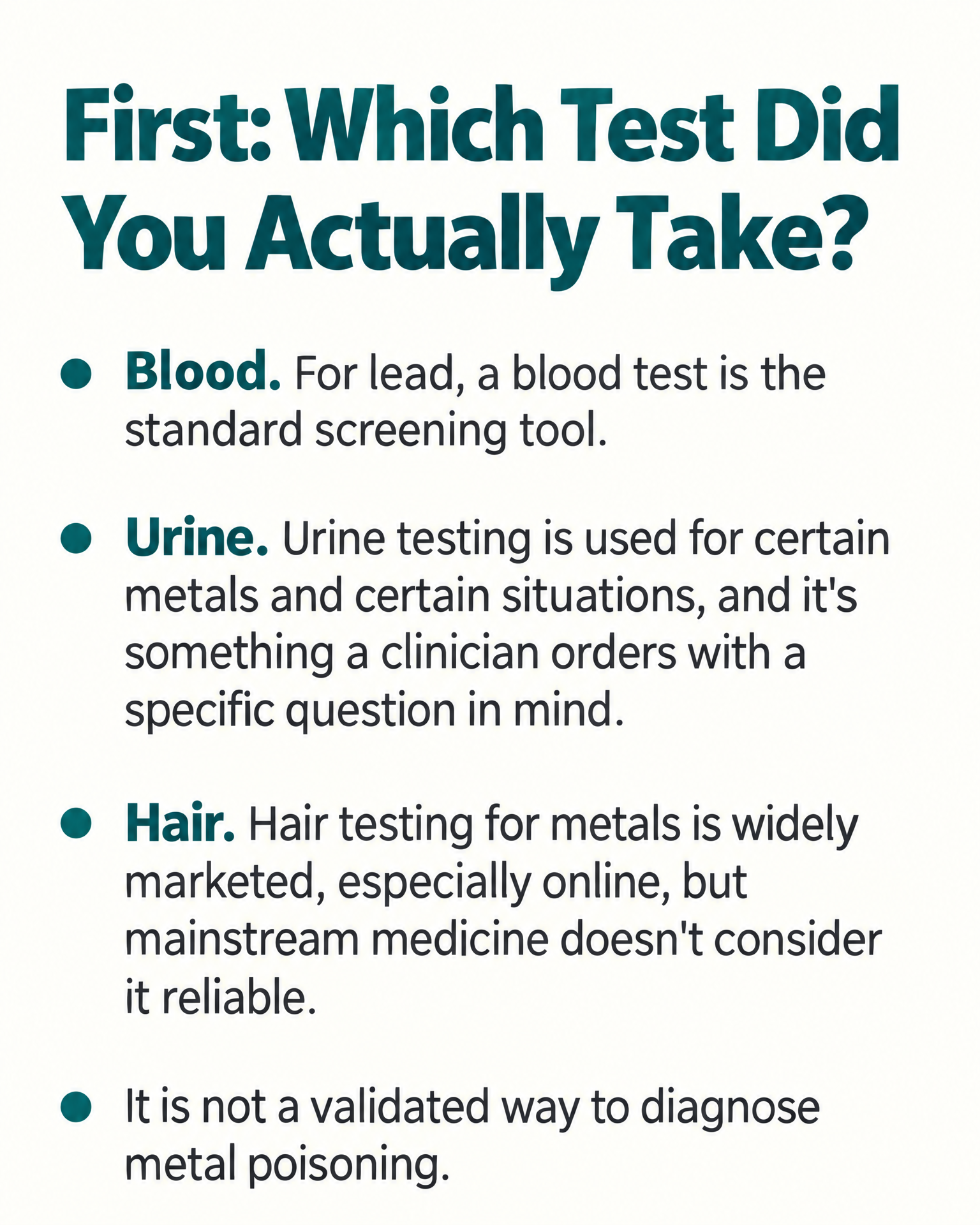
Before you read a single number, look at the top of the report and find out what kind of sample was tested. Blood, urine, and hair are not interchangeable. Each one tells a different story, and one of them barely tells a story at all.
Blood. For lead, a blood test is the standard screening tool. If you’re trying to learn whether lead is a concern, this is the test clinicians reach for. It reflects what’s circulating in your blood, which makes it most useful for recent or ongoing exposure.
Urine. Urine testing is used for certain metals and certain situations, and it’s something a clinician orders with a specific question in mind. A urine result from a standard collection can be meaningful. The trouble starts with how the sample was collected, which brings me to the next point.
Hair. Hair testing for metals is widely marketed, especially online, but mainstream medicine doesn’t consider it reliable. If your report came from a hair analysis, treat the numbers as a conversation starter at best, not a diagnosis. And it’s a poor reason to panic or to start buying things.
The “provoked” urine warning
Some practitioners give a chelating agent first, then collect urine afterward and compare it to a standard reference range. This is called provoked or challenge testing. It is not a validated way to diagnose metal poisoning. The agent pulls metals into the urine, so nearly anyone can look “high” afterward, and the reference ranges weren’t built for that situation.
If your report says “post-challenge,” “provoked,” or mentions a chelating agent was given before collection, those flagged numbers can’t tell you what you’re hoping they’ll tell you. Get a standard, unprovoked test through a clinician before drawing any conclusions.
Confirm Before You Conclude
A single number is a snapshot. Before you build a plan around it, make sure the snapshot is accurate.
Finger-stick results need a second look. Many lead screenings use a finger-stick (capillary) sample. Lead dust on the skin can contaminate that sample and make the reading come back falsely high. That’s why an elevated capillary result is confirmed with a venous draw, meaning blood taken from a vein. If your high result came from a finger prick, the very next step is that confirmation, not a spiral.
Repeat testing is normal. Clinicians often retest to see whether a result holds, rises, or falls. One reading tells you where you were on one day. Two or more start to show a direction, and direction is what matters most for deciding what to do.
Reference ranges differ. Different labs print different ranges, and the printed range isn’t always the same as a public health benchmark. For context, the CDC blood lead reference value for children is 3.5 µg/dL, and the CDC states that no safe blood lead level in children has been identified. For adults, the blood lead reference is 5 µg/dL (CDC/NIOSH). Those are reference points for acting and following up, not lines where “fine” flips to “emergency.”
So when you compare your number to the range on the printout, check which range the lab used and what population it was built for. A pediatric result read against an adult range, or the other way around, will mislead you.
Find the Source Before Anything Else
Here’s the part most people skip: if there’s an ongoing source, nothing else you do will matter much. You can’t get ahead of an exposure that keeps refilling the tank. Finding and stopping the source comes first.
Work through it in a sensible order, starting with where you spend the most time.
Home. Older housing is the classic suspect for lead, especially where paint is chipping, peeling, or getting disturbed by renovation. Dust from sanding, scraping, or demolition travels. Think about window sills, doors, and floors that take friction. Also consider old plumbing and fixtures.
Water. Drinking and cooking water can carry metals from pipes and fittings. If your home’s plumbing is older, or you’re not sure what it’s made of, water testing is a straightforward step and a good one.
Work. Some jobs bring metals home on clothes, boots, and hands. Construction, renovation, auto repair, metalwork, battery and electronics work, and similar trades are worth thinking through. If you work in one of those fields, ask about workplace exposure controls and how clothing and hands are handled before going home.
Hobbies. This one surprises people. Stained glass, soldering, pottery and glazing, shooting and ammunition handling, fishing weights, and restoring old furniture or antiques can all be exposure routes.
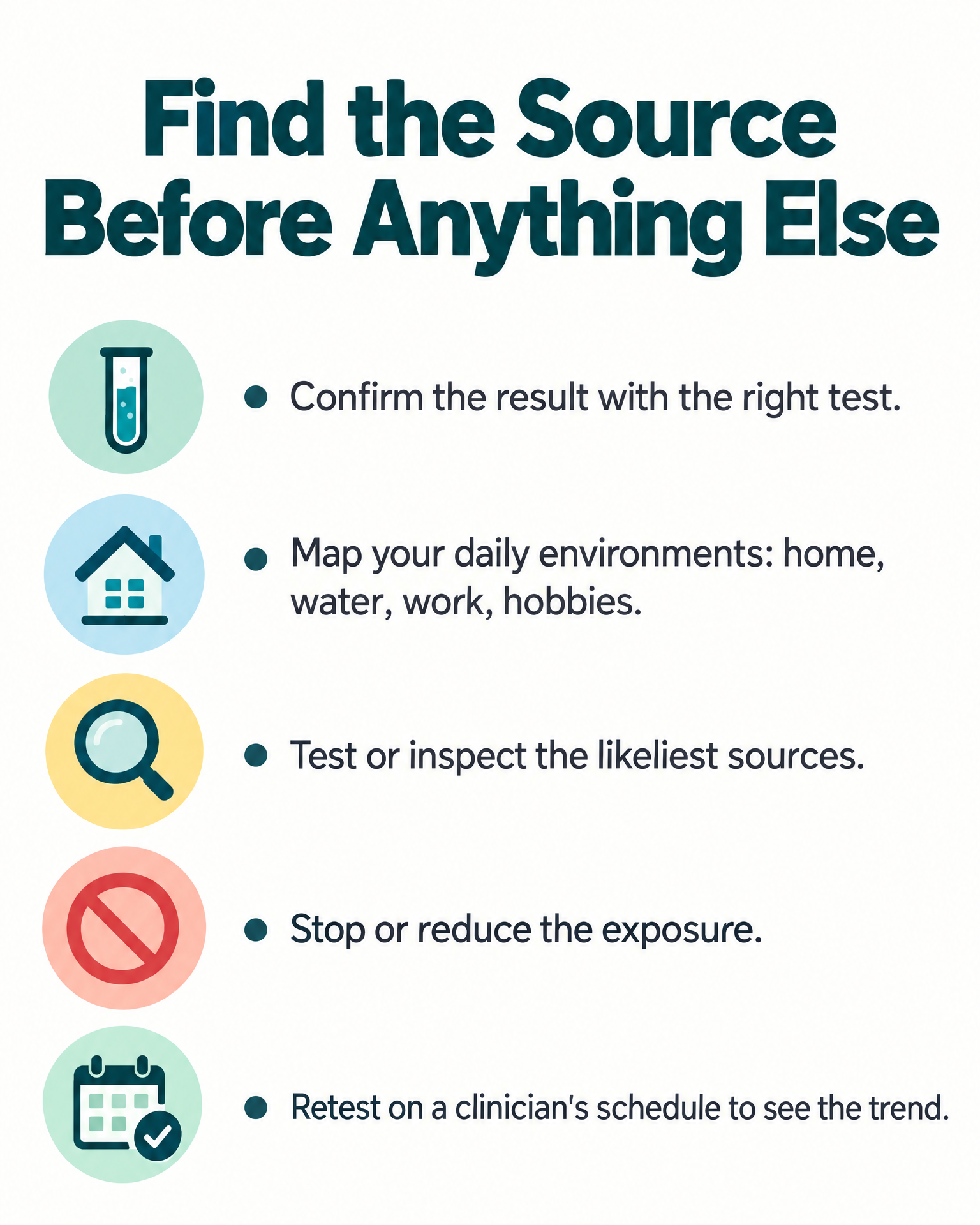
The order of operations:
- Confirm the result with the right test.
- Map your daily environments: home, water, work, hobbies.
- Test or inspect the likeliest sources.
- Stop or reduce the exposure.
- Retest on a clinician’s schedule to see the trend.
Notice that step one and step five are both testing, and the middle is detective work. That’s the real shape of this process.
The Medical Side Belongs With a Clinician
Once a result is confirmed, interpreting it and deciding what to do about it is clinical work. I’ll keep this general, because the details depend on the person, the metal, the level, and the circumstances.
At lower levels, clinicians commonly focus on finding and removing the source, reviewing diet and nutrition, and scheduling follow-up testing to see which way things are moving. That’s often the whole plan, and it works because removing the exposure lets the body’s levels come down on their own over time.
At higher levels, clinicians tend to get more involved: closer monitoring, a fuller look at symptoms and health history, additional workup, and in some cases specialist referral or poison-control consultation. Children and pregnant people get extra attention, since lead is stored in bone and can be released during pregnancy.
Chelation is a prescription medical therapy reserved for specific situations, directed by a clinician. It isn’t a casual add-on and certainly not something to self-direct based on a lab printout. If you’ve seen chelation talked about online and want the real picture of what it is and isn’t, here are the facts to know about chelation therapy.
Where Supplements Fit — and Where They Don’t
Nobody’s test result is a supplement prescription. A flagged number does not mean you need a particular product, and no lab report points to a specific capsule, powder, or drop.
The right order is source first, clinician second, and supplements, if you’re curious about them at all, a distant third. They’re not a substitute for finding the exposure, and they’re not a substitute for the follow-up your clinician sets up.
If you do get curious, hold any product to an evidence standard. Ask what was actually studied, in whom, and whether the claim being made matches what the research showed. Marketing language like “detoxes heavy metals” is easy to write and hard to back up. Learning what counts as good evidence for a detox supplement will make you much harder to sell to and much better at spotting the products worth a second look.
Be especially skeptical of anything pitched alongside a hair test or a provoked urine test. If the same company sells the test and the fix, the incentives are obvious.
Straight Talk: The Goal Is a Plan
I run ZeoliteForDetox.com, and I’ll say this plainly: the goal here isn’t a product. It’s a plan. A good plan looks like this: the source is found and removed, and your levels are trending down on follow-up tests. That’s the win.
If your results are sitting in front of you right now and they’re making you anxious, that’s a normal reaction, and it deserves a real conversation with a clinician who can look at your actual numbers, your history, and your situation. Bring the report, tell them what kind of test it was and how it was collected, and ask what they’d confirm, what they’d retest, and when. That conversation will do more for you than another hour of searching.
Questions People Ask Me
Does a high result mean I have heavy metal poisoning?
Not by itself. A high number needs context: what kind of test it was, how the sample was collected, whether it’s been confirmed, and what the reference range was built for. A finger-stick result, for example, can read falsely high from lead dust on the skin, which is why elevated results get confirmed with a venous draw.
Can I trust a hair test I ordered online?
Hair testing for metals is widely marketed, but mainstream medicine doesn’t consider it reliable. If something on a hair report worries you, take it to a clinician and ask about a standard blood or urine test instead.
What’s wrong with provoked urine testing?
The test involves giving a chelating agent and then measuring what comes out in urine. It isn’t a validated way to diagnose metal poisoning, because the agent itself drives metals into the urine and the comparison ranges weren’t designed for that. A standard, unprovoked test is the more meaningful route.
Should I start a detox supplement while I wait for more testing?
Waiting is the time to confirm the result and look for sources, not to start a product. If a source is out there, it matters far more than anything you could take. Bring any supplement questions to your clinician so they fit into the bigger picture.
What’s a “normal” blood lead level?
The CDC’s reference value for children is 3.5 µg/dL, and the CDC states that no safe blood lead level in children has been identified. For adults, the blood lead reference is 5 µg/dL (CDC/NIOSH). These are reference values used to trigger follow-up, so a number above them is a reason to look into the cause, not a reason to guess.
Where to Go Next
If your report is a blood lead result, the next read is our breakdown of blood lead test results, which goes deeper on what those numbers and ranges mean. If you’re still deciding whether testing makes sense for you, or which kind, start with when to get tested.
And if you’ve done the groundwork, meaning the result is confirmed, the source is handled, a clinician is in the loop, and you’re ready to evaluate products on your own terms, the zeolite supplement buying checklist shows you how to size one up before you spend a dollar.
Recent Posts
You're standing in the water aisle, or scrolling a product page, and every box says some version of "reduces lead." The pitcher says it. The faucet attachment says it. The no-name filter at half the...
If you're pregnant, trying, or raising small kids, you've probably run into the headlines. Lead in this, arsenic in that, mercury in something you were told was healthy last year. Each one reads like...