
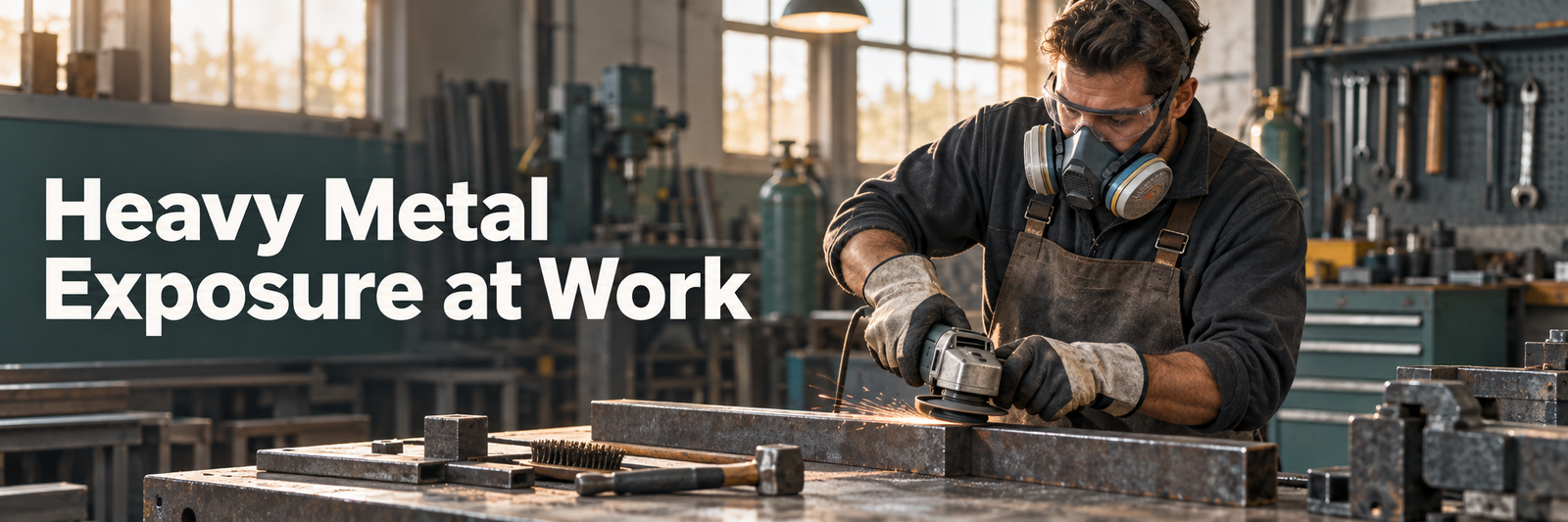
You come home with grit in the creases of your hands and a metallic taste you stopped noticing years ago. Your boots live by the door, your work jacket hangs on the same hook as everyone else’s coats, and nobody has ever asked what’s in the dust you breathe from seven to three.
Or maybe you’re not the one on the job. Maybe your spouse is, and their clothes go straight into the hamper with the kids’ laundry. Their truck seat is where your toddler’s snack ends up on the floor.
Most people in these situations never get the dots connected. Doctors ask about diet, sleep, and stress, but rarely about solder fumes, scrap yards, or the paint you scraped off a bridge last spring. So the workday stays invisible in the exposure picture, and the people most likely to be carrying a load are the ones least likely to be asked about it.
That’s what this article is for. I’m going to walk through which jobs put metals in the air and on the skin, which metals go with which trades, what the rules say your employer has to do, how work dust ends up at home, and what’s actually in your hands to change.
Table of Contents
The Jobs Where Exposure Is Part of the Shift
Some work simply comes with metal. Not as a freak accident, but as an ordinary part of the process. The classic list looks like this:
- Battery manufacturing and recycling
- Smelting
- Radiator repair
- Firing ranges
- Bridge and construction renovation and demolition
- Painting
- Plumbing
- Soldering
- Ceramics and stained glass
- Jewelry making
Look at that list and you’ll notice it isn’t all heavy industry. Yes, smelters and battery plants are on it. But so are the person at a hobby bench with a soldering iron, the glass artist, the jeweler, and the plumber working on older pipe. Some of these are full-time trades, and some are side work or weekend passions that happen in a garage with no ventilation.
What ties them together is the way metals travel: as fine dust, as fumes from heat, as residue on tools and surfaces, and as particles that land on skin and get carried to your mouth. Heating metal, grinding it, sanding old paint, cutting it, or tearing out old structures all put particles into the air that you can’t see and won’t smell.
If your job or hobby appears on that list, it’s worth taking seriously. If it doesn’t, but you work around metal dust, scrap, or old painted surfaces, the same logic applies.
The Metals by Trade
“Heavy metals” is a catch-all. At work, the useful question is which metal your trade actually puts in front of you. Here’s the practical mapping.
Lead
Lead is the big one for the occupational list. Battery manufacturing and recycling, smelting, radiator repair, and firing ranges are classic lead settings. Bridge and construction renovation and demolition bring it in through old paint and coatings. Painters stripping or sanding older surfaces run into it. Plumbers and solderers meet it through older pipe and solder materials. Stained glass work involves lead as well, and ceramics can bring it in through glazes.
Cadmium
Cadmium shows up in nickel-cadmium (ni-cad) batteries, in pigments, and in plating work. So battery work and anything involving colored pigments or metal finishing is where it tends to live. The thing worth knowing about cadmium is that it accumulates in the kidneys over decades. It’s a slow-build metal, which is exactly why it’s easy to overlook in a long career.
Mercury
Mercury comes in different forms: elemental, inorganic, and methylmercury. Elemental mercury is the silvery liquid you may remember from old thermometers, and it’s the form more likely to turn up in older equipment and facilities. Methylmercury is the form tied to the food side of exposure rather than a typical workshop. Which form you’re dealing with matters, because they behave differently in the body.
Arsenic
Arsenic is a metalloid that gets grouped in with the heavy metals, and it tends to come up in smelting and metal-processing settings. If you work around ore, smelter dust, or metal-processing byproducts, it belongs on your radar alongside lead and cadmium.
The takeaway: lead is the metal most strongly tied to the job list above, cadmium is the quiet accumulator in batteries, pigments, and plating, mercury depends on the form and the setting, and arsenic belongs to smelting-type work. Knowing your trade’s likely metals gives you something specific to ask about instead of a vague worry.
What OSHA Requires
Workers in covered industries aren’t supposed to be left guessing. In plain language, here’s the framework for lead in general industry.
Exposure limits. OSHA sets a permissible exposure limit for lead of 50 µg/m³, averaged over an 8-hour shift (an 8-hour time-weighted average). That’s the ceiling for how much lead should be in the air you breathe over a workday.
Action level. There’s also an action level of 30 µg/m³. Hit that, and certain employer duties kick in, including things like air monitoring and medical surveillance. Think of it as the tripwire that says the workplace has to start paying closer attention before reaching the limit.
Monitoring. Employers are expected to measure what’s actually in the air in areas where lead is a concern, rather than assuming it’s fine. If you’ve never seen air sampling results at your job and you work in a lead-related trade, that’s a reasonable thing to ask about.
Respirators. Where air levels can’t be brought down enough by other means, respiratory protection comes in. A proper respirator program isn’t just handing someone a mask. It involves the right type for the hazard and fit and use that actually works.
Blood lead checks. For covered workers, blood lead testing is part of the picture. A blood lead test is the standard screening tool for lead exposure, and it’s how both workers and employers see whether the controls on paper are working in real bodies.
You don’t need to memorize regulations. You need to know they exist, because “my employer never mentioned any of this” is a signal worth following up on.
The Take-Home Problem
Here’s the part that rarely makes it into a safety briefing: work doesn’t stay at work.
Dust settles on your clothes, in your hair, on your boots, on your hands, and on your tools. It rides home in the truck. It ends up on the car seat, the floor mats, the steering wheel, the entryway floor, and the laundry pile. Then it meets the people who are least equipped to handle it.
Children are the reason this matters so much. CDC has not identified a safe blood lead level in children. Kids also absorb far more of the lead they ingest than adults do, and hand-to-mouth behavior, which is simply what small children do all day, raises their exposure. A toddler crawling across a floor and then chewing on fingers is a very efficient way for fine dust to get from your boots into a small body.
This isn’t meant to make you feel guilty about your job. It’s meant to point out that the home is the second exposure site, and it’s one you have a lot more control over than the factory floor.
What You Can Actually Control
You may not be able to redesign your workplace’s ventilation. You can still change a lot of what comes home. Start here:
- Change at work if you can. Leave work clothes and shoes at the job, and put on clean ones before you get in your car. If your workplace has showers, use them before going home.
- Wash up before eating, drinking, or smoking. Hands carry dust to your mouth. Wash them well before breaks and meals, not after.
- Keep food and drinks out of work areas. Not on the bench, not in the truck bed, not in the dusty cab.
- Separate the laundry. Wash work clothes on their own, away from the family’s clothing. Don’t shake them out in the house.
- Leave boots at the door, or outside it. Better yet, keep a dedicated pair that never crosses the threshold.
- Keep the vehicle in mind. Work gear and the kids’ car seat shouldn’t share space. Wipe down surfaces that get dusty.
- Clean with wet methods. Wet wiping and HEPA-style vacuuming beat dry sweeping, which just throws fine dust back into the air.
- Ask for your records. If your workplace monitors air or tests blood, you can ask to see your results and the air monitoring data. Those records are the difference between guessing and knowing.
If you do hobby work at home, soldering, stained glass, pottery, or jewelry, treat your workspace like a small job site. Keep it away from living areas and kids, ventilate it, and clean it wet.
Straight Talk: High Numbers Are a Workplace Conversation
I run ZeoliteForDetox.com, and I’ll say this once, plainly: if a blood test or air monitoring result comes back high, that is a conversation with your employer and a clinician. It is not a supplement conversation.
The adult blood lead reference value from CDC/NIOSH is 5 µg/dL. If your number is at or above that, or your workplace air numbers are pushing the action level, the first questions are about the source: what’s in the job, what controls are failing, and what your clinician wants to do about it. Fix the exposure, get medical guidance, and bring in your employer where the job is the cause. Nothing else I write on this site changes that order.
Questions People Ask Me
Do I need to work in a factory to have occupational exposure?
No. Plumbers, painters, jewelers, stained glass artists, ceramicists, and people who solder at a hobby bench can all be exposed. Renovation and demolition work on older structures counts too. The job title matters less than what you’re cutting, heating, sanding, or handling.
How would I even know if I’m being exposed?
For lead, a blood lead test is the standard screening tool. Beyond that, ask whether your workplace does air monitoring and whether you can see the results. If you work in a trade on the classic list and nobody has ever tested anything, that’s reason enough to raise it.
Can my work really affect my kids?
Yes. Dust travels home on clothes, boots, hands, and in vehicles. Children absorb far more ingested lead than adults and put their hands in their mouths constantly, and CDC has not identified a safe blood lead level in kids. That’s why changing at work and separating laundry matter so much.
Is cadmium or mercury exposure handled the same way as lead?
The specifics differ. Cadmium, which turns up in ni-cad batteries, pigments, and plating, builds up in the kidneys over decades, so long careers matter. Mercury varies by form, with elemental mercury (like in old thermometers) behaving differently from methylmercury. If you work around either, ask your employer and clinician what applies to your specific setting.
Where to Go Next
If your workday put you on the list, the next useful step is understanding what testing can and can’t tell you. The heavy metal testing overview walks through the options in plain language, so you know what to ask for and what each test is actually for.
If you’ve already had a blood lead test, or you’re about to, the blood lead test results guide helps you make sense of the numbers, including how they compare to the reference values and what to bring to a clinician.
And if you came into this article without a clear picture of what heavy metals even are, start with what are heavy metals. It’s the foundation for everything else on the site, and it’ll make the rest of your reading click faster.
Recent Posts
You're standing in the water aisle, or scrolling a product page, and every box says some version of "reduces lead." The pitcher says it. The faucet attachment says it. The no-name filter at half the...
If you're pregnant, trying, or raising small kids, you've probably run into the headlines. Lead in this, arsenic in that, mercury in something you were told was healthy last year. Each one reads like...