
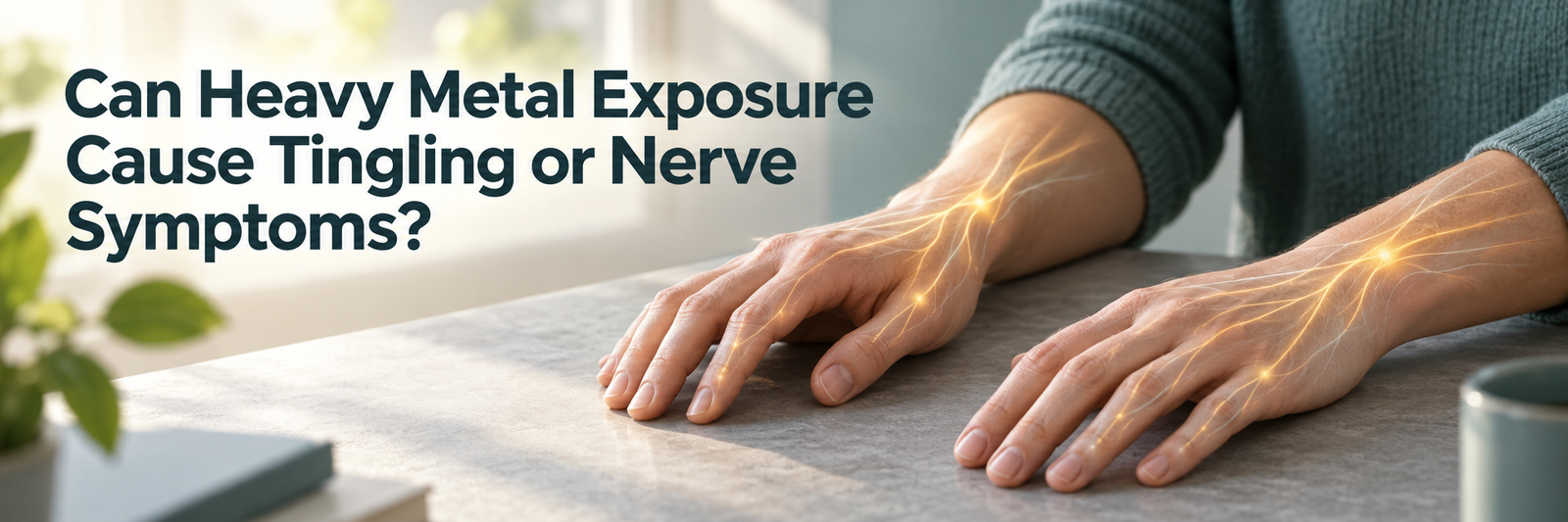
Your fingers buzz when you wake up. Or the soles of your feet burn at night, or there’s a patch of numbness that wasn’t there last month. You started searching for an explanation, and somewhere along the way you ran into the words “heavy metals.”
Now you’re stuck between two worries. One is that you’ll brush off something real. The other is that you’ll fixate on metals while the actual cause sits somewhere else, untouched. Both are reasonable fears, and the internet tends to feed both at once.
I run ZeoliteForDetox.com, and I wrote this article to sort that out. It’s meant to help you see where metals fit in the picture, where they don’t, and how to tell the difference without guessing. By the end, you’ll know what questions to ask yourself and what to do with the answers.
Table of Contents
Yes, Nerves Are on the List
Let’s start with what’s settled. Peripheral nerves, the long cables running out to your hands, feet, arms, and legs, can be damaged by heavy metals. That’s an established effect of significant exposure to lead, arsenic, and mercury.
The key word there is significant. The documented nerve problems come from real, meaningful exposure, the kind that shows up in workplaces, contaminated environments, certain poisoning events, or long-term sources that went unnoticed. These metals interfere with how nerve cells work and how they’re protected, and over time that can show up as sensation changes and weakness.
So the short version of your worry is legitimate: metals are a recognized cause of nerve symptoms. The more useful question is whether your situation looks like the kind where that applies.
What Metal-Related Nerve Trouble Tends to Look Like
Nerve trouble from metals has a recognizable shape, and it’s worth knowing what it is. Once you see the pattern, a lot of vague worry turns into something you can check against your own life.
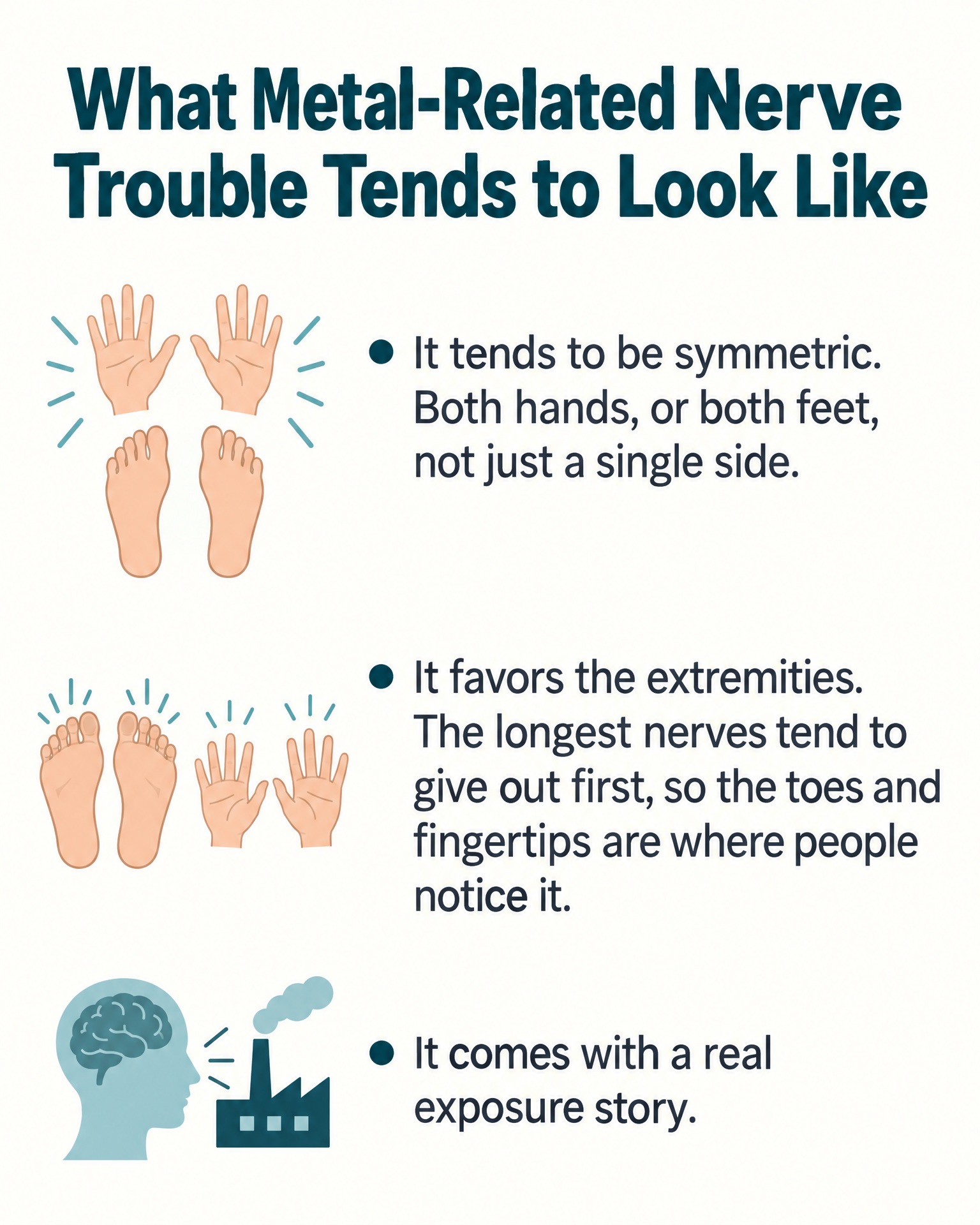
It tends to be symmetric. Both hands, or both feet, not just a single side. When the problem is body-wide, like a toxic exposure circulating in the blood, it usually reaches matching areas at the same time. Symptoms that show up on only one side, in a spot with no match on the other, tell a different story.
It favors the extremities. The longest nerves tend to give out first, so the toes and fingertips are where people notice it. The earliest signs are usually subtle: a faint tingling or pins and needles in the feet, a patch of numbness, a mild burning, or a feeling that your socks are bunched up when they aren’t. Plenty of people shrug that off at first. As things progress, the sensation tends to creep gradually upward from the toes and fingertips. That’s where the classic “wearing gloves and socks” description comes from. The odd feeling sits where gloves and socks would sit and fades above them. In more advanced cases, weakness can follow. Hands may feel clumsy, grip loosens, jars slip, and buttons and keys get fiddly. Walking can feel less steady, especially when your feet aren’t giving you good information about the ground.
It comes with a real exposure story. This is the piece people skip. Nerve symptoms tied to metals generally show up alongside a history that makes sense: years working with lead paint or batteries, soldering, metal recycling, or smelting; a private well with a known arsenic problem; an old home with deteriorating lead paint under renovation; or a documented source of mercury. Without something like that, the metals theory has very little to stand on.
Other symptoms can travel with it. Stomach complaints, tiredness, and trouble concentrating are frequently mentioned. If tiredness is part of what you’re dealing with, my piece on heavy metals and fatigue covers how that symptom fits in and why it’s so hard to pin on any one thing.
The Honest Problem: Tingling Has a Long List of Causes
Here’s where I want to slow you down, because this is where most people get led astray.
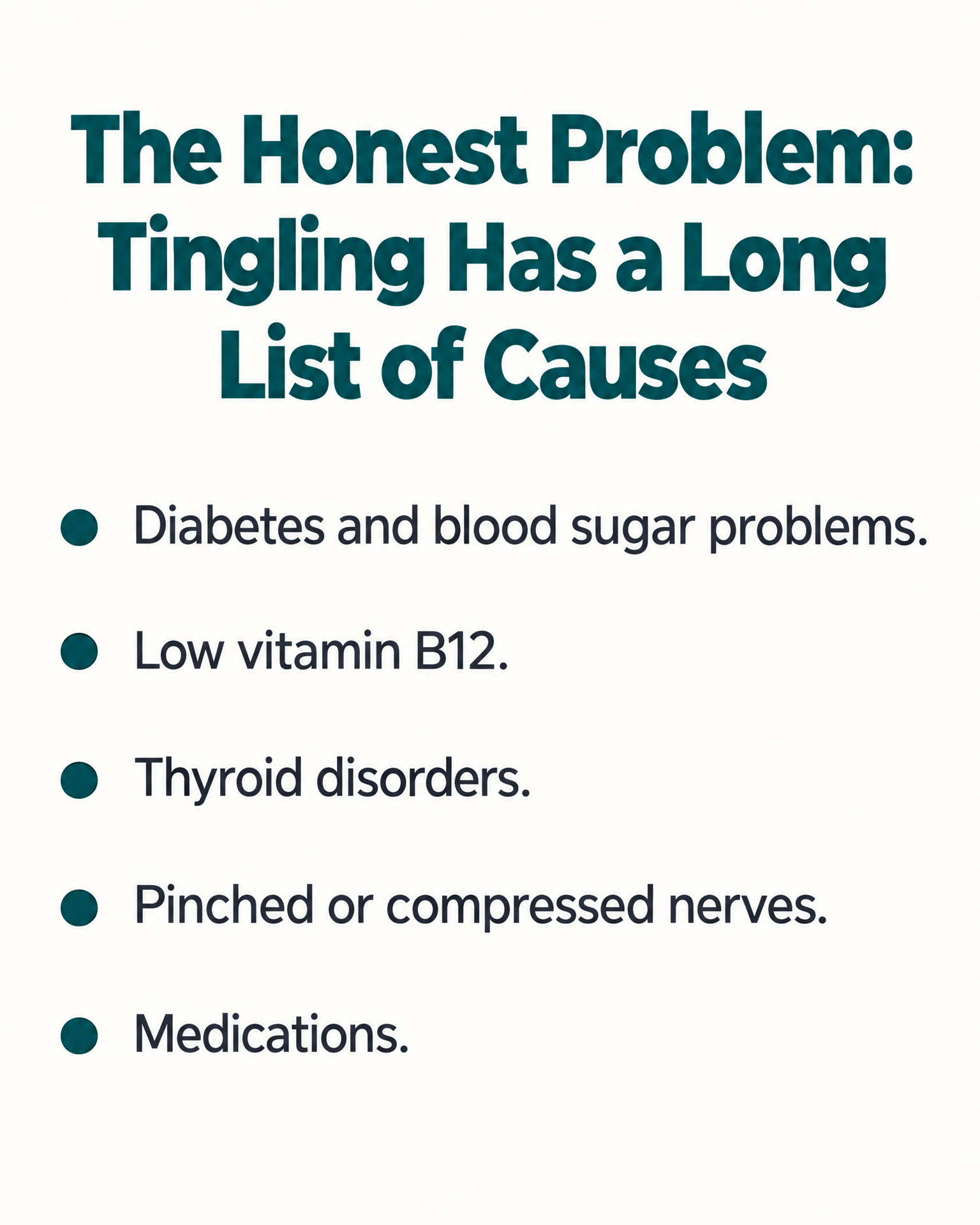
Tingling and numbness are some of the most common nerve complaints there are, and the list of things that cause them is long. Heavy metals are on it, but they’re far from the first suspect for most people. The usual culprits include:
- Diabetes and blood sugar problems. Nerve damage in the feet and hands is a well-known complication, and it often creeps in gradually.
- Low vitamin B12. Your nerves depend on it. When levels drop, tingling and numbness can be among the first signs.
- Thyroid disorders. An underactive thyroid in particular can affect nerves and cause sensation changes.
- Pinched or compressed nerves. Carpal tunnel at the wrist, a nerve irritated at the elbow, or a problem in the neck or lower back can all send tingling down an arm or leg.
- Medications. Some drugs list nerve symptoms as a side effect. If the tingling started after a new prescription, that timing is worth noting.
Notice that several of these are easy to check and easy to treat. That’s good news. It also means that if you assume metals and stop there, you could spend months on the wrong track while something fixable keeps going.
Pattern matters here too. Tingling in just your right hand, especially at night or after typing, points toward a compressed nerve far more than a body-wide toxic process. Symmetric tingling in both feet could be a lot of things, and diabetes and B12 are two the first lines of questioning will almost certainly cover.
Why Your Exposure History Matters More Than Symptom Matching
You can’t tell what’s causing nerve symptoms by how they feel. Burning feet from a metal problem and burning feet from a vitamin deficiency feel the same. That’s why the symptom list alone will never settle this, and why your history carries so much weight.
A useful exposure history comes down to dose, route, and timing.
Dose. Metals matter when the amount is meaningful. Trace background exposure that everyone has is a different situation from heavy, repeated contact. The nerve effects in the documented cases come from significant exposure, not from everyday life.
Route. How did it get in? Breathing dust or fumes at work, drinking contaminated water, swallowing paint chips or lead-contaminated soil, handling materials with bare skin, or using certain imported products or traditional remedies of uncertain origin. Knowing the route points you toward the source, and finding the source is half the battle.
Timing. When did the exposure happen, and when did the symptoms begin? Did the tingling start after a renovation, a job change, or a move? Or has it been there for years with no change in your surroundings? A clear timeline can make a connection plausible, and a lack of one is informative too.
Here’s what the contrast looks like. Picture someone who spent months stripping old paint in an older house, sanding in a closed-up room with no respirator, and whose tingling feet showed up during that stretch. Now picture someone in a newer home on city water, with no unusual work or materials in their life, whose symptoms have drifted along unchanged with no link to anything. The first story gives you something to follow. The second gives the metals theory almost nothing to hold onto.
Don’t forget the exposures that don’t feel like exposures. Hobbies and second jobs get left off the list all the time because they’re fun or occasional: stained glass, soldering electronics, pottery and glazes, refinishing furniture, casting fishing weights or ammunition, or a weekend side gig in a workshop or garage. Count them.
Write all of this down while it’s fresh: jobs, hobbies, the age of your home, your water source, and anything unusual you’ve been handling or ingesting. It’s some of the most valuable information you can have on hand.
How You Actually Check
Guessing is what got you here. Checking is how you get out.
If lead is your concern, the standard screening tool is a blood lead test. It’s a simple blood draw, widely available, and it’s the established way to see whether lead is a factor. For adults with a plausible lead exposure, it’s a sensible first step.
For everything else, the right path is a workup with a clinician. That means a conversation about your symptoms and history, a physical exam that includes checking sensation, strength, and reflexes, and bloodwork that looks at the common causes: blood sugar, B12, and thyroid function among them. If the picture points toward a nerve being compressed, that’s evaluated too. If your history suggests arsenic or mercury, a clinician can decide what testing fits, since the right test depends on the metal, the timing, and the kind of exposure.
Testing for metals is a topic with real nuance, and what’s worth doing depends on your circumstances. I lay out the decision in when to get tested for heavy metals, which is worth a read before you book anything.
The biggest advantage of this approach is that it covers all your bases at once. You’re not betting on one theory. You’re ruling things in and out, and that’s how you land on an answer you can trust.
Straight Talk
If your numbness or tingling is new, getting worse, or comes with weakness, get in front of a clinician promptly. Don’t wait until you’ve finished your own research, and don’t wait for a metals test result to decide it’s time. Nerve symptoms are easier to deal with when they’re caught early, whatever the cause turns out to be.
That’s the one piece of advice I’d push hardest. Everything else in this article is about helping you think clearly. This is about not sitting on something.
Questions People Ask Me
Can low-level everyday exposure to metals cause tingling?
The nerve damage that’s well documented comes from significant exposure. Ordinary background contact is a very different thing, and it isn’t the usual explanation for tingling in the hands and feet. If you have a specific, heavier source in your history, that changes the conversation.
Would it affect just one hand or foot?
Metal-related nerve trouble tends to be symmetric, affecting both sides in matching places. Symptoms confined to one hand or one limb more often suggest a local issue like a compressed nerve. A clinician can sort out which you’re dealing with.
Should I just get a heavy metal panel to be safe?
I’d start with your history and a visit to a clinician, who can pick tests that make sense for you. A blood lead test is the standard tool if lead is a real possibility. Running broad panels without a reason to suspect exposure can create confusion rather than clarity.
Does this matter more for children?
Children are more vulnerable to lead, and the CDC has not identified a safe blood lead level in kids. Their reference value is 3.5 µg/dL. This article focuses on adults, but if you’re worried about a child’s exposure, bring it to their pediatrician.
Where to Go Next
If you’ve decided testing makes sense, start with when to get tested for heavy metals to figure out what’s appropriate for your situation. Once you have numbers in hand, understanding heavy metal test results will help you read them without panic or false comfort.
And if you’ve worked through the steps above and you’re ready to evaluate products, my zeolite supplement buying checklist shows you what to look for and what to skip.
Recent Posts
You're standing in the water aisle, or scrolling a product page, and every box says some version of "reduces lead." The pitcher says it. The faucet attachment says it. The no-name filter at half the...
If you're pregnant, trying, or raising small kids, you've probably run into the headlines. Lead in this, arsenic in that, mercury in something you were told was healthy last year. Each one reads like...