
Another recall notice lands in your inbox or your feed. Lead in a toy. Lead in kids’ jewelry. A brand name you may or may not recognize, a photo of a product that looks a lot like something in your playroom.
So you start looking around the house. The painted wooden blocks from a yard sale. The metal charm bracelet from a party favor bag. The hand-me-down truck that’s been through three kids. Suddenly everything looks suspect, and you’re stuck between two bad options: throw out half the house, or shrug and hope for the best. Neither feels right, and guessing wrong in either direction feels bad.
I run ZeoliteForDetox.com, and this is the article I wish more parents had in hand when those headlines hit. It sorts the rules from the real-world gaps, shows you which items keep turning up in recalls, and gives you a short, workable list of things to look at in your own home. By the end, you’ll know where to look and where to stop looking.
Table of Contents
Why Kids Are the Focus
Children aren’t just smaller adults, and when it comes to heavy metals the difference is large.
Start with behavior. Small kids put things in their mouths. Toys, keys, jewelry, the edge of a windowsill, their own fingers after crawling across the floor. Mouthing is how they explore the world, and it’s a normal stage of development. It also means any metal in or on an object has a direct route into the body. Hand-to-mouth behavior adds to it. A child who plays with something, then eats a snack without washing up, can take in whatever was on their hands.
Then there’s the body itself. Children absorb far more of the lead they ingest than adults do. And because their brains and bodies are still developing, the stakes of that exposure are higher. That’s why the CDC has identified no safe blood lead level in children. The goal isn’t to hit some acceptable number. It’s to keep exposure as low as reasonably possible.
That’s the whole reason toys and kids’ products get so much regulatory and media attention. It’s not that every toy is dangerous. Kids are the group where small sources matter most, so a sensible approach is to know which sources are worth your attention.
The Rules on Paper: What CPSIA Actually Guarantees
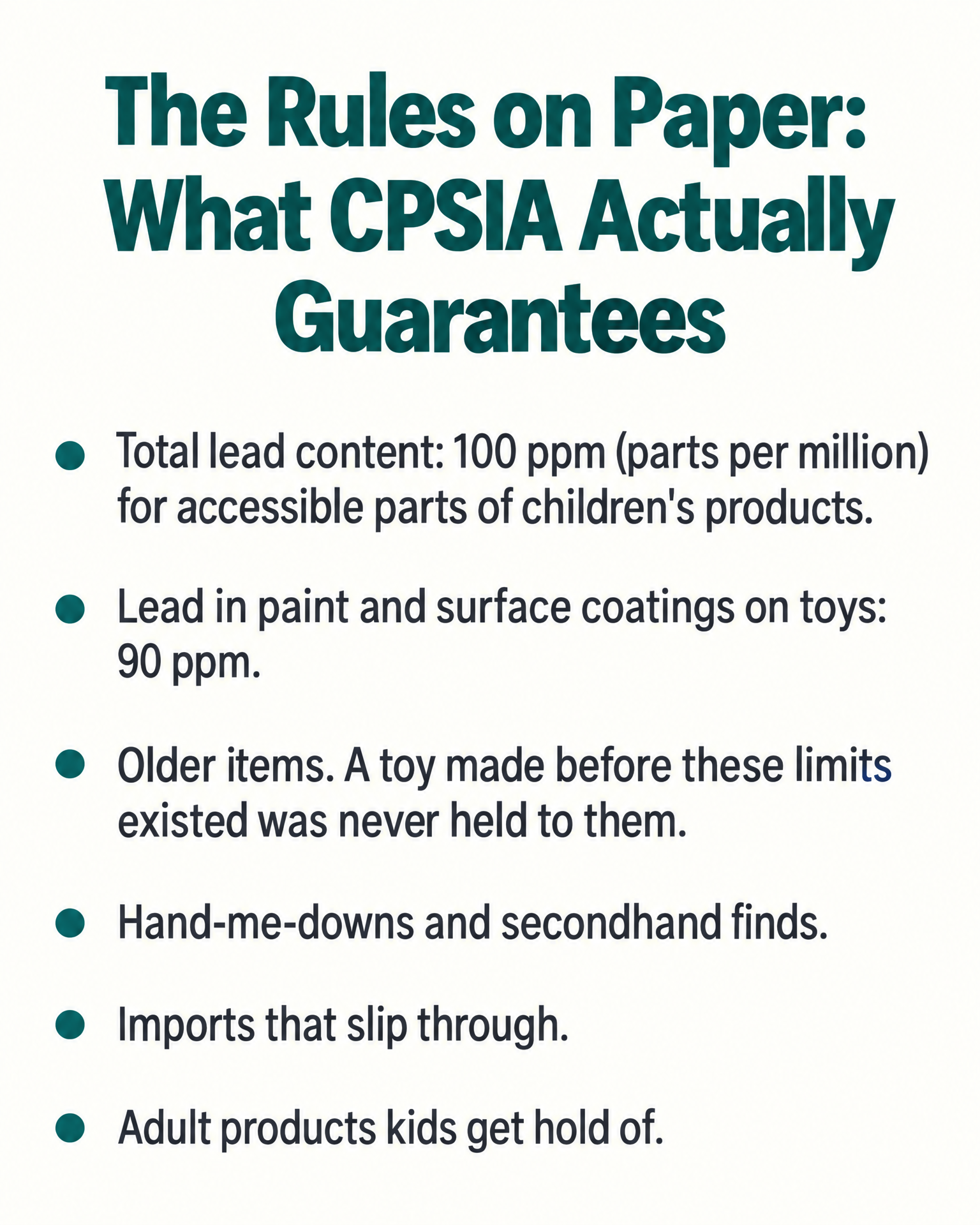
In the United States, the main federal rulebook for this is the Consumer Product Safety Improvement Act, usually shortened to CPSIA. It sets hard limits on lead in children’s products:
- Total lead content: 100 ppm (parts per million) for accessible parts of children’s products.
- Lead in paint and surface coatings on toys: 90 ppm.
“Accessible parts” simply means the parts a child could touch, mouth, or swallow pieces of during normal use or reasonably foreseeable misuse. Those are strict limits, and they apply to products designed or intended primarily for children. A new toy from a legitimate manufacturer, sold through normal retail channels, is built to meet them and goes through required testing and certification.
That’s the good news, and it’s real. The framework works, and new, compliant children’s products are a much safer bet than the same categories used to be.
Here’s what the rules don’t reach:
- Older items. A toy made before these limits existed was never held to them. Age doesn’t make it unsafe by default, but it means there’s no guarantee behind it.
- Hand-me-downs and secondhand finds. These carry the history of when and where they were made, which you often can’t see.
- Imports that slip through. Products sold through informal channels, flea markets, or third-party sellers can bypass the system. Not every item sold to American families went through the testing the law requires.
- Adult products kids get hold of. The limits are written for children’s products. A pair of adult costume earrings, a set of keys, or a decorative brass item isn’t held to the same standard, but a toddler will still put it in their mouth.
So the rules protect you well where the rules apply. The work is in knowing the places they don’t.
The Recurring Offenders
Recall notices from the Consumer Product Safety Commission (CPSC) can feel random, but they aren’t. The same themes keep coming back, and knowing them is what turns a vague worry into a watchlist.
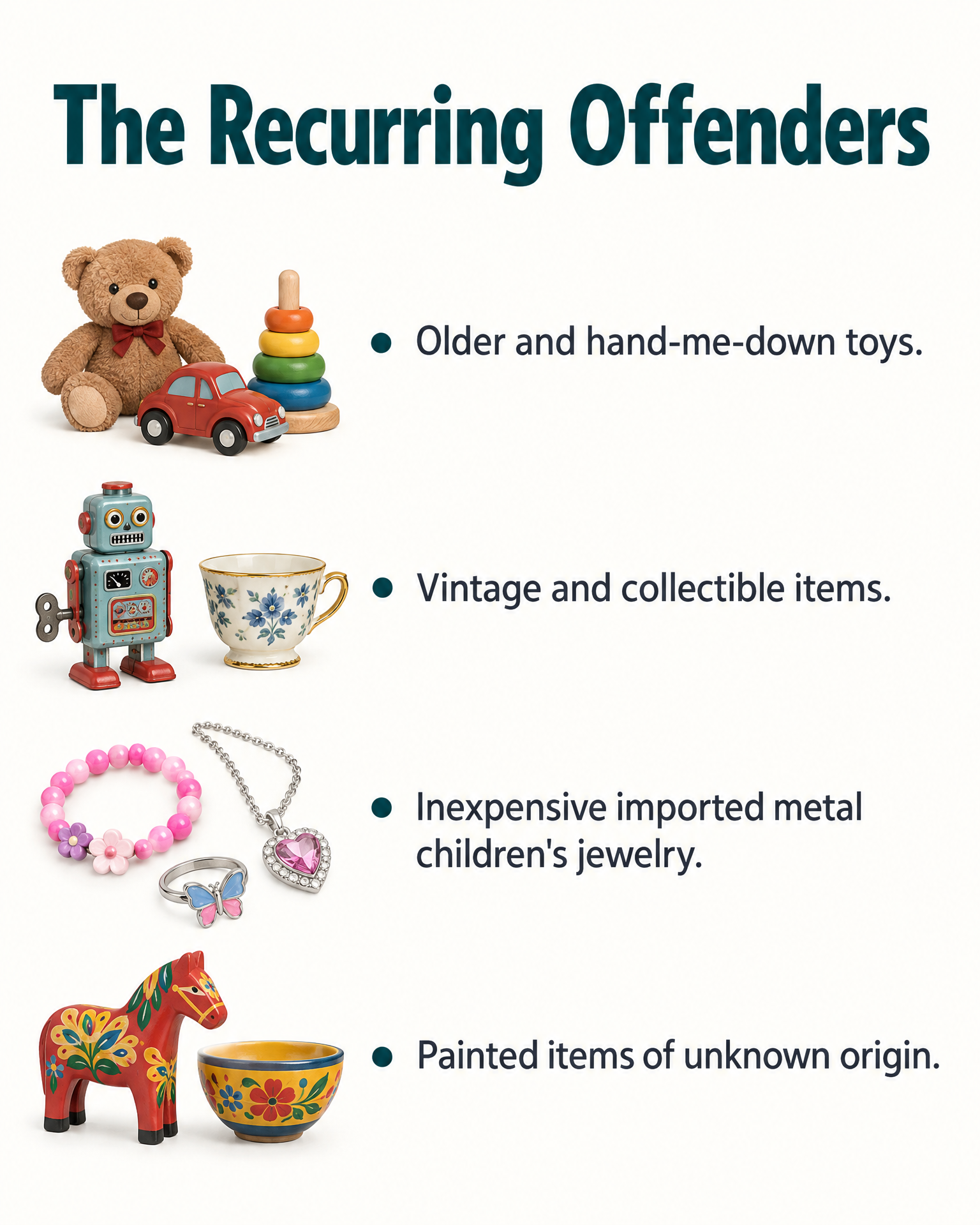
Older and hand-me-down toys. This is one of the most consistent recall themes. Toys that have been stored in basements, passed between families, or pulled from a grandparent’s attic were made under different rules or none at all. Painted toys in particular can carry old coatings that wouldn’t pass today.
Vintage and collectible items. Antique toys, die-cast metal pieces, old painted figures, and nostalgic items are made to be admired, not mouthed. If a collectible is on a low shelf where a small child can reach it, it’s functioning as a toy whether you meant it to or not.
Inexpensive imported metal children’s jewelry. This is the other big recurring theme. Cheap charm bracelets, pendants, rings, and novelty jewelry made with low-cost metal alloys have shown up in recalls again and again. These items are small, shiny, and appealing, and they often end up in a child’s mouth. Metals other than lead, such as cadmium, have turned up in this category too.
Painted items of unknown origin. A hand-painted wooden toy, a decorative trinket, a souvenir with no label, a craft-fair item with no manufacturer information. When you can’t tell who made it or what’s in the paint, you can’t tell whether it meets any standard at all.
Notice the pattern. These aren’t the mainstream, boxed, brand-name toys on a store shelf. They’re items with unclear age, unclear origin, or unclear materials. That’s the key filter: uncertainty about where something came from is the real risk factor.
Beyond the Toy Box: Heavy Metals Around the House
Some of the most overlooked sources aren’t toys at all. They’re ordinary household objects that a curious child can reach and mouth.
Keys and brass items. Many keys and brass fixtures are made from alloys that can contain lead. Kids love keys. A set of keys handed over to quiet a fussy baby is a classic move, and a better choice is a toy that was actually made to be chewed on.
Adult costume jewelry. Fashion jewelry made for adults isn’t held to the children’s product standard. A dress-up box that includes grown-up bangles and necklaces is worth a second look.
Some ceramics and glazes. Certain ceramic dishes, mugs, and decorative pieces, especially handmade, antique, or imported ones with decorative glazes, can contain lead in the glaze. Pieces meant purely for decoration are the ones to keep away from food and from small hands.
Fishing weights. Lead sinkers and similar tackle are small, heavy, and easy to pick up. If someone in your house fishes, keep that gear stored where kids can’t reach it, and handle it away from the kitchen and play areas.
Old-stock mini blinds. Older vinyl mini blinds have been a known source of lead dust as they age and degrade. If you have blinds that have been hanging a long time, or you’ve picked up old stock, that’s one to be aware of, especially where kids play near windows.
You’ll notice what these items have in common with the toy offenders. They’re older, they’re informal, or they were never designed with a child in mind. That’s the connection worth keeping.
Practical Habits That Cover Most of It
You don’t need a lab or a complicated system. A handful of routines handle most of the realistic risk.
Check the CPSC recalls. The CPSC publishes recall notices, and you can look up a specific product by name. If a headline catches your eye, search for the item you own rather than guessing. Signing up for recall alerts is a low-effort way to stay current without scrolling the news.
Retire what’s suspect. If a toy is on a recall list, remove it. If an item is cracked, flaking, chipping, or peeling paint, it’s time to let it go. Don’t pass it along to another family or donate it.
Wash hands after play. This is the habit that does the most work. Rinsing a child’s hands after play, and especially before eating, cuts down on what gets from surfaces to mouths. It also covers dust and dirt you can’t see.
Keep adult items out of reach. Keys, costume jewelry, fishing tackle, decorative metal pieces, and craft supplies belong up high or behind a closed door. If a child can reach it, assume it will end up in their mouth.
Be choosy about secondhand painted and metal items. Secondhand is fine for plenty of things, such as board books, stuffed animals, and plastic building sets from reputable makers. The ones to think twice about are older painted toys, metal toys of unknown origin, and any jewelry that came without a label or a maker.
Buy from sellers who stand behind their products. Established retailers and manufacturers that provide certification and contact information are going to be easier to trace if a problem comes up than a seller you can’t identify.
That’s the list. It’s short on purpose.
Straight Talk: A Short Watchlist, Not a Purge
Here’s the part I most want you to take away. Recalls are the system working. When the CPSC announces that a product has lead in it, that means someone tested it, found the problem, and got it pulled. That’s a good outcome, and it’s far better than not knowing.
The goal isn’t to empty the playroom. It also isn’t to look at every object in your house as a potential hazard. That kind of constant suspicion wears you out, and it doesn’t make your kids any safer. What helps is a short watchlist of the known repeat offenders: older and hand-me-down toys, inexpensive imported metal jewelry, painted items of unknown origin, and the household objects kids tend to grab, like keys and adult jewelry. Check those, deal with what needs dealing with, and let the rest go.
If you have a specific worry about a particular child, such as a known exposure or a product they’ve been chewing on for a while, that’s a conversation for your doctor, who can talk through whether testing makes sense. For everything else, a watchlist and a few habits will carry you a long way.
Questions People Ask Me
Are new toys from regular stores safe?
New children’s products from established retailers are made to meet the federal limits: 100 ppm total lead for accessible parts, and 90 ppm for paint and surface coatings on toys. That doesn’t make every product perfect, which is why recalls happen, but it makes the mainstream toy aisle a much lower-risk place than a pile of old or unlabeled items.
Should I throw away all my kids’ older toys?
No. Go through them with the watchlist in mind. Pay attention to painted toys, metal toys, and anything with peeling or chipping paint, and anything you can’t trace. Plain items like wooden blocks without paint, fabric toys, and books don’t fit the recurring recall themes.
How do I find out if a specific toy has been recalled?
Search the product name on the CPSC’s recall pages. If the item has no brand or label, that’s a signal in itself. When you can’t identify where something came from, treat it with the same caution you’d give a product that’s been recalled and put it out of a young child’s reach, or retire it.
Is it a problem if my child chewed on a key or a piece of jewelry once?
A single moment of mouthing is very common, and the practical response is simple: take the item away, wash hands, and keep it out of reach from then on. If you’re concerned about repeated exposure or a product you know contains lead, bring it up with your pediatrician.
Do I need to worry about ceramics and dishes?
It’s worth knowing which ones are the usual suspects: antique, handmade, or imported pieces with decorative glazes, particularly ones sold as decorative rather than food-safe. Reserve those for display, and use ordinary, clearly food-safe dishes for kids.
Where to Go Next
If your concern reaches beyond toys and into the bigger picture of how children are exposed to metals, the pregnancy and childhood exposure guide covers how these exposures happen at the stages when they matter most. For the rest of the house, the home toxin-reduction checklist walks through room-by-room changes that fit into normal life. And if your home has some age on it, lead paint and dust in older homes explains one of the most significant sources of lead for kids, and what to do about it.
When you’re ready to evaluate products, those guides are the place to start, because they’ll help you decide what you actually need before you look at anything else.
Recent Posts
You're standing in the water aisle, or scrolling a product page, and every box says some version of "reduces lead." The pitcher says it. The faucet attachment says it. The no-name filter at half the...
If you're pregnant, trying, or raising small kids, you've probably run into the headlines. Lead in this, arsenic in that, mercury in something you were told was healthy last year. Each one reads like...