

If you’re pregnant, trying, or raising small kids, you’ve probably run into the headlines. Lead in this, arsenic in that, mercury in something you were told was healthy last year. Each one reads like a new thing to worry about, and none of them tells you how much it applies to your kitchen, your house, or your kid.
The real cost of all that noise is that it blurs the picture. When every metal feels equally urgent, the few things you can actually control get buried under the many you can’t. You end up anxious in general and unsure what to do in particular.
Here’s the more useful way to see it: the list of controllable sources is short and knowable. This article lays out which risks are real, which are uncommon, and which handful of things are in your hands, so you can do them and move on.
Table of Contents
Why This Window Matters
Pregnancy and early childhood are the periods when the brain and body are being built. Systems that will last a lifetime are forming quickly, which is why health agencies pay closer attention to exposures in this window than at any other point.
Lead is the metal that gets the most attention here, for a few specific reasons.
Lead crosses the placenta. What a mother is exposed to can reach the baby during pregnancy.
Lead can be stored in bone. Lead that entered the body years earlier can settle in a mother’s bones and be released during pregnancy. That’s one reason clinicians ask about past exposure, such as an older childhood home or a past job, as well as current sources.
Young children absorb far more of the lead they swallow than adults do. A toddler and an adult can take in the same amount, and the toddler’s body will take up much more of it.
Hand-to-mouth behavior raises exposure. Small kids crawl, touch the floor, touch the windowsill, and put their hands in their mouths. Dust and dirt end up inside them without anyone noticing.
None of this means every pregnancy or every toddler is at risk. It means the window deserves a little attention up front, because small, ordinary changes made early do the most good. The next section shows how few of those changes there are.
The Short List of Controllable Sources
When you cut through the noise, the sources you can do something about fit on one hand. Five things cover most of it.
1. Drinking water. Lead gets into tap water mostly from old pipes, fittings, and fixtures inside buildings, not from the water source itself. If your home is older, or you aren’t sure what your plumbing is made of, find out. Your water utility can tell you what they know, and testing the water at your tap is a straightforward way to replace guessing with an answer. If you’re mixing infant formula with tap water, this one matters most.
2. Paint dust in homes built before 1978. The federal ban on lead-based paint in housing came in 1978, so homes built before then may have lead paint somewhere in them. Intact paint that’s left alone is generally not the issue. The trouble starts when paint is disturbed: sanding, scraping, renovating, or old windows and doors that grind paint into dust every time they open and close. That dust settles on floors and sills, right where kids play. If you’re expecting or have little ones, renovation in an older home is something to hand off to a professional rather than take on yourself.
3. Job and hobby dust that comes home. Some work and hobbies put metal dust on skin, clothes, and shoes: renovation and painting, auto repair, battery work, soldering, stained glass, and target shooting, to name a few. The dust itself isn’t the whole story. The ride home on clothing is how it reaches a nursery or a toddler’s play space. Changing clothes and shoes before you walk into the living areas, and washing work clothes apart from the family laundry, takes care of most of it.
4. Fish choices. Mercury in fish is real, and it’s also very manageable. There’s a clear, short list of fish to skip, covered in the next section.
5. Rice-heavy diets. Rice and rice-based foods are a source of arsenic, and inorganic arsenic is the form of concern. This only becomes a consideration when rice dominates the diet, for example when rice is the main grain at nearly every meal, or rice-based snacks and cereals are the daily default for a toddler. The fix is variety. Rotate in other grains like oats, barley, quinoa, and wheat-based foods, and rice goes back to being one food among many.
That’s the list: water, paint dust, dust from work and hobbies, a few fish, and variety in grains. Almost everything else you’ll read about is either rare, outside your control, or a smaller piece of the picture than it’s made to sound.
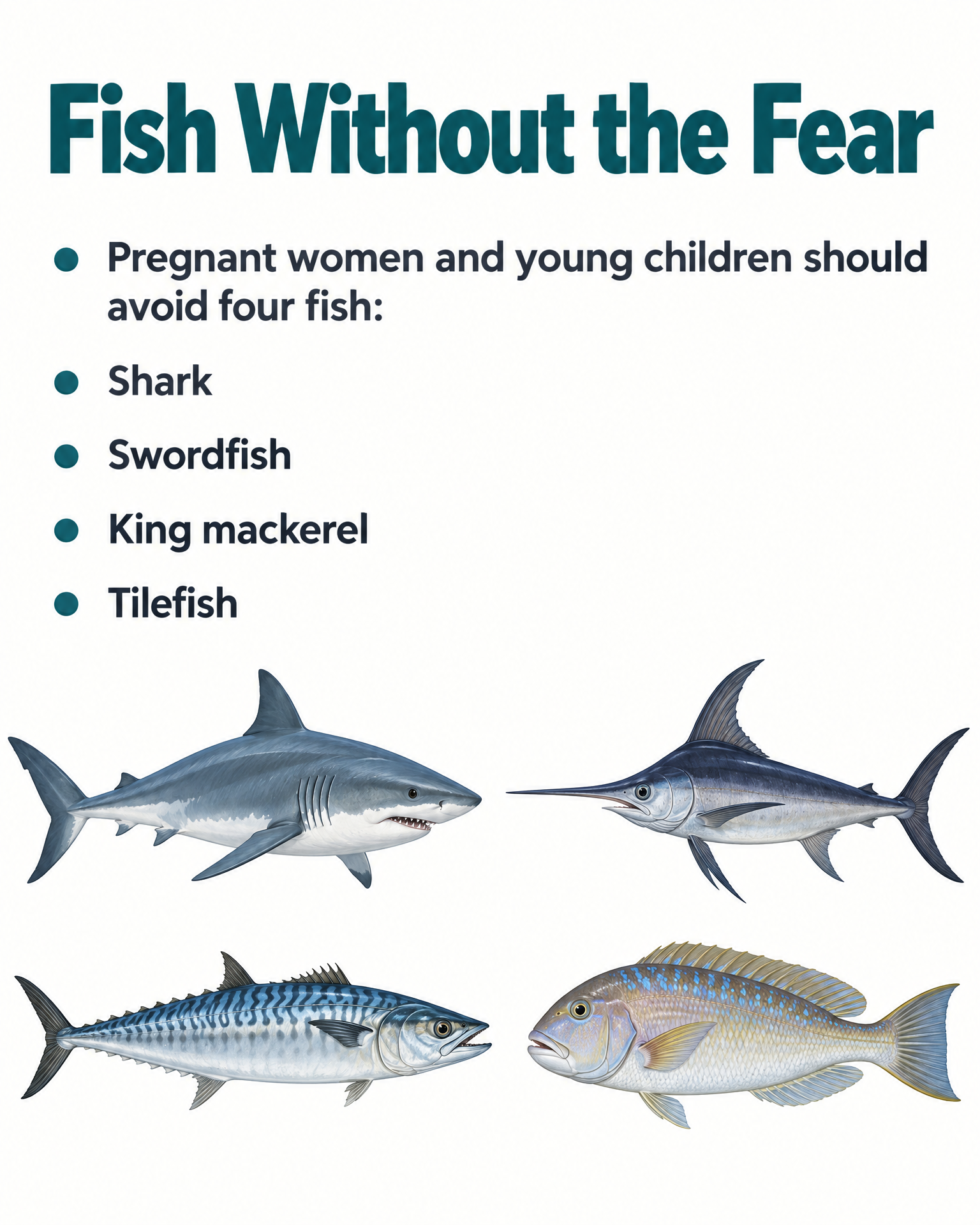
Fish Without the Fear
Fish is where well-meaning advice often turns into avoiding the whole food group, and that’s an unnecessary loss. So here it is plainly: low-mercury fish remain a nutritious food, not a threat. There’s no reason to give up seafood because of a headline.
The guidance from the FDA and EPA is specific and short. Pregnant women and young children should avoid four fish:
- Shark
- Swordfish
- King mackerel
- Tilefish
These are large, long-lived predatory fish that accumulate more methylmercury, the form of mercury that matters for the developing nervous system. That’s the reason for the exclusion. It doesn’t apply to fish in general.
Everything else on the menu is a different conversation. Plenty of commonly eaten fish and seafood are low in mercury, and they’re a good source of protein and other nutrients that a pregnancy or a growing child benefits from. If you like fish, keep eating it. Just skip the four above.
If you want to fine-tune, the FDA and EPA publish a chart sorting common fish by mercury level, and it’s easy to keep on your phone for the grocery store or a restaurant. Avoiding four fish is not a big lifestyle change.
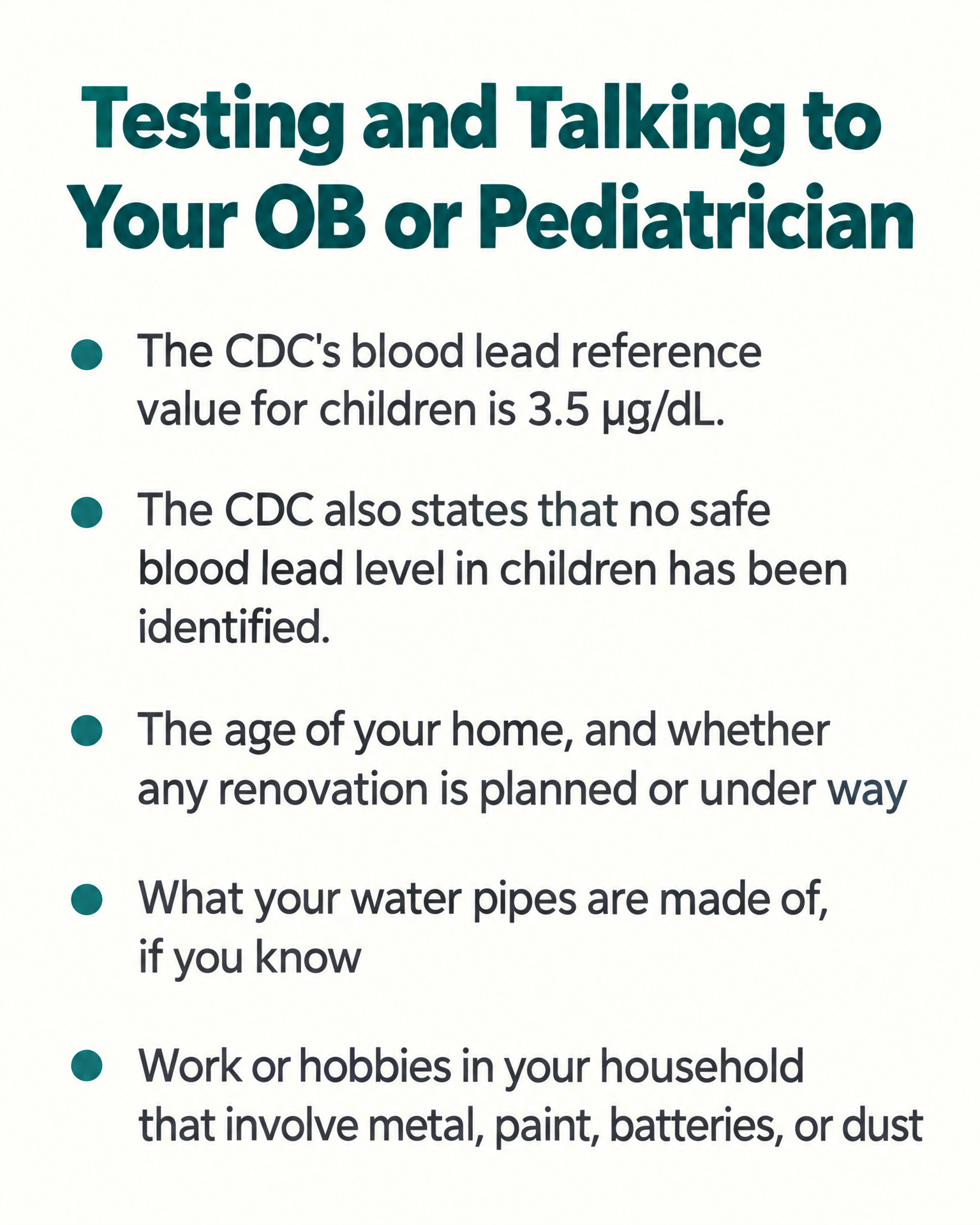
Testing and Talking to Your OB or Pediatrician
Testing sounds heavier than it is. In practice it’s a routine part of care, and it’s risk-based. Clinicians decide who to screen by asking about where you live, how old your home is, what you or your household do for work, and a few other everyday details. If those answers point toward a possible source, a test is a simple way to see what’s actually going on.
The standard tool is a blood lead test. It’s a blood draw, and it measures lead in the bloodstream. For children it’s often a small fingerstick or a draw at the pediatrician’s office. It’s a common, familiar test, and clinicians order it all the time.
Two facts about the numbers are worth knowing:
- The CDC’s blood lead reference value for children is 3.5 µg/dL.
- The CDC also states that no safe blood lead level in children has been identified.
Taken together, those two points tell you how to read the test. The reference value is a marker used to flag children whose levels are higher than most, so that someone can look for the source and follow up. It isn’t a pass/fail line. Because no level has been identified as safe, the goal is always the same: find where lead is coming from and reduce it. A result near or above that value just starts the conversation about where to look.
Here is what to bring up at an appointment:
- The age of your home, and whether any renovation is planned or under way
- What your water pipes are made of, if you know
- Work or hobbies in your household that involve metal, paint, batteries, or dust
- Any significant lead exposure in your own past, like an older childhood home
- What your child eats regularly, especially if rice features heavily
You don’t need to arrive with a worry. You just need to share what’s true about your household, and your OB or pediatrician will tell you whether a test makes sense. It’s a normal part of looking after a pregnancy or a young child, the same way a conversation about sleep or vaccines is.
What NOT to Do
This is the one place I’ll be blunt. During pregnancy and childhood, leave detox products, cleanses, and chelation alone. They’re off the table unless a specialist is directing the care.
Chelation is a medical treatment used under supervision for confirmed cases, not a wellness step. Cleanses and detox products have no role for a pregnant woman or a small child. Exposure reduction in this window comes from changing the source, not from taking something to clear it out.
That’s also why this article carries no supplement angle and never will. The things that help are the ones on the short list above, plus a conversation with your clinician.
Straight Talk: The Controllable List Is Short and Doable
I run ZeoliteForDetox.com, and I’ll tell you what I’d tell a friend who’s expecting. Most of what you can do about metals in this window comes down to a handful of ordinary habits and one or two conversations with a clinician.
Know what’s in your water. Respect the paint in an older home. Keep work dust from coming through the door. Skip four fish and enjoy the rest. Mix up the grains. Ask your OB or pediatrician whether a blood lead test makes sense for your family. That is the whole plan, and it isn’t a heavy one.
Everything else, including the rare scenarios that fuel headlines, is either outside your control or a matter for your doctor to weigh with you. You don’t have to carry it by yourself, and you don’t have to read every alarming article to be a careful parent. If you’ve covered the short list, you’ve done the part that’s yours to do.
Questions People Ask Me
Do I need a blood lead test if I’m pregnant?
Not automatically. Screening in pregnancy is based on risk factors, such as an older home, certain jobs or hobbies, or past exposure. Tell your OB about your household and let them decide. If a test makes sense, it’s a routine blood draw.
Is it safe to eat fish while pregnant?
Yes. Low-mercury fish are a nutritious part of a pregnancy diet. The FDA and EPA advise pregnant women and young children to avoid just four: shark, swordfish, king mackerel, and tilefish. Everything else is a matter of personal choice and variety.
Should I stop giving my toddler rice?
No. Rice is fine as one of several foods. Arsenic only becomes a consideration when rice and rice-based foods make up most of the diet, since inorganic arsenic is the form of concern. Rotating in other grains like oats, barley, and wheat-based foods handles it.
What does it mean if my child’s result is above 3.5 µg/dL?
It means your child’s level is higher than most children’s, and the next step is to look for the source. The CDC reference value is a flag for follow-up, not a diagnosis, and no safe blood lead level in children has been identified, so the aim is to find the source and reduce it. Your pediatrician will walk you through what to check and when to retest.
I grew up in an older house. Does that matter for my pregnancy?
It’s worth mentioning to your OB. Lead can be stored in bone and released during pregnancy, so past exposure is part of the picture your clinician considers. Mentioning it is how you and your doctor decide together whether a test is useful.
Where to Go Next
If your home was built before 1978, the most useful next read is lead paint and dust in older homes, which covers where lead hides in an older house and how to deal with it safely. If your concern is what’s in the nursery and the toy box, heavy metals in children’s toys and household products sorts out what’s worth a second look. And if you or your child has had a test, or one is coming up, how to read blood lead test results explains what the numbers mean so you can walk into the follow-up conversation prepared.
Recent Posts
You're standing in the water aisle, or scrolling a product page, and every box says some version of "reduces lead." The pitcher says it. The faucet attachment says it. The no-name filter at half the...
Another recall notice lands in your inbox or your feed. Lead in a toy. Lead in kids' jewelry. A brand name you may or may not recognize, a photo of a product that looks a lot like something in your...