
This article is general education, not medical advice. If you suspect poisoning, call Poison Control (U.S.: 1-800-222-1222) or seek emergency care.
The Short Version, Before the Long One
Chelation therapy is prescription medicine. Specific FDA-approved drugs latch onto toxic metals such as lead, arsenic, mercury, or excess iron and copper, so the body can flush them out. It happens after a confirmed diagnosis, under supervision, with lab work along the way.
Detox supplements are the pills, powders, drops, patches, and suppositories sold to “pull heavy metals” out of you. None is approved to treat metal poisoning, and no good evidence says they do it.
Both get called chelation. The marketing depends on that overlap.
Four things to carry with you:
- Medical chelation therapy treats diagnosed poisoning or overload. It isn’t a wellness routine.
- The FDA has not approved any over-the-counter product to treat toxicity, detoxify, or chelate heavy metals.
- Chelating drugs are potent. Without monitoring they can drain calcium, zinc, and copper, injure kidneys, and in the wrong form, kill.
- If you’re worried about heavy metals, start with a clinician-ordered blood or urine test and a search for the source, not a supplement.
Table of Contents
It Usually Starts With a Tired Person and a Good Website
Picture someone who has felt foggy and wrung-out for months. Doctors shrugged, or the appointments were too short. So they search at midnight and land on a clean, calm page selling “heavy metal detox drops,” with a testimonial from a woman who “finally felt clear.”
The page mentions chelation. That part is real. Chelation therapy is legitimate medicine with a long history, and it has pulled children back from the edge of lead poisoning.
What the page leaves out is that the medicine and the product share a name and almost nothing else.
This guide pulls them apart. It covers what each one is, what each can and can’t do, and why unsupervised chelation is one of the few wellness trends with a documented trail of deaths.
One Word, Three Meanings
Chelation comes from the Greek chēlē, “claw.” A chelating agent is a molecule that grabs a metal ion and holds it in a stable complex. People use the word in three different ways, and most of the confusion lives in the gaps between them.
| Meaning | What it is | Where you’ll meet it |
|---|---|---|
| Medical chelation therapy | Prescription drugs that bind toxic metals for excretion | Hospitals and specialist clinics, for poisoning or metal overload |
| Chelated minerals | Nutrients like magnesium glycinate or zinc bisglycinate, bound to amino acids for absorption | Ordinary dietary supplements. Nothing to do with detox |
| “At-home chelation” marketing | Products claiming to remove heavy metals or “toxins” | Wellness retail, social media, some alternative clinics |
A “chelated” magnesium capsule is not chelation therapy. And a detox drop that borrows the vocabulary does not become a drug.
How Medical Chelation Therapy Actually Works
The drug travels through your bloodstream, finds its target metal, and wraps around it. The resulting water-soluble complex leaves through the kidneys, or in some cases the bile.
Each chelator has its own preferences. There is no universal one, and choosing wrong can make things worse, which is why this is a specialist’s job.
The FDA-approved chelating agents and what they’re for
| Agent | Typical use | Route |
|---|---|---|
| Calcium disodium EDTA (CaNa₂EDTA) | Severe lead poisoning | IV or IM |
| Succimer (DMSA) | Lead poisoning, especially in children | Oral |
| Dimercaprol (BAL) | Acute arsenic, mercury, and severe lead poisoning | IM injection |
| Deferoxamine | Acute iron poisoning; transfusional iron overload | IV, SC |
| Deferasirox / deferiprone | Chronic iron overload (thalassemia, sickle cell disease) | Oral |
| Penicillamine / trientine | Wilson’s disease (copper overload) | Oral |
| Prussian blue | Thallium and radioactive cesium | Oral |
| Ca-/Zn-DTPA | Internal contamination with plutonium, americium, curium | IV, inhaled |
Some agents, such as DMPS, are used in toxicology practice without being FDA-approved as marketed products in the U.S. Check current labeling.
For more on the best-known agent, see our explainer on what is EDTA chelation.
What a legitimate course of treatment looks like
It’s slower and less dramatic than a wellness protocol.
- The history. Occupation, the age of your home (lead paint), your water source, hobbies, imported remedies or cosmetics.
- Confirmation. Usually a whole-blood lead level, blood or 24-hour urine tests for arsenic or mercury (read with recent seafood in mind), or ferritin and transferrin saturation for iron overload.
- The right specialist. A medical toxicologist, a poison center consult, a hematologist, or a hepatologist, depending on the metal.
- Source control. Getting the person away from the exposure. Without this, chelation is bailing a boat that’s still leaking.
- Monitored dosing. Kidney function, liver enzymes, blood counts, and minerals like calcium, zinc, and copper are tracked throughout.
- Follow-up. Repeat levels, to confirm the drop and to watch for rebound as metals seep back from tissues like bone.
When Chelation Therapy Is Actually Warranted
Chelation is reserved for cases where the toxic burden or the symptoms are serious enough to justify the drug’s risks.
- Lead poisoning. In children, succimer is generally considered at very high blood lead levels (commonly cited around ≥45 µg/dL), and clinicians follow current CDC, AAP, and poison-center guidance. Lower levels are handled by removing the exposure. The CDC’s blood lead reference value for children is 3.5 µg/dL, a number that triggers investigation and source removal, not drug therapy. If this is your worry, read about lead poisoning symptoms and testing.
- Acute arsenic, mercury, or other heavy-metal poisoning, usually with symptoms and confirmatory labs.
- Iron overload from repeated transfusions or inherited disorders.
- Wilson’s disease, a genetic disorder of copper metabolism that needs lifelong management.
- Radiological or nuclear contamination, with specific agents.
Then there’s a fact worth sitting with. Most people with mildly elevated “metal” readings on consumer tests don’t meet any threshold for treatment. Trace amounts of lead, arsenic, mercury, and cadmium turn up in nearly everyone, because they live in soil, water, and food. Detectable is not the same as toxic. Our guide on how to read heavy metal test results goes deeper.
Inside the “Detox” Aisle
Commercial detox supplements arrive in many costumes:
- Binders and adsorbents: activated charcoal, zeolite, bentonite clay
- Botanicals and algae: chlorella, spirulina, cilantro
- Fibers: modified citrus pectin
- Antioxidants and sulfur compounds: NAC, alpha-lipoic acid, glutathione
- “Oral EDTA,” suppositories, and chelation patches or foot pads
- Multi-ingredient “cleanse” kits
The regulatory reality
In the U.S., dietary supplements fall under the Dietary Supplement Health and Education Act (DSHEA). They don’t need FDA approval for safety or effectiveness before they reach shelves. A company can say a product “supports detoxification” without proving anything. But claiming it can treat or cure a disease, heavy-metal toxicity included, turns it into an unapproved drug claim. The FDA has sent warning letters to sellers of over-the-counter chelation products for exactly that.
What the evidence shows
- Oral EDTA is poorly absorbed. Only a small fraction crosses the gut, so it doesn’t behave like the IV drug used in hospitals.
- Chlorella, cilantro, zeolite, and similar products rest on limited, low-quality evidence, mostly animal studies or small human ones. None has been shown to treat metal poisoning in people.
- Foot pads and patches have no credible mechanism for pulling metals through skin. The dark color is a reaction between moisture and the pad’s ingredients, not toxins leaving your body.
- Alpha-lipoic acid deserves caution. Some animal research suggests weak or partial chelators can shuffle metals between tissues, though what that means in humans is still debated.
- Quality control is uneven. Independent testing of botanical and mineral supplements has found heavy-metal contamination, an uncomfortable irony for a product sold to remove them.
If you still want to try a binder-style supplement like zeolite, treat it as an ordinary supplement purchase, not a treatment. Nothing above suggests it replaces chelation or medical care, and the evidence for these products remains limited. But if you’re going to buy one, a few things are worth paying attention to: amounts disclosed on the label, published heavy-metal testing of the finished product, and claims that stay honest about what’s known.
Our comparison guide puts six zeolite supplements side by side on label disclosure, third-party testing, and cost per 30 days. For a worked example of one product examined that way, see our ROOT Clean Slate review, which covers its formula, the evidence, and the price.
Medical Chelation vs. Detox Supplements, Side by Side
| Feature | Medical chelation therapy | Commercial detox supplements |
|---|---|---|
| Regulatory status | FDA-approved drugs for specific indications | Not approved to treat metal toxicity |
| Who decides | Physician or toxicologist after diagnosis | The consumer or the seller |
| Proof required | Lab-confirmed poisoning or overload | None |
| Dosing | Weight-based, protocol-driven | Arbitrary, label-based |
| Monitoring | Kidney, liver, blood counts, minerals | None |
| Evidence of benefit | Strong for approved indications | Weak to nonexistent for metal removal |
| Main risks | Real but managed (hypocalcemia, kidney injury, mineral depletion) | Delayed diagnosis, contaminated products, misuse of true chelators |
| Cost to health | Justified by the danger of untreated poisoning | Potentially wasted money and time |
What each one can and can’t do
Medical chelation can lower blood levels of a specific toxic metal in confirmed poisoning. It can reduce acute danger such as lead encephalopathy or iron toxicity, and prevent organ damage from chronic iron or copper overload.
It can’t reverse neurological damage from past lead exposure, treat conditions with no metal toxicity behind them, work as a general cleanse or anti-aging therapy, or stand in for removing the source.
Detox supplements can provide ordinary nutrients or fiber, depending on what’s in them. They can also cost you money.
They can’t treat diagnosed heavy-metal poisoning, reliably pull metals out of bone or brain, or improve on what your liver, kidneys, gut, and lungs already do every minute of the day.
Your body isn’t waiting for a product to start detoxifying. The liver metabolizes, the kidneys filter, and the gut and bile carry waste away. When poisoning overwhelms those systems, that’s when medicine steps in.
Where Unsupervised Chelation Goes Wrong
Medical chelation is acceptably safe because of the structure around it. Remove the structure and the risks stack up.
Calcium crashes. The most serious documented danger involves edetate disodium (Na₂EDTA), a different compound from the calcium-containing version used for lead. It binds blood calcium so aggressively that it can stop the heart. CDC reporting in the mid-2000s documented deaths from hypocalcemia after the wrong EDTA product was given, including a child with autism. The FDA later restricted edetate disodium. The two names differ by a few letters. The outcomes differ by a life.
Kidney injury. Chelator–metal complexes leave through the kidneys. Without hydration management and monitoring, they can damage them.
Mineral depletion. Chelators aren’t picky enough to ignore nutrients. Zinc, copper, magnesium, and iron can go down with the toxins, creating problems of their own.
Redistribution. The wrong agent, dose, or timing can push metals into sensitive tissues instead of out of the body.
Drug-specific hazards. Deferiprone can cause dangerously low white blood cell counts. Dimercaprol can spike blood pressure and hurts to inject. Others affect liver enzymes or cause rashes. Each one demands a clinician who knows it well. For a fuller rundown, see side effects of chelation therapy.
Treating a problem you may not have. Unproven tests can “diagnose” metal toxicity in perfectly healthy people.
The cost nobody sees. Fatigue, brain fog, and cognitive changes can come from thyroid disease, anemia, sleep apnea, depression, B12 deficiency, or something else entirely treatable. Every month spent on a detox protocol is a month not spent finding out.
The Testing Trap
Many people start chelation because a test told them they were “loaded with metals.” Which test matters enormously.
- Provoked (challenge) urine tests. The patient takes a chelating drug, then urine is collected. This artificially boosts metal excretion in anyone, healthy people included, and the result is compared against ranges meant for unprovoked samples. The American College of Medical Toxicology has advised against the practice.
- Hair analysis. It can’t reliably tell outside contamination (shampoo, water, environment) from internal exposure, and labs vary widely.
- Unvalidated at-home kits. These often rely on inappropriate reference ranges or methods.
- Recent seafood. A fish dinner can spike urinary arsenic with mostly harmless organic forms. Proper testing speciates arsenic. If fish is your worry, read up on mercury in fish.
The right approach is whole-blood or timed urine collection without provocation, ordered by a clinician and interpreted in context.
Heart Disease, Autism, and Other Claims You’ll See Online
Heart disease. The NIH-funded Trial to Assess Chelation Therapy (TACT), published in JAMA in 2013, tested EDTA-based infusions in more than 1,700 older adults who had already had a heart attack. The primary outcome showed a modest reduction in cardiovascular events, but the trial had high dropout and other limitations. Major cardiology groups haven’t adopted chelation as standard care. A follow-up trial in people with diabetes (TACT2) was designed to test the signal further, so look for the latest published results. TACT raised a question. It didn’t establish a treatment. More in chelation for heart disease and the TACT trial.
Autism. Major medical and regulatory bodies don’t support chelation for autism, and there’s no evidence that metal toxicity causes it. Children have been harmed and killed by the practice. The FDA has warned against products marketed this way. See chelation therapy and autism.
Alzheimer’s, fatigue, “brain fog,” anti-aging, cancer prevention. None is a recognized indication for chelation.
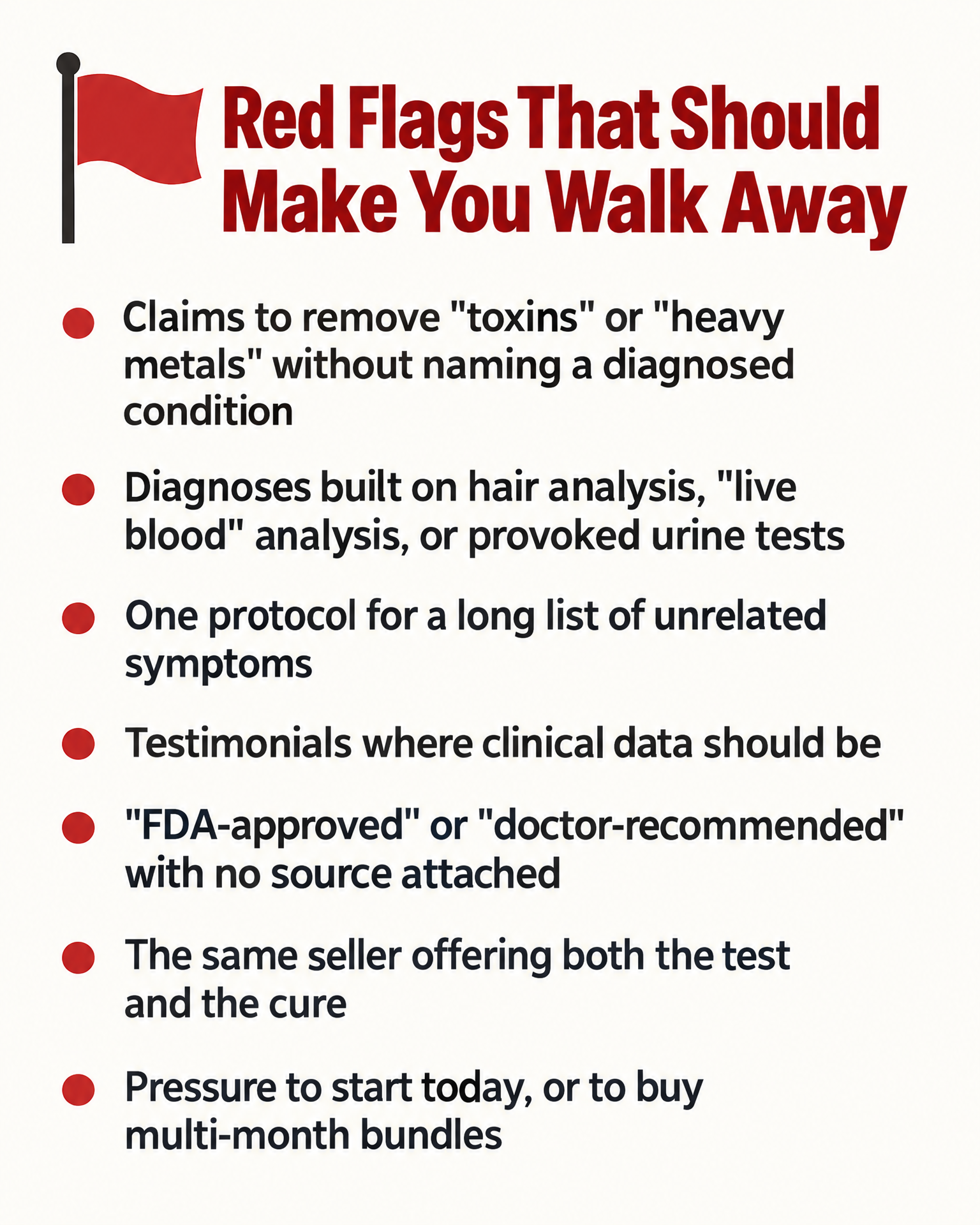
Red Flags That Should Make You Walk Away
- Claims to remove “toxins” or “heavy metals” without naming a diagnosed condition
- Diagnoses built on hair analysis, “live blood” analysis, or provoked urine tests
- One protocol for a long list of unrelated symptoms
- Testimonials where clinical data should be
- “FDA-approved” or “doctor-recommended” with no source attached
- The same seller offering both the test and the cure
- Pressure to start today, or to buy multi-month bundles
- Chelation pitched for autism, ALS, or other conditions with no metal-poisoning basis
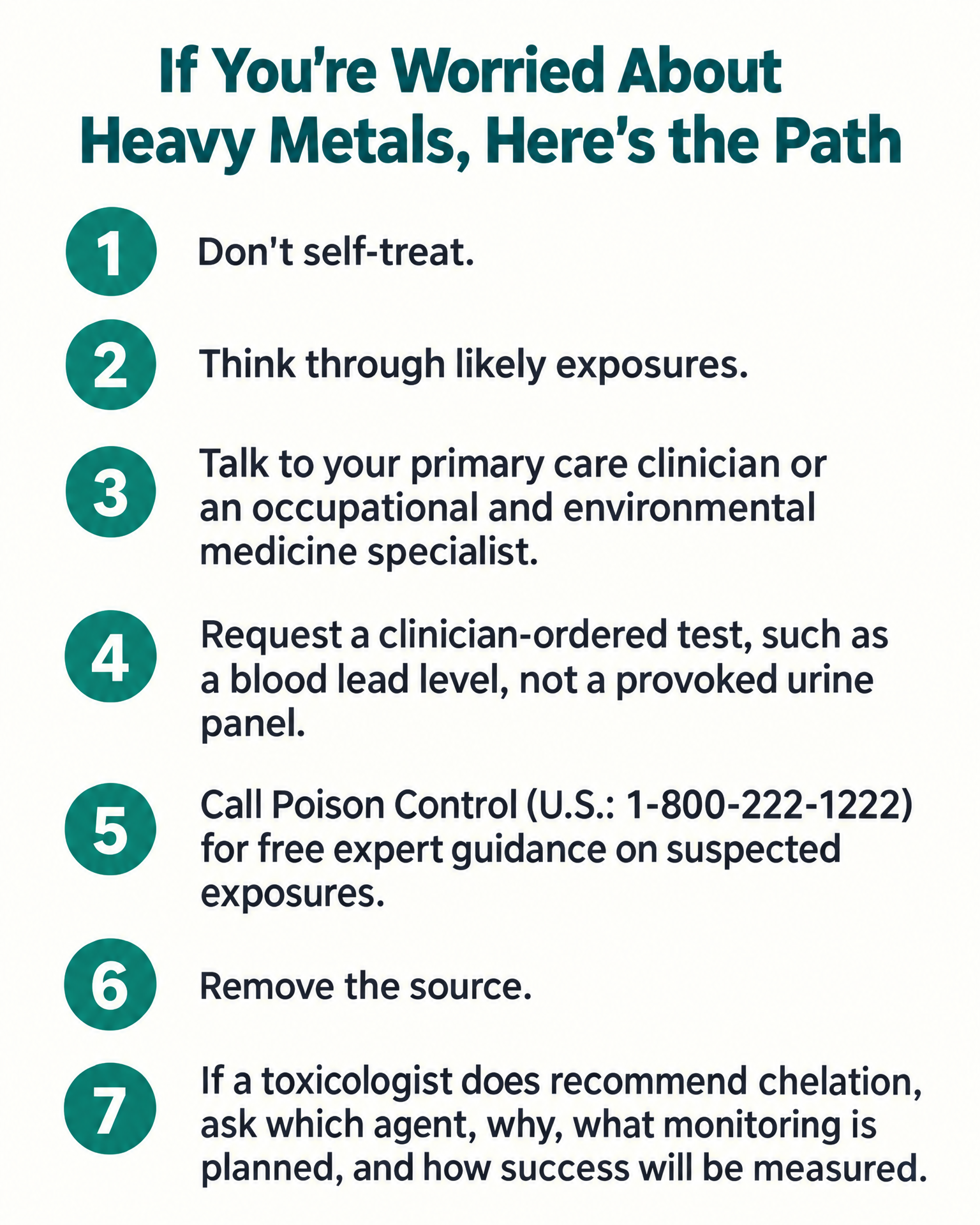
If You’re Worried About Heavy Metals, Here’s the Path
- Don’t self-treat. Don’t buy a chelator or start a cleanse while you wait for answers.
- Think through likely exposures. An older home with chipped paint, a private well, imported spices or traditional remedies, ceramics, workplace contact, hobbies like soldering, stained glass, or firearms, or frequent high-mercury fish.
- Talk to your primary care clinician or an occupational and environmental medicine specialist. Ask which test, if any, makes sense.
- Request a clinician-ordered test, such as a blood lead level, not a provoked urine panel.
- Call Poison Control (U.S.: 1-800-222-1222) for free expert guidance on suspected exposures.
- Remove the source. Often that is the treatment.
- If a toxicologist does recommend chelation, ask which agent, why, what monitoring is planned, and how success will be measured.
Weighing medical treatment against commercial claims raises many questions, and they are easy to forget when an appointment is short. Asking from memory tends to bring vague answers and guesswork.
The Symptom & Exposure Timeline Builder is a free five-page workbook. Its medication and supplement log gives you a place to write down questions for a clinician or pharmacist, next to any prior test results. The visit preparation sheet lists your top concerns and records to bring. It recommends no test and no treatment.
Bring focused questions about proven treatment and supplement claims to your next appointment. Get the Free Timeline Builder
If it’s a child you’re worried about, call the pediatrician and your local health department. Many offer lead testing and home assessments.
If You’ve Already Been Taking Chelation Products
Take a breath. Plenty of people have, and most supplements are unlikely to cause acute harm. Still:
- Stop any injectable, suppository, or “oral EDTA” product, and tell your clinician exactly what you took.
- Bring the labels. The ingredients matter.
- Ask whether kidney function, calcium, and mineral levels should be checked.
- Get urgent care for muscle cramps or spasms, tingling around the mouth, palpitations, fainting, severe weakness, decreased urination, or fever with a sore throat (a possible sign of low white blood cells with certain drugs).
Questions People Quietly Type Into Search Bars
Wait, is chelation therapy even real? Yes. It treats confirmed poisoning or overload of certain metals, including lead, arsenic, mercury, iron, and copper (as in Wilson’s disease), using FDA-approved drugs under medical supervision.
Then why does everyone sell it as a detox? Because the word is real and the claim sounds plausible. But detox supplements aren’t approved for metal poisoning, aren’t dosed or monitored like medicines, and lack evidence that they remove heavy metals.
Do over-the-counter chelation products work? There’s no good evidence they do. The FDA says it hasn’t approved any OTC chelation product to treat toxicity or disease.
Is oral EDTA at least safe? It’s poorly absorbed, so it probably won’t do what the label implies. Injectable EDTA, especially the wrong formulation, can be dangerous and has caused deaths.
Could chelation help my heart? It isn’t standard treatment. TACT showed a modest signal with significant limitations, and mainstream cardiology guidelines don’t recommend it.
Does chelation cure autism? No. There’s no evidence it does, and it has seriously harmed children.
How would I know if I actually have heavy metal poisoning? Through clinician-ordered testing, usually blood or timed urine, combined with exposure history and symptoms. Hair tests and provoked urine tests aren’t reliable.
Can’t I just detox heavy metals naturally? Your liver, kidneys, and gut already clear many substances. For a real exposure, the best moves are removing the source and seeing a clinician. Eating enough iron, calcium, and other nutrients also helps limit lead absorption.
What are the side effects of chelation? Depending on the drug: low calcium, kidney stress, mineral depletion, liver enzyme changes, rashes, low white blood cell counts, and GI upset. That’s why monitoring matters.
Who do I see if I think I’ve been exposed? Start with your primary care clinician, who can refer you to a medical toxicologist or occupational and environmental medicine specialist. Poison Control (1-800-222-1222 in the U.S.) can guide you right away.
Products / Tools / Resources
Things worth having on hand, or worth bookmarking, if heavy metals are on your mind. None of it replaces a clinician, but all of it moves you in a useful direction.
Services and hotlines – Poison Control, 1-800-222-1222 (U.S.). Free, confidential, staffed by toxicology professionals. Save it in your phone now. – Your state or local health department. Many offer free or low-cost lead testing and home assessments, especially for children. – Pediatric Environmental Health Specialty Units (PEHSU). Specialists who can advise families on children’s environmental exposures. – Association of Occupational and Environmental Clinics (AOEC). A directory for finding clinics that handle workplace and environmental exposures.
Testing – A clinician-ordered whole-blood lead test. Still the right first step for suspected lead exposure. – State-certified lab testing for private well water. Far more useful than a store-bought strip. Your health department can point you to certified labs. – Lead paint testing by a certified inspector or risk assessor for homes built before 1978.
Reducing exposure at home – A water filter certified to NSF/ANSI Standard 53 for lead reduction. Check the certification on the packaging, not just the marketing. – A HEPA-filter vacuum and wet-wiping supplies for dust in older homes. Lead dust is a bigger concern than most people realize. – EPA’s lead-safe renovation guidance (RRP rule) before you sand, scrape, or demolish anything in an older house. – FDA/EPA fish consumption advice for choosing lower-mercury seafood, especially if you’re pregnant or feeding young children.
If you do take supplements – Third-party verified products (look for USP or NSF Contact seals), which at least confirm that what’s on the label is in the bottle. – ConsumerLab-style independent reviews for supplement quality testing. – A symptom journal. A simple notebook or phone note with dates, symptoms, foods, and exposures. It makes appointments far more productive.
Reading and sources to trust – FDA consumer guidance on chelation and OTC chelation products – CDC pages on childhood lead poisoning and the blood lead reference value – CDC MMWR report on deaths linked to edetate disodium – Lamas GA et al., TACT, JAMA, 2013, and the TACT2 publications – American College of Medical Toxicology position statement on post-challenge urinary metal testing – NIH/NCCIH summary on chelation therapy – ATSDR ToxFAQs for plain-language summaries of individual metals – DailyMed prescribing information for each chelating agent – AAP and CDC clinical guidance on pediatric lead management – Wilson Disease Association, for patients and families
Recent Posts
Two bottles, one maker, and names that blur together. Pure Body and Pure Body Extra both come from Touchstone Essentials. Both are zeolite in pure water, both are dosed three times a day, and both...
Most people who start reading about detox supplements already have a worry in the background. Heavy metals turn up in the conversation about water, food, and air, along with a long list of everyday...