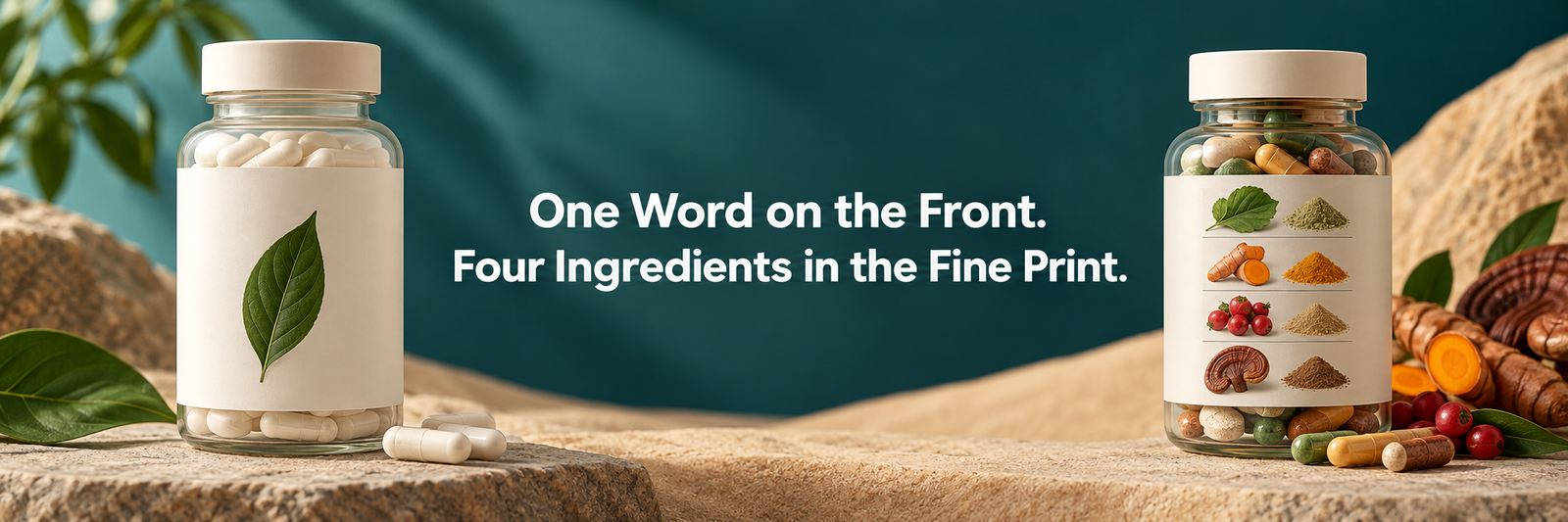
Two bottles can both say “zeolite detox” on the front. One may hold a single purified mineral in water. The other may be a four-ingredient blend in which zeolite is just one name on a list. On a crowded marketplace page, including TikTok Shop, the front-of-label language is often nearly identical, and the differences sit in small print or in a product description you have to scroll to find.
That difference matters because the two products are not the same kind of thing. A single-ingredient product lets you ask one set of questions: what is this material, how much is in a serving, and what is known about it? A blend multiplies those questions by the number of ingredients and often withholds the numbers needed to answer them.
This article teaches you to read the label and know which kind of product you are holding. It explains what “binder” means as a marketing word, what each common blend ingredient is, why undisclosed amounts are a problem, and what kinds of documentation would actually support a claim. It does not recommend any product.
Table of Contents
What “Binder” Actually Means on a Label
“Binder” is a marketing term. It is not a regulated product category, and it is not an approved claim. No agency defines what qualifies a product to be called a binder, so any maker can use the word on anything.
The idea behind the word is straightforward. A binder is a substance promoted as attracting and holding unwanted compounds in the digestive tract so that they travel through and out rather than being absorbed. The picture is a sponge or a magnet. Different ingredients are described as working by different mechanisms: adsorption onto a surface, ion exchange inside a crystal structure, or chemical attraction to large organic molecules.
It helps to separate three things a label can tell you:
- The intended story. “Binder” tells you the maker wants you to think of the product as something that grabs and holds.
- The material. The ingredient list tells you what is physically in the bottle.
- The demonstrated outcome in a person. This is what happens in a human body, and a label word alone says nothing about it.
A binder claim tells you the story the seller is telling — not whether that story has been tested.
The Ingredients, One at a Time
Binder blends draw from a fairly small set of ingredients. Here is what each one is, in plain terms, and how it is usually described.
Zeolite (clinoptilolite)
Zeolites are a family of naturally occurring minerals, often formed when volcanic ash reacts with water over long periods. The type most often sold for supplements is clinoptilolite. Its crystal structure is a honeycomb of tiny cages and channels, and the framework carries a natural negative charge.
Makers describe that charge as the key feature. The story is that positively charged particles, such as certain metal ions, can be drawn into the cages and held there through cation exchange, in which one positively charged ion swaps places with another. That is the mechanism as manufacturers present it. It describes a property of the material, and it is not a statement about outcomes in a person.
Zeolite products come as powders, capsules, and liquids, and the physical form of the mineral varies. Particle size is one of the biggest ways brands differentiate themselves, with some describing their material as milled to very fine fractions. If you want to see how size is measured and why it appears so often in marketing, the particle-size explainer covers it in detail.
Because zeolite is a mined mineral, the raw material varies from source to source — one reason identity and purity documentation matters.
Humic acid
Humic acid belongs to a group of dark organic substances formed when plant and animal matter decomposes in soil, peat, and certain ancient deposits. It is not a single molecule. It is a mixture of large, complex, variable molecules, which is part of why two humic products can differ considerably.
The story told for it in supplements is gut-level binding support, with the large molecules described as interacting with various compounds in the digestive tract. On labels it often appears as part of a “humic/fulvic” mineral complex, which means the humic and fulvic fractions are listed together rather than separately. Humic acid is generally less soluble than fulvic acid, especially in acidic conditions, which is one reason the two are separated in descriptions.
Fulvic acid
Fulvic acid comes from the same family of humic substances. It is the smaller, lighter fraction, with lower molecular weight, and it stays dissolved across a wider range of acidity than humic acid. That solubility is why fulvic acid is the form that tends to appear in liquid products.
In marketing, fulvic acid is usually framed as a mineral carrier or transport aid, a molecule said to help hold minerals in solution and move them around. Notice that this is a different story from the “binder” story attached to humic acid and zeolite. The two ideas can sit side by side in one blend, so a single “binder” label can bundle ingredients that are promoted for different, even opposite-sounding, purposes. A label saying “fulvic and humic acid mineral” also does not tell you the ratio between the two, the source material, or how the extract was processed.
Activated charcoal
Activated charcoal is carbon, often made from wood, coconut shell, or other plant material, that has been processed to become extremely porous. The pores create a huge surface area, and molecules can stick to that surface, a process called adsorption.
It is a genuine adsorbent with a long history. It is used in hospital and emergency settings for certain poisonings, where clinicians decide whether it is appropriate and manage the dose and timing. That is a medical use under professional supervision. It does not by itself show that a daily supplement capsule or drop does the same job in the same way.
Activated charcoal is also famously non-selective. It adsorbs a wide range of substances, and the surface does not distinguish between what a person might want to remove and what they would rather keep, such as nutrients or medications.
Modified citrus pectin (PectaSol)
Pectin is a fiber found in the peel and pulp of citrus fruit. “Modified” means the pectin has been processed, typically with changes to acidity and temperature, so that its long chains are broken into smaller fragments. The point of the modification is that smaller fragments can be absorbed, whereas ordinary pectin passes through the gut largely intact.
PectaSol is a brand name for one particular modified citrus pectin product, so when a blend lists “PectaSol (modified citrus pectin),” it is naming a branded ingredient. It is usually marketed around galectin-3, a protein that binds certain sugars. The label name tells you the processing and the brand. It does not tell you how much is in the product or whether the marketing story has been demonstrated in people.
A different material: silica-based products
Some detox products use silica instead of zeolite. Silica is a different material entirely. It is not a zeolite, even though the two may sit side by side in a search for “detox minerals.” The zeolite-vs-silica explainer sets out how they differ, and it is worth checking which one is actually named on the label.
Binder blends list several materials together, and a front label can suggest more than the ingredient list confirms. Guessing at the contents is where comparisons tend to go wrong.
The Supplement Claims & Label Evidence Scorecard is a free worksheet for the actual ingredient list. Its ingredient-identification section records zeolite, silica or other verified components, never assumed from marketing. The documentation checklist notes whether complete ingredient disclosure is confirmed, not found, or unclear.
Use it to read blended product labels without guessing the contents. Get the Free Label Scorecard
Single-Ingredient vs. Blend: What Actually Changes
The main change is what the label lets you know.
With a single-ingredient product, the active material is the product, and the dose is usually stated. A liquid zeolite label might list, for example, 30 mg of processed clinoptilolite per serving. That one line gives you the identity of the material, the amount per serving, and a number you can use to compare against other products.
In a blend, several ingredients share one bottle. Labels frequently give a single combined weight, or sometimes no weight at all. From that, you cannot tell how much of each ingredient you are getting. You also cannot tell which ingredient a given claim rests on. If a page says “binder blend” and makes a statement about binding, is that statement about the zeolite, the charcoal, the pectin, or all of them together? The label may not say.
Blends are not automatically worse. A blend with every amount disclosed can be as easy to evaluate as several single products. But blends are harder to evaluate, because each added ingredient adds questions about identity, amount, source, and supporting documentation, and because a combined total can hide a very uneven split.
The Undisclosed-Amounts Problem
Many blend labels use what is called a proprietary blend. Ingredients are listed, usually in descending order by weight, but the amount of each is not given. At most you get a total blend weight.
That arrangement blocks several basic comparisons:
- Price per milligram. You cannot work out what you are paying for any single ingredient, so you cannot compare against a single-ingredient product containing the same material.
- Dose comparison. If a source describes an amount of an ingredient in a study or a technical document, you cannot tell whether the product contains anything near that amount.
- Ratio. A blend listing four ingredients might be mostly one and a trace of the others. An ingredient can appear on the label while making up a very small fraction of the total.
- Claim attribution. You cannot link a stated purpose to the ingredient responsible for it.
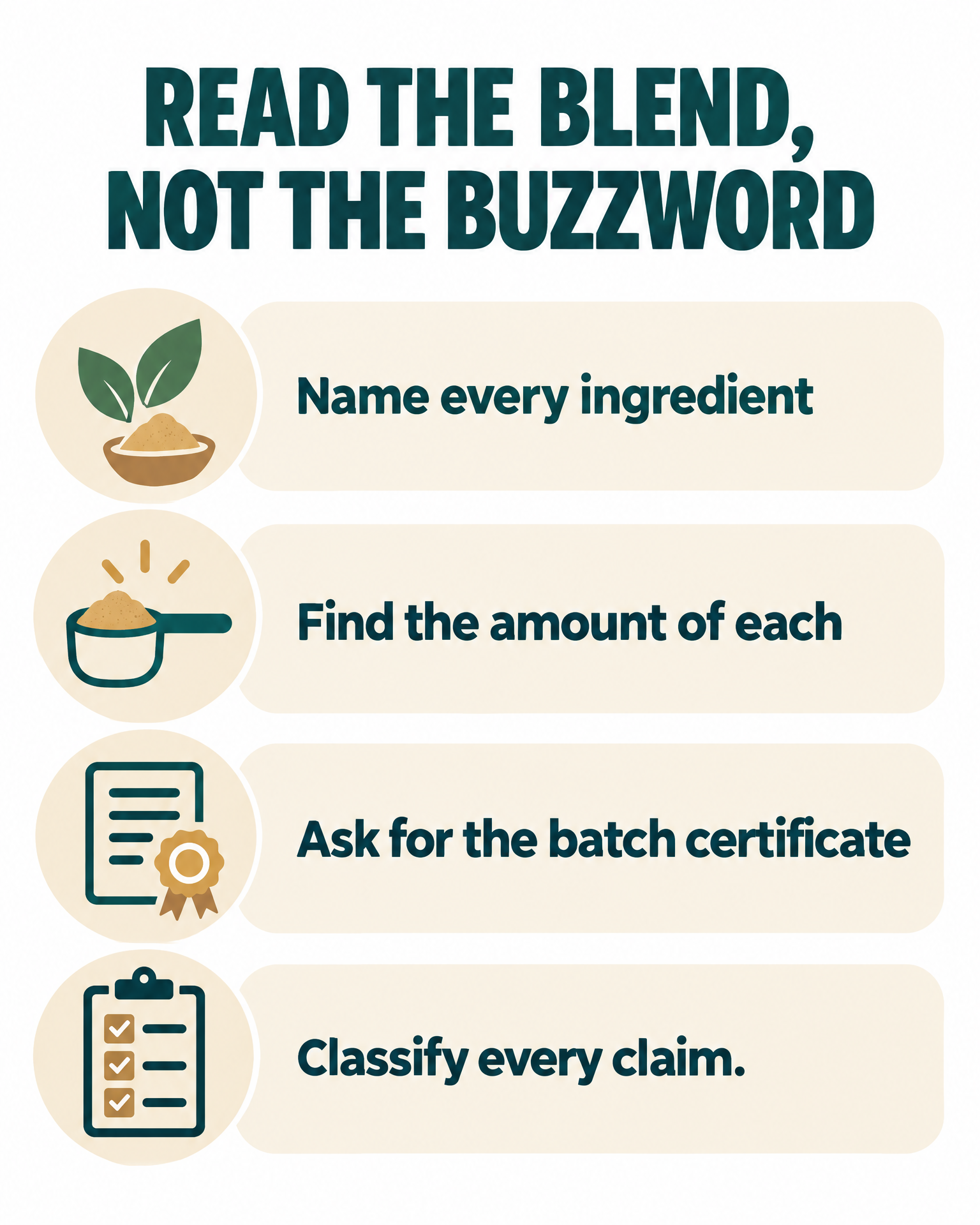
The ingredient order gives a rough hint, since the first-listed ingredient generally weighs the most, but it does not give magnitudes. Total blend weight is the only number you get, and a total says nothing about how it is divided.
This leaves several questions unanswerable from the label alone. How much of each ingredient is in a serving? Is the zeolite in a quantity comparable to a stand-alone product? Was each ingredient tested separately, or only the finished blend? Did anyone verify that the label matches the contents? Those questions can only be answered with documentation from the maker, and that is the focus of the later sections.
A Worked Example: Reading One Blended Label
Here is how to apply these tools to a real listing, using only what the listing itself shows.
On TikTok Shop, a seller called Roots Herbal Healing sells a “Zeolite Binder” drop (1 oz) as part of a two-bottle “Perfect Detox Pair” bundle. Its listing shows four binder ingredients: clinoptilolite zeolite, fulvic and humic acid mineral, activated charcoal, and PectaSol (modified citrus pectin). The amount of each ingredient is undisclosed.
What is known from the listing.
- The ingredient identities: a zeolite (clinoptilolite), a humic/fulvic mineral complex, activated charcoal, and a branded modified citrus pectin.
- The format: a 1 oz liquid drop product.
- The bundle context: it is sold paired with a second bottle as the “Perfect Detox Pair,” so the purchase is a set rather than this one bottle on its own.
What is not known from the listing.
- The amount of each ingredient, or even a split between them.
- Whether the zeolite is stated by particle size or processing method.
- The ratio of humic to fulvic acid, and the source of that material.
- Whether any of the four ingredients has its own identity or purity documentation, such as a certificate of analysis for the finished product.
- Which ingredient any stated purpose is attached to.
What to ask for. A shopper could ask the seller for amounts per serving of each ingredient, a batch-specific certificate of analysis from an independent laboratory, particle-size data for the zeolite, and a statement of what testing, if any, supports each claim on the page. Whether the seller can or will answer is itself useful information. Nothing here is a judgment for or against buying the product. The point is that reading the label this way separates what the page tells you from what you would need to know.
What Documentation Would Actually Support a Claim
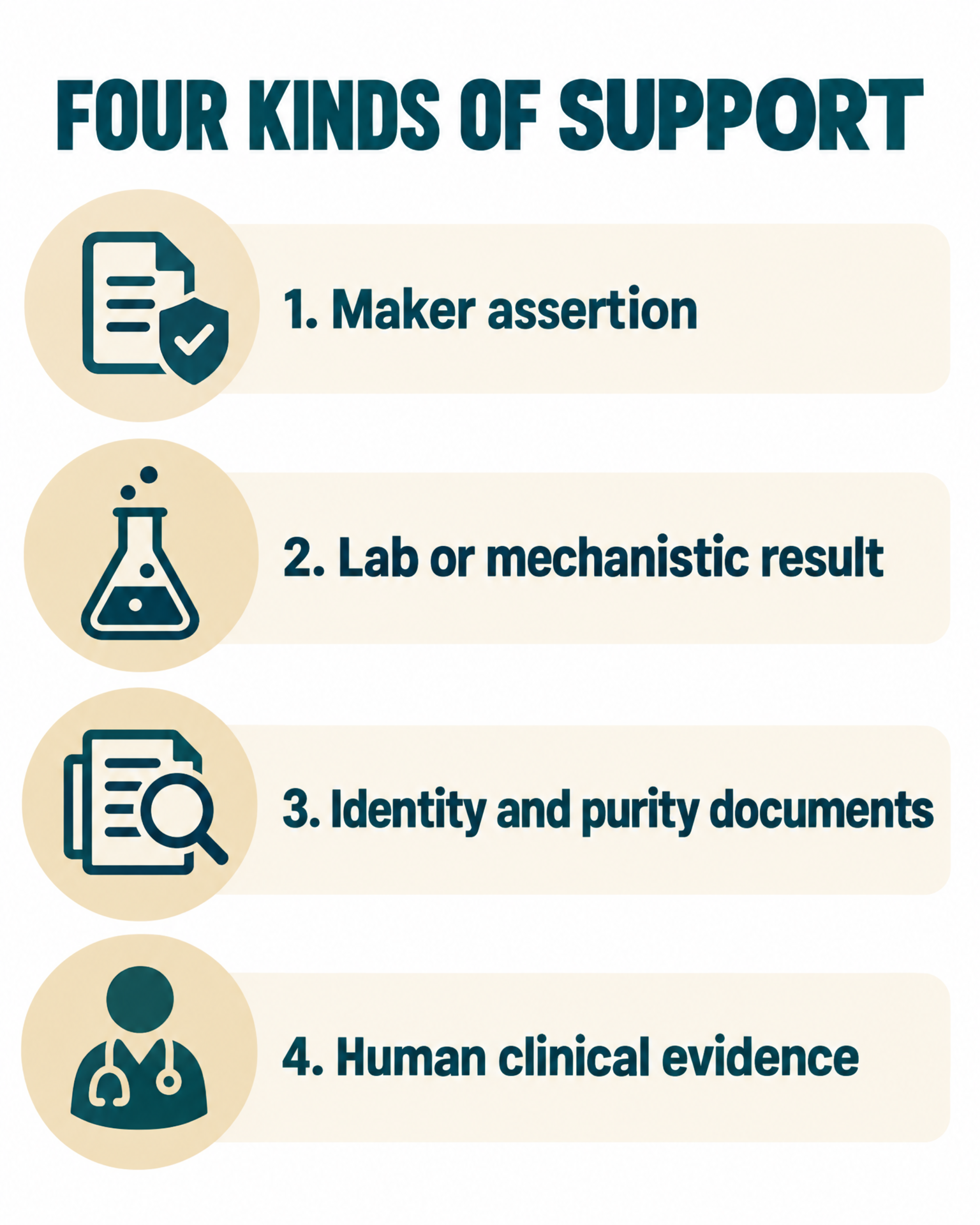
Not all support is the same kind of support. It helps to sort it into four types.
- Maker assertion. The seller states something on a label, page, or video. This is the most common type, and it is only a statement. It can be accurate, but it is not independent evidence.
- Laboratory or mechanistic results. These include in-vitro binding tests, where a material is mixed with a compound in a lab setting, and measurements such as particle-size analysis. They show how a material behaves under controlled conditions. They do not show what happens in a living digestive tract.
- Published identity and purity documentation. A certificate of analysis, ideally from an independent laboratory and tied to a specific batch, speaks to what is in the bottle: the material’s identity and whether certain contaminants were tested for. It does not speak to what the product does in a body.
- Human clinical evidence. This means studies in people, with defined doses, outcomes, and comparison groups. It is the only type that addresses effects in a person directly.
Across this product category, maker assertions are extremely common. Laboratory and mechanistic results exist for some individual materials, though they are often generic to the raw material rather than to the specific branded product. Identity and purity documentation is available from some makers and absent from many. Human clinical evidence tied to a specific finished product, in particular a multi-ingredient blend, is rare. The first thing to check is which of the four types a seller is actually offering, because the types are easy to blur on a product page.
The buying checklist turns these categories into questions you can put to any seller.
Questions You’re Probably Already Asking
Is a blend better than a single ingredient?
Neither format is inherently better. A single-ingredient product is easier to evaluate because the material and dose are usually stated. A blend can be reasonable, but it only becomes evaluable when each ingredient’s amount and supporting documentation are disclosed.
Does “binder” on the label mean it binds toxins in my body?
No. “Binder” describes the story the seller is telling about the product, not a demonstrated result. It is not a regulated term, and it does not establish what any ingredient does once inside a person.
How can I tell how much zeolite is in a blend?
Often you cannot from the label. If amounts are undisclosed, the only routes are asking the seller for a per-ingredient breakdown or a batch certificate of analysis that lists quantities. If neither is available, the amount remains unknown.
Are humic acid and fulvic acid the same thing?
They are related but not identical. Both are humic substances from decomposed organic matter. Fulvic acid is the smaller, more soluble fraction, while humic acid is larger and less soluble, particularly in acidic conditions. Labels that list “humic/fulvic” together do not necessarily tell you the proportion of each.
Should I avoid blended products?
That is a personal decision, and this article does not make it for you. What it offers is a way to judge any blend: can you identify every ingredient, find its amount, and see what documentation exists? A blend that answers those questions can be assessed like any other product, and one that does not leaves gaps you will need to fill by asking.
Tools and Resources
Use this checklist on any binder or detox label, single-ingredient or blend.
| Step | Question to ask | What a clear answer looks like |
|---|---|---|
| 1. Identify every ingredient | What exactly is each item on the list, and is it a generic material or a branded one? | Each ingredient is named specifically (for example, clinoptilolite rather than just “zeolite”), with source and form where relevant |
| 2. Find the amount of each | How much of each ingredient is in one serving? | Individual amounts per serving, not just a total blend weight |
| 3. Ask what documentation exists | Is there a batch-specific certificate of analysis, particle-size data, or other test results? | Independent laboratory documents tied to a specific lot, available on request |
| 4. Classify each claim | Is the claim a maker assertion, a lab or mechanistic result, identity/purity documentation, or human clinical evidence? | The type of support is stated, and the claim does not outrun it |
Recent Posts
Two bottles, one maker, and names that blur together. Pure Body and Pure Body Extra both come from Touchstone Essentials. Both are zeolite in pure water, both are dosed three times a day, and both...
Most people who start reading about detox supplements already have a worry in the background. Heavy metals turn up in the conversation about water, food, and air, along with a long list of everyday...